Get Full Government Meeting Transcripts, Videos, & Alerts Forever!
Get email alerts on the Red Tide Nitrogen topic
No spam. Unsubscribe anytime.
Study presented at coalition links Caloosahatchee nitrogen loads to duration of red tide blooms
Summary
Researchers told the coalition that measured nitrogen loads from the Caloosahatchee watershed correlate with how long severe Karenia brevis (red tide) events persisted in the Gulf, and they urged managers to prioritize August-November reductions in watershed loading.
Researchers told the coalition on Feb. 21 that measured nitrogen loads to the Gulf of Mexico from the Caloosahatchee watershed correlate with the duration of severe Karenia brevis (red tide) blooms along Southwest Florida.
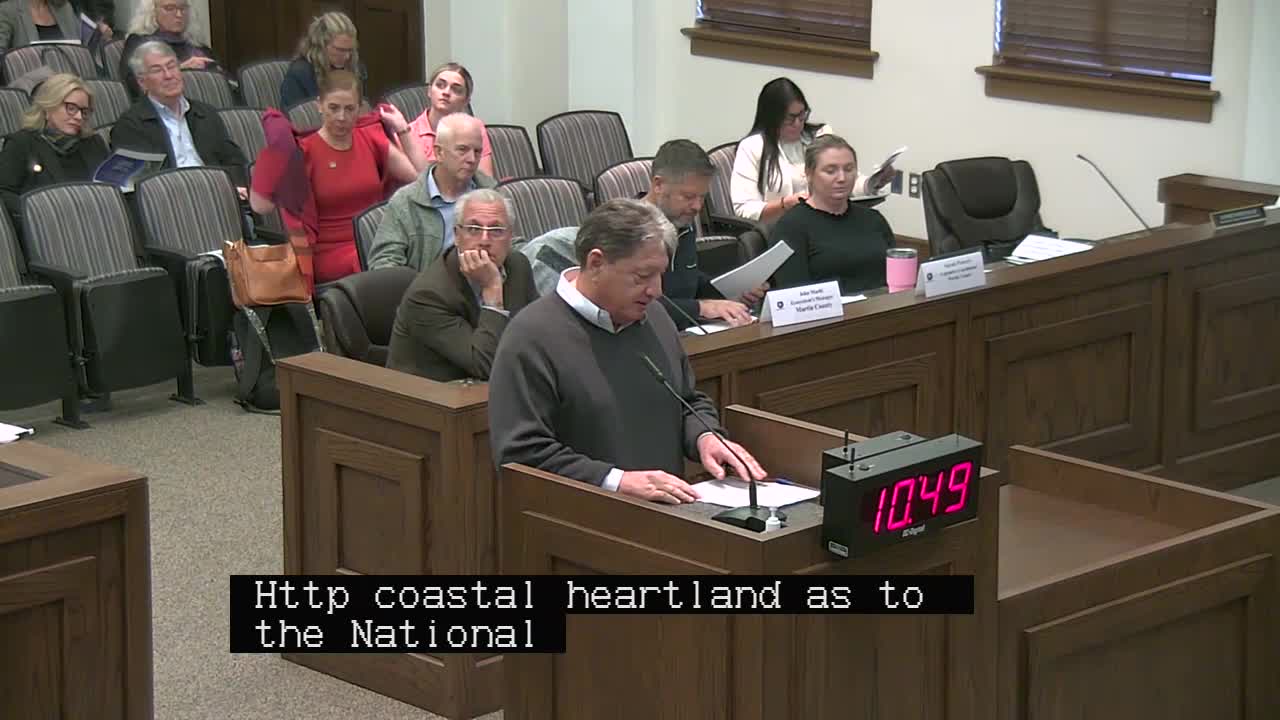
The study, presented by hydrologist Steve Schwab and Jennifer Hecker of the Coastal and Heartland National Estuary Partnership (CHNEP), analyzed daily red tide cell counts and watershed load and flow data from about 2007 onward and found the strongest statistical relationship with loads from the Caloosahatchee River.
Why it matters: Coalition members and staff said longer red tide events have demonstrable economic and ecological impacts across the coast. Presenters argued that while red tide is a naturally occurring organism offshore, anthropogenic nutrient loads can lengthen and intensify shoreline impacts when an offshore bloom is advected onshore.
Study findings and thresholds
The presenters used two empirical thresholds to define severe blooms: 10,000 cells per liter sustained for 30 days, and 100,000 cells per liter sustained for 30 days. For the study period they identified a dozen multi-week events above those thresholds and examined nutrient and flow conditions 30 days before and after each event’s initiation.
Steve Schwab said hydraulic load (runoff volume) drove most short-term variance in total nitrogen loads; when runoff and nitrogen concentrations coincided, the resulting metric best explained differences in bloom duration. Correlations were strongest when Caloosahatchee loads were considered separately — Schwab reported substantially higher correlation coefficients for that river than for other examined watersheds (Peace River, Myakka and smaller tributaries).
Management implications discussed
Jennifer Heckard of CHNEP told the coalition that roughly half of the nitrogen load affecting the Caloosahatchee shoreline can be traced to Lake Okeechobee discharges and half to local watershed sources, and urged a two-pronged approach: expedite storage and treatment north and south of Lake Okeechobee to reduce high-volume discharges, and accelerate local watershed actions (septic-to-sewer conversions, wastewater upgrades, stormwater retrofits and fertilizer controls) to lower basin nutrient loading.
Presenters highlighted a seasonal window of concern: 30 days before through 30 days after bloom initiation, with most historical bloom initiations falling in September–October (the study found about 75% of the multi-week events began between September and January). That timing makes August–November a critical period for load-reduction actions, the researchers said.
Public and commissioner discussion
Commissioners asked whether the study controlled for rainfall versus runoff; Schwab said the runoff (hydrologic load) measure, which combines flow volume and concentration, had stronger explanatory power than raw rainfall. Commissioners and staff also discussed local projects intended to treat nitrogen, and district and county representatives described pilot facilities and possible treatment technologies, including coagulant (alum) injection and wetlands-based approaches.
Ending
Presenters provided CHNEP and university links and urged the coalition to use the results to inform operational and funding priorities: reduce high-volume, nutrient-rich discharges in the late summer and early fall, and accelerate local watershed nutrient controls.