Get Full Government Meeting Transcripts, Videos, & Alerts Forever!
Get email alerts on the Rezoning topic
No spam. Unsubscribe anytime.
Santa Rosa commissioners rezone 5-acre Woodlands parcel to neighborhood commercial after resident objections
Summary
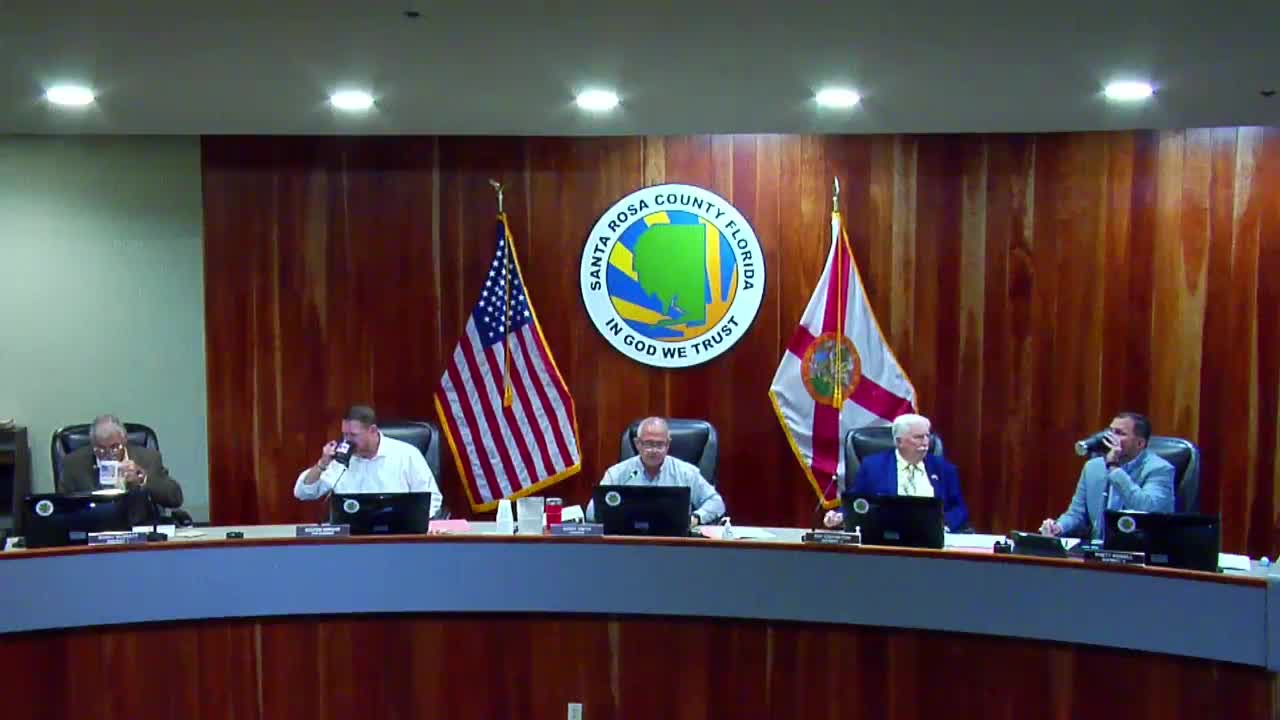
After more than a dozen residents voiced concerns about traffic, property values and the prospect of storage units, the Santa Rosa County Board approved rezoning a 5-acre parcel in The Woodlands to Neighborhood Commercial by a 4-1 vote on Feb. 27, 2025.
Santa Rosa County commissioners voted 4-1 on Feb. 27 to rezone a roughly 5-acre parcel in The Woodlands from its prior residential designation to Neighborhood Commercial, after residents urged the board to preserve the area for housing and raised concerns about traffic, lights and property values.
The motion to approve Neighborhood Commercial passed after public comment from 14 residents and a discussion among commissioners about whether a broader commercial zoning (HCD) would better serve future master planning. The applicant’s representative said there are no firm development plans tied to the rezoning and that the applicant would accept Neighborhood Commercial as a compromise.
The decision matters because the parcel sits between two entrances to The Woodlands subdivision and immediately faces townhouses and single-family lots. Residents told commissioners they bought homes expecting a residential frontage; several said they fear a storage facility or late‑night uses that would change the neighborhood’s character. Reverend Tom Sharon, who said he is president of the homeowners association, told the board, “We want a nice calm residential setting,” and said many neighbors petitioned against commercial uses that feel intrusive.
Several residents raised traffic and safety concerns. Josephine Kavanaugh said the development’s two entrances already make egress difficult and warned that any commercial use that attracts frequent, round‑the‑clock traffic would worsen congestion. Abby Harrison, who lives directly across from the parcel in a townhouse, said she fears nighttime lighting and noise and asked commissioners to consider restrictions on operating hours and lighting.
Clint Fisher, who identified himself as the applicant’s representative, said during rebuttal that the applicant has no specific proposal for storage or other uses at this time: “There are no intentions for this site to be developed in anything certain without a rezoning.” He said the applicant was amenable to Neighborhood Commercial and highlighted that small businesses such as a coffee shop or daycare could serve local residents. Fisher also noted the adjacent apartment complex is leasing quickly, which he argued supports the case for nearby neighborhood services.
Commission discussion centered on two zoning options discussed in the county planning materials: Neighborhood Commercial (a low‑intensity category intended to serve adjacent residential areas) and HCD (a broader mixed residential‑commercial category recommended in the county’s future land‑use guidance). A member of county staff summarized the Neighborhood Commercial standards from the Land Development Code, saying the designation is intended to “provide a limited range of commercial uses in appropriate and easily accessible locations adjacent to residential areas” and that it generally prohibits service stations and drive‑through facilities and limits certain retail and dining sizes.
Some commissioners said HCD could be appropriate for long‑term master planning of arterial corridors, while others said Neighborhood Commercial provided clearer, more enforceable limits on intrusive uses. One commissioner suggested a conditional use process could be used to review specific proposals (for example, a storage facility) should an applicant later request such a use.
After discussion, a commissioner moved to approve Neighborhood Commercial. The motion was seconded and, after voice vote, the board recorded 4 in favor and 1 opposed; the rezoning passed.
Votes at a glance
- 2024-20 CU — Bearing Fruit Community Church (Antonio Jackson): Approved without objection. (Vote tally not specified in record.) - 2024-43 RSS — Lowell T. Barlow: Approved without objection. (Vote tally not specified in record.) - 2024-44 RSS — Mark Allman (2200 block of Highway 87 South): Approved without objection. (Vote tally not specified in record.) - Amending ordinance — Buddy’s LLC: Approved without objection. (Vote tally not specified in record.) - DHC Woodlands LLC rezoning (item 2): Approved (Neighborhood Commercial). Voice vote: 4 in favor, 1 opposed. - Additional ordinances were recommended and recorded as passed without objection at adjournment.
The board recorded no specific conditions (such as hours-of-operation limits) beyond those already in the Land Development Code; staff told commissioners that while site‑plan lighting standards exist, enforcing hours of operation would be difficult. Commissioners and staff noted the property’s future land‑use designation allows a mix of residential and commercial activity, which contributed to the decision to permit a limited commercial node at this location.
The county chair closed the special rezoning meeting after the final items were recommended and recorded as passed.