Get Full Government Meeting Transcripts, Videos, & Alerts Forever!
Get email alerts on the Ems topic
No spam. Unsubscribe anytime.
Minnehaha County EMS reports rising call volume and new certification, posts cardiac-arrest metrics
Summary
Minnehaha County Emergency Medical Services told the county commission the system saw increased call volume in 2024, a transfer of EMT licensing oversight to a state board, a new ambulance-driver certification requirement and quality metrics for cardiac arrest response.
Dr. Jeff Luther, the county’s quality assurance director for primary-service ambulance districts, told the Minnehaha County Commission on March 4 that 2024 saw rising call volume and operational changes that are reshaping local emergency medical services.
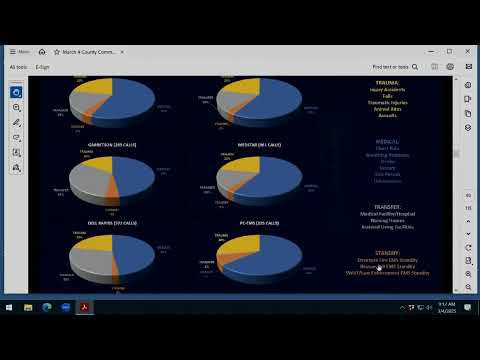
Lede: Dr. Jeff Luther said call volume has increased alongside population growth, with notable rises in transfer calls, “sick person” calls, lift assists and breathing problems; he also described a statutory change moving EMT licensing oversight and a new certification requirement for ambulance drivers.
Nut graf: The update matters because it affects staffing, training and how the county measures clinical quality — including cardiac-arrest care — and because local services must adjust to newly centralized state licensing and new driver certification requirements that could change who may legally drive county ambulances.
Body: Luther told commissioners that the county’s EMS system has evolved from largely volunteer basic-life-support care to broader advanced-life-support coverage in many primary-service areas. He said that oversight of EMTs moved in 2024 to “the Board of Medical Nociopathic Examiners” (as referenced in the presentation) and that, by statute, ambulance drivers now must hold a certification beyond traditional on-the-job EVOC training.
“The 911 call is based on what's called priority dispatch,” Luther said, describing how response resources are assigned. He noted transfers — including interfacility and nursing-home moves — were a major share of calls last year and that the county now uses the ImageTrend electronic patient-care record to collect data.
Luther described the county’s chart-review practice: he examines all pediatric, trauma and cardiac-arrest calls and a random selection (about 25%) of other calls each quarter. He said cardiac-arrest response is a key quality metric. Among the quarter metrics he presented, the mechanical compression device known as LUCAS was used in 63% of cardiac-arrest calls where it was appropriate; epinephrine was administered “100 percent of the time” for cardiac arrest cases reviewed.
The presentation also covered airway choices (greater use of laryngeal mask airways over endotracheal intubation in many cases), monitoring of end-tidal CO2 and how documentation rates for some measures have room to improve. Luther said hospital destinations and receiving-hospital feedback remain part of quality follow-up when a chart is flagged.
Commission discussion and context: Commissioners asked clarifying questions about acronyms and system boundaries. Chair Karski and Commissioner Heisey thanked Luther for the overview and noted the complexity of the system as EMS work grows with the county’s population. Luther recommended staff and commissioners contact him by email for detailed follow-ups on specific metrics.
Ending: The county will continue quarterly monitoring and follow-up work; Luther’s report flagged training, documentation and adaptation to the new certification and state-oversight rules as near-term priorities.