Get Full Government Meeting Transcripts, Videos, & Alerts Forever!
Get email alerts on the Legal Financial Liability topic
No spam. Unsubscribe anytime.
Committee approves payment to satisfy judgment against criminal court clerk Howard Gentry
Summary
The committee approved a resolution authorizing the Department of Law to satisfy a $193,279.92 judgment against criminal court clerk Howard Gentry, following litigation involving the Nashville Bail Fund and contested fee deductions from cash bonds.
The Budget & Finance Committee voted to authorize the Metropolitan Department of Law to satisfy a judgment against criminal court clerk Howard Gentry in the amount of $193,279.92 to be paid from the judgment and losses fund.
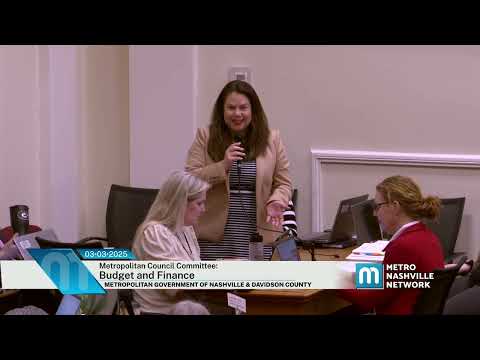
Melissa Roberge, Senior Counsel with Metro Legal, explained the background to the committee. She said state court judges issued an order that required certain fees be deducted from cash bonds; that order initially exempted the Nashville Bail Fund and later withdrew that exemption. When the Nashville Bail Fund sued, Metro Legal entered a limited appearance on behalf of the clerk because he serves in both state and Metro roles. A federal district court later determined that the state court rule as applied was unconstitutional and awarded attorney fees to the Nashville Bail Fund. “They were approximately $340,000 and those fees were awarded against the criminal court clerk because he was the only party that was in front of the district court at the time,” Roberge said in committee.
Roberge said the clerk pursued avenues to have the State of Tennessee pay the judgment, reasoning it flowed from a state court order, but those efforts were unsuccessful. She described the Department of Law’s handling of the matter as “a lot of delicate dancing to try to balance the variety of interests here.” Committee members asked clarifying questions about whether the clerk was executing a state court judge’s order; the committee was told he was carrying out the state judge’s order and thus had limited discretion.
After discussion, the committee approved the resolution by voice vote. The approved resolution directs payment of $193,279.92 from the judgment and losses fund to satisfy the attorney fee judgment awarded in the litigation.