Get Full Government Meeting Transcripts, Videos, & Alerts Forever!
Get email alerts on the Monroe Avenue Streetscape topic
No spam. Unsubscribe anytime.
Buckeye weighs keeping current Monroe pilot or moving to 3-lane center-turn section; staff to collect traffic and business data
Summary
City staff presented options to change Monroe Avenue's downtown cross section, weighing the existing 2-lane pilot against a 3-lane center-turn configuration and a long-term full reconstruction tied to utilities and storm-drain work.
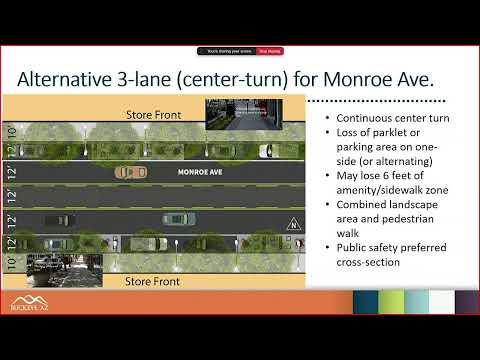
City staff presented alternatives for Monroe Avenue's downtown cross section and streetscape, including keeping the temporary 2-lane pilot, shifting to a 3-lane configuration with a center turn lane, or a full reconstruction that would widen sidewalks, add parklets and relocate utilities.
Staff said the Downtown Specific Area Plan (DSAP) vision favors fewer through lanes, enhanced pedestrian space, parallel parking and parklets to encourage dining and retail activity. The city has implemented temporary restriping and a block-level landscape demonstration; staff proposed collecting additional data and holding further community workshops before making a permanent design choice.
Key numbers and timing: staff gave a ballpark estimate of about $600,000 to fully obliterate existing pavement markings and restripe Monroe as an interim condition; a complete reconstruction of Monroe tied to updated storm-drain and utility work would be a much larger capital project, with staff estimating roughly $27,000,000 and saying full reconstruction is likely five or more years out because it depends on updated plans, cost estimates and flood-control programming.
Safety and operations: staff reported preliminary data showing a decrease in vehicular accidents and average vehicle speeds in the corridor after the pilot restriping, though councilmembers requested that staff collect more systematic measurements of queuing, left-turn delays and public-safety response times before deciding on a permanent cross section. Councilmembers and several residents and business owners described mixed anecdotal experiences: some residents and businesses expressed inconvenience from queuing and changes in traffic flow, while staff and some council members said the pilot had reduced speeds and accidents.
Design trade-offs discussed included whether to provide a permanent continuous center turn lane through the corridor or to provide left-turn pockets at major intersections only; how much curb-to-curb width to allocate to sidewalks, parking and travel lanes; and how to phase work around utilities and business impacts. Staff recommended further outreach with downtown property and business owners and a follow-up workshop to gather stakeholder feedback and present comparative visuals and controlled data.
No formal action was taken. Staff said they would collect additional traffic and business-impact data, refine cost estimates for interim striping and permanent reconstruction, and return with a community-engagement plan and a design recommendation.