Get Full Government Meeting Transcripts, Videos, & Alerts Forever!
Get email alerts on the Water Supply Treatment topic
No spam. Unsubscribe anytime.
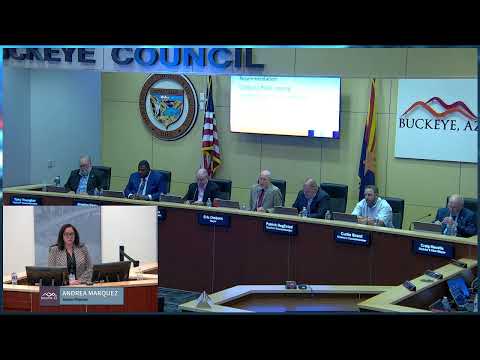
Buckeye council approves agreement with APS to treat brackish groundwater
Summary
The City of Buckeye approved an agreement with Arizona Public Service and partners to send concentrated brine from reverse-osmosis (RO) treatment to nearby power plants, beginning a phased plan to manage high-TDS groundwater as the city grows.
The City of Buckeye City Council on March 4 approved item 4GS, an agreement with Arizona Public Service (APS) and partner utilities to treat and discharge brine produced from reverse-osmosis (RO) systems that will treat the city’s brackish groundwater.
City staff said the multi-party agreement is intended to streamline treatment and disposal of the concentrated brine stream that remains after RO removes salts from groundwater with high total dissolved solids (TDS). The presenter said the effort builds on studies dating to October 2021 and earlier pilot work and that parts of the project are already under way at the Red Hawk generating facility and would use Palo Verde’s downstream infrastructure.
The city’s presenter, identified in the meeting as Mr. Lowe, described the operational approach and near-term steps. The city currently operates roughly 22 wells in the central brackish area, of which about six are considered primary wells; many wells have TDS levels above the city’s raw-water acceptance standard. According to the presenter, Buckeye accepts raw well water with TDS below 1,000 parts per million and aims to deliver “polished” water below 500 parts per million.
Lowe said RO is currently the only viable treatment technology being used in the plan: wells would be paired with small-scale RO facilities where needed, with further polishing at the Fairlawn Water Campus before distribution. The concentrated brine would be routed to generation facilities for beneficial use or disposal through existing lines. Lowe described a separate set of drain wells managed by the Buckeye Irrigation District that release about 22,000 acre-feet a year downstream; that water is also high in TDS and would require treatment to be used for potable supply.
When asked by a councilmember how many homes 22,000 acre-feet could serve once treated, Lowe replied, “One acre-foot gets you about 3 homes,” a roughly 66,000-home equivalence if converted to potable water.
Lowe and staff said the project timeline includes about 24 months for the immediate project components described in the agreement, with broader deployment of system solutions taking roughly five to seven years as the city grows and additional wells come online. The presenter said city staff will continue coordinating with APS, Goodyear and the owners of the downstream line to set connection points and fees for accepting and treating the brine stream.
Council voted to approve item 4GS unanimously. The presenter thanked the council after the vote.
Why it matters: Buckeye is a fast-growing community whose future potable supply depends in part on integrating lower-quality brackish wells. The agreement aims to reduce capital and operating costs for individual RO installations by centralizing or coordinating treatment and disposal with regional partners and power-plant infrastructure.