Get Full Government Meeting Transcripts, Videos, & Alerts Forever!
Get email alerts on the Special Education Inclusion topic
No spam. Unsubscribe anytime.
Midland High’s Unified Sports and ESA partnership highlighted as district says elementary program space is at capacity
Summary
Midland Public Schools officials and Midland County ESA presented the district's inclusive Unified Sports program and described an expanding set of special‑education services housed in local schools, warning that elementary classrooms are at capacity and the ESA will request additional space next year.
Midland Public Schools showcased Unified Sports and described how a long‑standing partnership with Midland County ESA supports students with exceptional learning needs, but district leaders warned Tuesday that elementary school space is maxed out and the ESA will request additional classrooms next year.
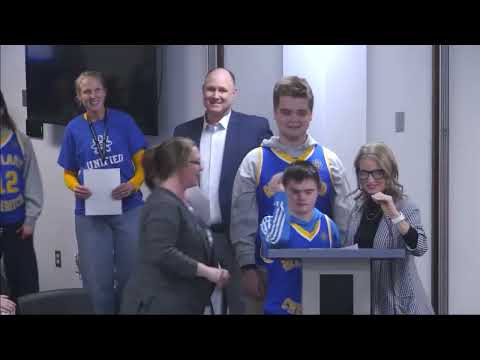
The presentation at the Feb. 18 Board of Education meeting centered on Midland High School's Unified Champions program — a team that pairs students with and without intellectual disabilities — and on the broader collaboration that places ESA specialists inside MPS buildings. "Unified Sports is a nationwide initiative that joins athletes with and without intellectual disability disabilities on the same team," Athletic Director Eric Albright said, explaining the program's purpose and how Midland added Unified basketball in 2019 and bocce in 2021.
The district tied the extracurricular program to classroom supports. "We're gonna be sharing with you how Midland Public Schools partners with Midland County ESA to, promote inclusivity and the least restrictive environment," Special Services Supervisor Lindsay Johnson told the board. Anthony Gates, the district's special services director, described a model where Midland County ESA handles low‑incidence, high‑impact needs while Midland Public Schools staffs and supports higher‑incidence, lower‑impact services inside local buildings.
Why it matters: district officials said the partnership expands inclusive opportunities while concentrating specialized staff where they can serve multiple schools. During the meeting the presenters outlined three "core pillars" that make the model work — programs, time and space — and said creative use of building space has been required to meet demand.
Program and staffing details presented to the board included a newly opened foundational fives classroom in the pre‑primary center this school year and a range of programs for students with emotional impairments, mild cognitive impairments, resource room and collaborative room services. The district also provided staff counts: "we have over 110 staff members, including teachers, itinerants, administrative assistants, office professionals, and administrators," Johnson said, and "39 full time paraprofessionals and we have 97 part time paraprofessionals." The presenters said ESA staff bring highly specialized skills needed for the county's low‑incidence population.
Several students and family members spoke about the Unified team's impact. Student Nicole Giardina said the program eased her anxiety and changed how she sees teammates: "Seeing them throw their arms up and scream as they run down the court after making a shot ... even when we lose a game, it's still very exciting and it's still a thrilling rewarding experience." Jessica Polis, mother of a team member, told the board, "This program has been more than just a basketball team. It has been a place of inclusion, growth, and joy for all involved."
Board members pressed staff on capacity. When asked how many classrooms are in the district's table of ESA placements, a board member later summarized that the district is "running at maximum capacity right now based on the need that's present." Superintendent Penny Miller Nelson said elementary buildings are the primary pinch point: "Our elementaries are maxed out," she told the board, adding that district leaders could look for secondary building space if needed but that the real need is in elementary schools.
District leaders said they are already planning for next year. "I've already started having conversations with Greg Bridal, who is our director of the ESA, and we are already having conversations about how we're needing up to 2 additional classrooms in the district at that elementary level," Anthony Gates said. Board members were told the ESA will formally request additional space and that district staff will explore creative solutions — for example, delivering some specialist services differently or repurposing maker spaces and other nontraditional rooms into classrooms.
The presentation highlighted inclusion as a benefit to the whole school culture, not only to students receiving specialized services. "It really elevates the entire school community and culture when we really embrace these students and frankly, the ESA staff as well as part of our school community," a board member said.
Board and district next steps: administration said it will continue conversations about facility use and will bring space requests to the board as finalized. The district also committed to ongoing community communication about the programs and to scheduling additional forums as needed.
The presentation and public remarks were part of the regular Feb. 18 board meeting at the Administration Building.