St. Johns board upholds committees' recommendations but restricts six contested books to older students with parental permission
Loading...
Summary
After a public hearing on objections filed by resident Jean Moore, the St. Johns County School Board kept six contested titles in high school libraries but voted to restrict access by grade and require parental permission for each title.
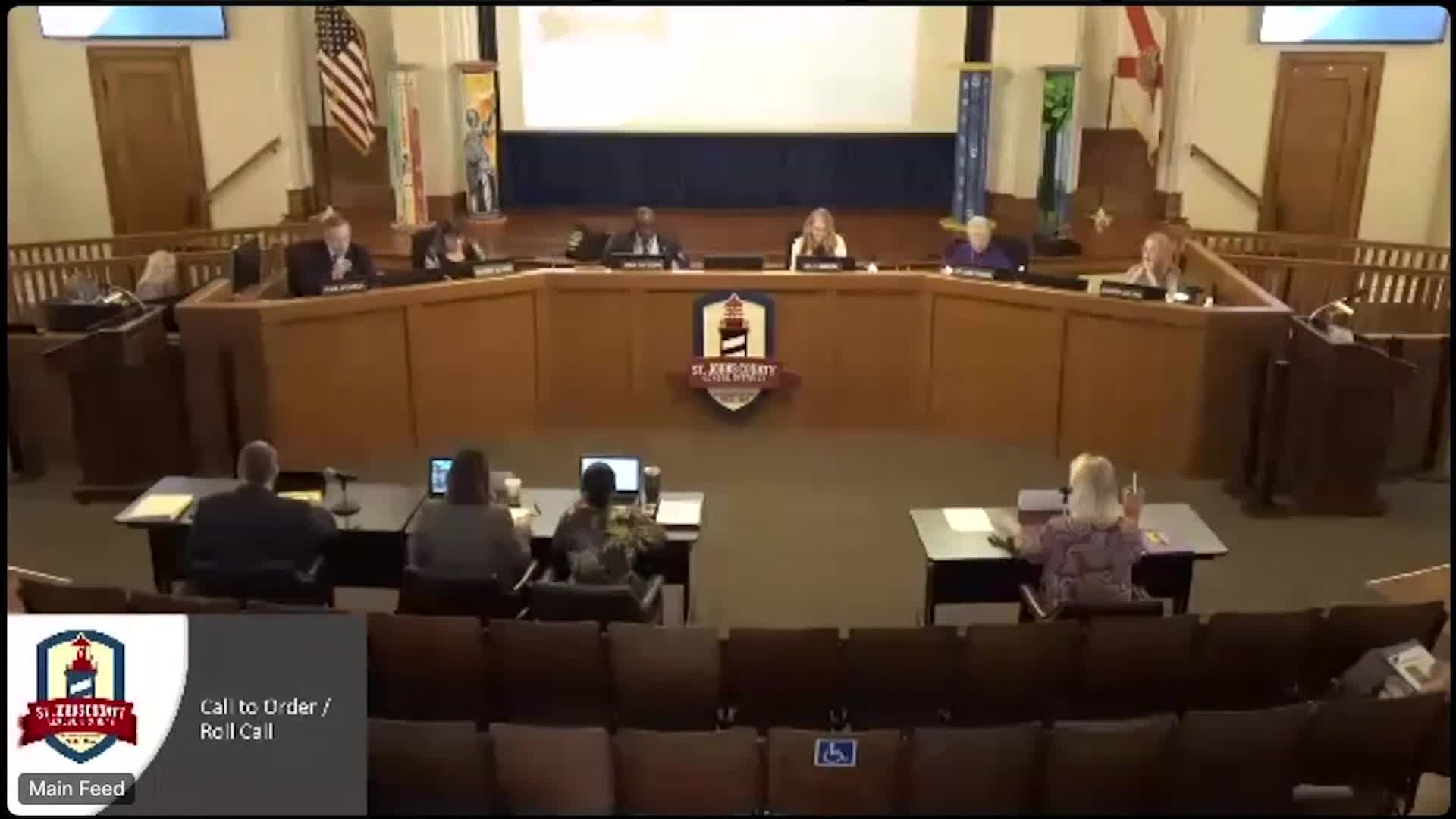
The St. Johns County School Board on Tuesday heard objections to six library titles and voted to keep all six in school collections while placing grade-level limits and requiring parental permission for student checkout.
The board conducted a hearing on written objections filed by Jean Moore, who objected to Tower of Dawn, Strange Truth, Storm and Fury, Half of a Yellow Sun, 19 Minutes and Normal People. The district's review committees had recommended retaining the titles for grades 9–12; Superintendent Tim Forsen accepted those recommendations before the appeal to the board. Board members then discussed each book and voted on restrictions.
Why it matters: The hearing tested the district's process for handling book objections under Florida law and highlighted disputes over age-appropriateness, explicit language and whether library materials should be limited at the school-district level. The board's decisions will affect what high-school students in St. Johns County can check out without additional parental consent.
At the hearing, Jean Moore, who filed the written objections and represented herself, read selected passages and argued repeatedly that explicit sexual content, profanity and graphic descriptions in the contested books were unnecessary and harmful to minors. "Kids don't need to pick around the cockroach to find the good parts," Moore said, using a metaphor she repeated in her remarks.
District staff described the review process. Dawn Sapp, associate superintendent for curriculum and instruction and chair of the District Library Book Objection Committee, said each committee met publicly, was composed of parents, community members, school and district staff, and had access to state statutes, professional reviews and district policy when making recommendations. "Each committee is given resources to assist them," Sapp said, and she said members read the pages cited in objections before voting.
Board attorney J. Upchurch explained the statutory standard the board must apply under Florida law (Florida Statute 1006.28) and noted the specific legal threshold for material that is criminally "harmful to minors" under Florida Statute 847.012. He told the board that obscenity or sexual conduct issues must meet a high three-part legal test to justify removal under the harmful-to-minors statute, while questions about suitability and age appropriateness should be considered under the other statutory criteria.
Superintendent Tim Forsen told the board he supported the committees' recommendations and stressed the importance of context when evaluating a complete work rather than isolated passages. "You have to know the whole story," Forsen said, describing why committee members read books in their entirety before making recommendations.
Parents, students and community members filled the auditorium and joined online. Supporters of the committees' recommendations said trained media specialists and volunteer committees are best placed to evaluate materials and that removing books would limit students' access to important viewpoints. "The library staff provides a tremendous benefit to the students," said Rebecca Patel, a parent and volunteer in a school media center. Several speakers, including students and authors' letters read aloud, said the contested books had educational or emotional value.
Opponents, chiefly represented by Moore, argued the passages she read were explicit and not appropriate for minors and urged the board to remove the titles from school shelves entirely or limit access more strictly.
Votes and outcomes: The board took separate votes on each title and recorded the following outcomes: Tower of Dawn — restricted to grades 9–12 with parental permission (motion by: Mrs. Barrera; second: Mr. Coleman; result: unanimous in favor). Strange Truth — restricted to grades 11–12 with parental permission (motion: not specified; second: not specified; result: passed 3–2). Storm and Fury — restricted to grades 11–12 with parental permission (motion: not specified; result: passed 4–1). Half of a Yellow Sun — restricted to grades 11–12 with parental permission (motion: not specified; result: passed 4–1). 19 Minutes — retained for grades 9–12 with parental permission (motion to retain, followed by motion to restrict 9–12 with parental permission; result: unanimous). Normal People — retained and restricted to grades 11–12 with parental permission (motion: not specified; result: passed 4–1).
Staff described mechanisms families can use to limit a particular student's access. Kim Dixon, the district director of media services, noted the Destiny library-management system can store parental restrictions on a student's account so media specialists are alerted when a student with restrictions attempts to check out a title. "If there is a restriction that a parent would like to impose on their child's library access, that is placed in Destiny," Dixon said.
Board members discussed practical limits of enforcing fine-grained grade restrictions inside a high school media center and urged that any restrictions be feasible for media specialists to implement. Several board members said committees and the superintendent could incorporate parental-permission recommendations earlier in the review process so appeals to the board are less frequent.
The public hearing concluded after about two hours and a half of testimony, committee and staff explanations, and extended public comment from dozens of speakers. Board Chair Coleman thanked participants and recessed the meeting. "This completes our public hearing on these 6 books," he said.