Get Full Government Meeting Transcripts, Videos, & Alerts Forever!
Get email alerts on the School Schedule Change topic
No spam. Unsubscribe anytime.
Duval staff recommends straight 7 for middle schools, 3-by-3 hybrid for high schools to reduce sections and ease budget gap
Summary
Chief of Schools Mr. Schneider presented a staff recommendation to move middle schools to a straight seven-period day and high schools to a 3-by-3-with-a-"skinny" hybrid; staff said the change could reduce sections, boost FTE and save an estimated $8 million to $10 million, but board members requested additional data and no vote was taken.
Chief of Schools Mr. Schneider recommended that Duval County Public Schools move all middle schools to a straight seven-period day and adopt a 3-by-3 block with a daily “skinny” period for high schools, saying the change would reduce the number of sections needed, increase full-time-equivalent (FTE) funding and help address a projected budget shortfall.
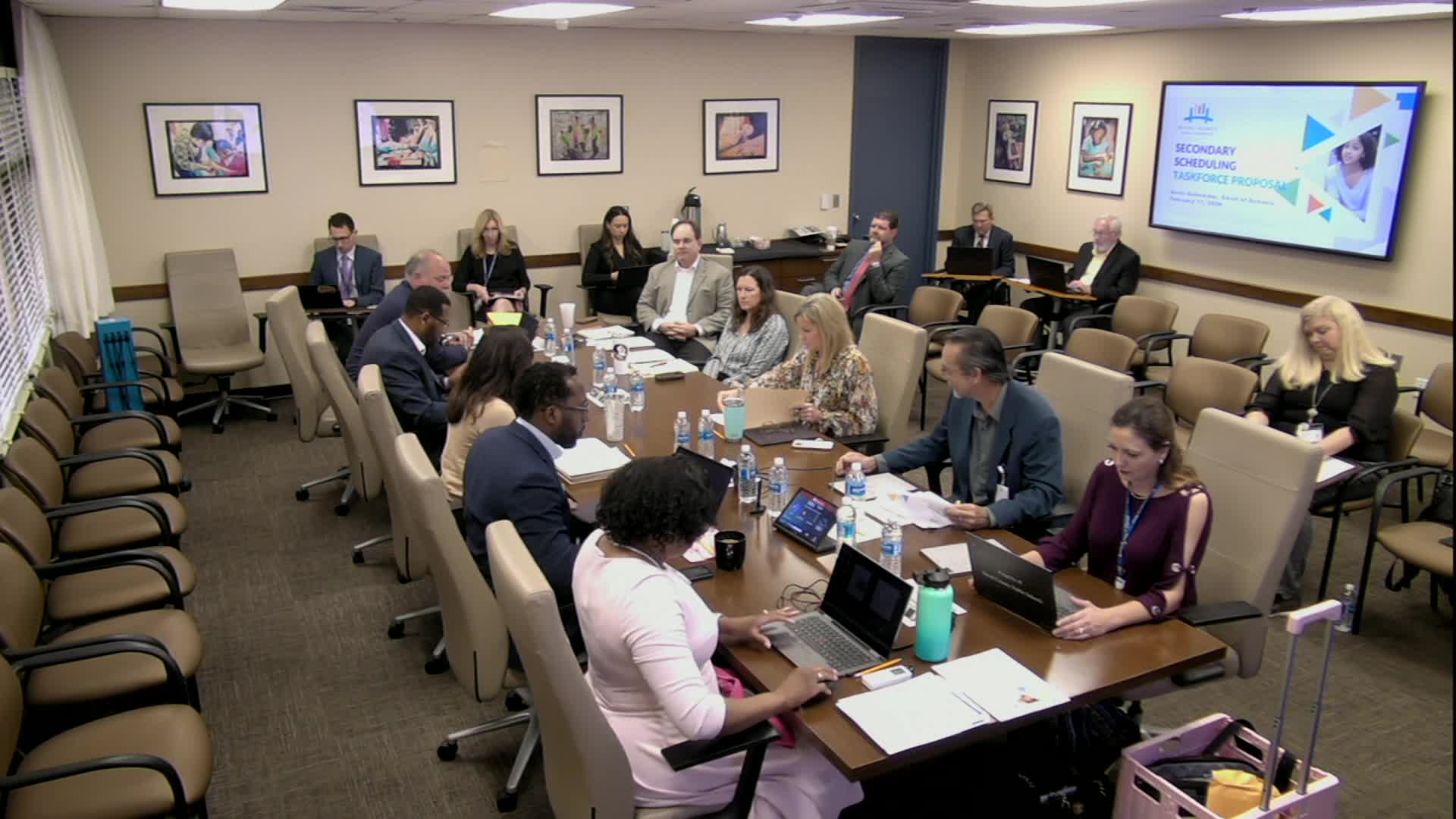
"The task force wasn't put together based upon people that we wanted to change. They were put together based upon if we were making a change, who would be best to give input on where we're going," Mr. Schneider told the school board while presenting the task force's work and final recommendation.
The recommendation followed a months-long task force review that included principals from IB, CTE, ACE and other Duval schools. The staff identified three main schedule options: a straight seven-period day (daily classes of about 45–50 minutes for middle school), a 3-by-3 block with a 100-minute block every other day plus a daily "skinny" period, and a hybrid 3-by-3 that modifies the block on one midweek day. Mr. Schneider said the task force’s preferred option was the 3-by-3 with the skinny for high schools and the straight seven for middle schools.
Why it matters: staff said fewer sections per teacher (moving from eight to seven sections at the high-school level) would lower the district's need to staff elective sections, potentially absorbing current vacancies and increasing funded FTE. Mr. Schneider said many seniors currently take partial schedules; he estimated "approximately 400 students" at some large high schools have partial days, which he said amounts to about 200 FTE and cited roughly $8,000 per FTE as context. Staff projected net savings between $8 million and $10 million, but members asked for a detailed breakdown.
Effects on specialized programs: board members pressed staff on how the schedules would affect IB and ACE programs, AP coursework and career academies. Mr. Schneider said IB and ACE students were considered in the modeling but noted constraints: under a straight seven-period model IB students would have "no room" for an additional elective in 11th and 12th grades, while ACE allows an elective in those years. He also said some high schools could continue offering block courses through the 3-by-3 option so AP and career-related certification work could remain possible.
On college admissions and course-taking, Mr. Schneider said university admissions officers evaluate students relative to the maximum AP options available at a student's school: "as long as you're taking the most that are offered to you," he said, students are considered on comparable footing. He and board members agreed that staff do not currently have comparative data showing private-school versus public-school college admission outcomes for local students and that such data would be difficult to compile.
Operational details and tradeoffs: Mr. Schneider summarized schedule mechanics—middle-school straight seven (about 50 minutes per period, roughly 75 minutes average daily planning time when accounting for pre/post-day planning), 3-by-3 blocks for high school (100-minute blocks every other day, a 50-minute skinny, and similar planning averages). He said credit totals would decrease under some models (from a possible 32 credits to about 28), which staff expect would reduce the share of seniors on partial schedules.
Union, staffing and implementation: staff said any high-school schedule change would require negotiation with the Duval Teachers Union (DTU) and possibly a memorandum of understanding for buyouts or voluntary 0/8th-hour schedules. Two implementation approaches were described: paying teacher buyouts for voluntary additional hours or using flexible start times so teachers still teach six of seven periods without extra pay. Mr. Schneider said teacher and DTU representatives will join implementation planning if the board moves forward.
Board response and next steps: board members asked for specific follow-up data before taking any decision. Dr. Vermeer, the superintendent, told the board he would provide the requested "bring-backs," including counts of students on partial schedules, the FTE and dollar correlations, IB enrollment-to-diploma conversion rates, and a detailed breakdown of the $8–$10 million projection. "Next steps for me are to provide the bring backs that some of you asked," Dr. Vermeer said. He also said he was considering a possible carve-out for four high schools with unique programmatic needs but that the decision must be balanced against districtwide fiscal considerations.
No formal vote was taken at the meeting. Board members repeatedly emphasized the need for more granular financial and enrollment data, clear estimates of impacts on electives and specialized programs, and negotiated agreements with DTU before any implementation decisions.
The board scheduled additional briefings and requested the staff return with the detailed analyses and the MOU implications needed to translate the recommendation into a budget and implementation plan.