Get Full Government Meeting Transcripts, Videos, & Alerts Forever!
Get email alerts on the Landmark Trees topic
No spam. Unsubscribe anytime.
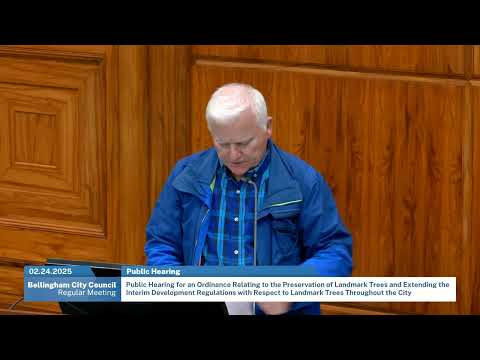
Bellingham council extends interim landmark tree rules six months, adds intent language; citizens press for transparency
Summary
The Bellingham City Council on Feb. 24 voted unanimously to extend an interim Landmark Tree Ordinance for six months and to add language clarifying the ordinance’s intent, after a public hearing that produced requests for greater transparency, stronger arborist oversight and an expanded public record of landmark‑tree decisions.
The Bellingham City Council on Feb. 24 voted unanimously to extend an interim Landmark Tree Ordinance (LTO) for six months and adopt a council amendment clarifying the ordinance’s purpose, preserving time for a full Type 6 legislative process to consider a permanent rule.
The extension, which continues an emergency ordinance first adopted May 20, 2024 and previously extended Nov. 4, 2024, passed after a public hearing that drew more than a dozen speakers and more than an hour of council discussion. Councilmember Dan Hamill moved adoption; Councilmember Skip Williams seconded. Councilmember Lisa Anderson proposed an amendment to add an intent provision; that motion passed 7-0. The final ordinance extension also passed 7-0.
Why it matters: supporters of landmark protections say the measures will protect large, long‑lived trees that provide canopy, air‑quality and climate benefits, while proponents of faster housing production asked the city to balance tree protection with development needs. Council and staff said the six‑month extension will allow time for multi‑department work, public input and for the city to monitor pending state actions — including a wildland‑urban interface (WUI) code proposal — before a permanent ordinance is published.
Public comments: Speakers across neighborhoods supported stronger rules and more administrative transparency. Robin Thomas of the Seahome neighborhood warned the ordinance must avoid “ambiguity” that could let legacy trees be removed without public understanding, saying in part, “Considering the hypothetical preservation of trees and open space in any location outside of the city limits when looking at a decision about a single significant tree seems to add a lot of ambiguity that is not measurable or enforceable by statute.”
Representatives of tree‑advocacy groups pressed for specific administrative changes. Michael Fear, founder of Walk a Million Trees Project, told council the ordinance’s housing impact would be small and urged more public reporting: “The potential housing impact of the landmark tree ordinance is very small,” he said, and asked that the city maintain an up‑to‑date public score sheet showing nominations and determinations.
Several speakers described problems with the current survey process and recommended more oversight of private arborists. Jim Smith, a landscape contractor, proposed spot checks and penalties for repeated underreporting of diameter‑at‑breast‑height (DBH) measurements: “Arborists who have repeatedly underreported DBH measurements should have their business license revoked for up to 3 years,” Smith said.
Developers urged clarity and quicker transition to a permanent code. Perry Eskridge, representing the Building Industry Association of Whatcom County, urged staff to begin the Type 6 process immediately so applicants and brokers would have clear rules when transacting property.
Staff clarifications and next steps: Blake Lyon, director of Planning and Community Development, said staff added language in response to council questions, confirmed a proposed $106 clearing and grading fee, and noted Section 8 includes a process by which the Bellingham Landmark Tree Committee may remove a tree from the inventory if it is no longer appropriate for designation. Lyon also told council the extension gives staff time to watch state‑level proposals, including WUI code discussions, that could affect local standards.
Council discussion and amendment: Councilmember Lisa Anderson led a push for more explicit intent language to make clear the ordinance aims to “lead to better development designs that balance the need to protect mature urban trees with other community goals as increased urban development occurs.” Anderson moved an amendment to add that language as a new provision while leaving existing purpose text in place; Councilmember Jay Littlequist seconded the amendment. The amendment passed 7-0.
Councilmember Dan Hamill then moved to approve the interim ordinance extension as amended; Councilmember Skip Williams seconded. The main motion passed 7-0.
Administrative commitments: During discussion, staff agreed to explore a public‑facing dashboard or “score sheet” to show nominations, decisions and removals over time. Director Lyon said the multi‑departmental nature of the program (Planning, Parks, Public Works, Legal) means staff would return with implementation details during the Type 6 process.
What remains unresolved: Commenters asked the city to: require a one‑page summary of site‑planning alternatives when removal is proposed; include low‑risk black cottonwoods as eligible landmark trees; require budget substantiation if developers claim a project would become infeasible; strengthen review and penalties for underreporting DBH; and ensure hearing examiner review of determinations. Council members and staff repeatedly said those topics are appropriate to consider in the Type 6 process that will follow the six‑month extension.
Ending: The council’s action allows the interim protections to remain in place while staff prepares a permanent ordinance and coordinates city departments. Staff told council it expects to begin the permanent process and return with more details and public materials during the coming months.