Get Full Government Meeting Transcripts, Videos, & Alerts Forever!
Get email alerts on the Land Use topic
No spam. Unsubscribe anytime.
First reading of zoning text amendments prompts extended public comment and developer pushback
Summary
The court heard a first reading of proposed text changes to Article 8 of the Owensboro Metropolitan Zoning Ordinance concerning solar energy systems; residents, developers and NextEra representatives urged further engagement while some commissioners flagged specific edits including decommissioning, setbacks and acreage limits.
At the meeting’s first reading of KOC 921.685 (an Owensboro Metropolitan zoning text amendment) on Feb. 20, the Daviess County Fiscal Court and members of the public discussed draft changes to rules governing utility-scale solar energy systems.
Judge Executive Caslin opened the item and explained that the Owensboro Metropolitan Planning Commission (OMPC) had held a public hearing and recommended text amendments on Jan. 9. The court reviewed the ordinance language at first reading; no final vote was taken — state law requires ordinance second reading before adoption.
Commissioners’ concerns and suggested edits included strengthening decommissioning bond language (with a five-year re-evaluation requirement), consistent setbacks (several commissioners proposed uniform 500-foot setbacks from sensitive public uses), clearer definitions for "prime farmland," and a proposed acreage cap (a draft limit of 1,200 acres for certain level-3 systems drew developer concern). Commissioner Conder warned that a long moratorium or overly restrictive limits could deter economic development.
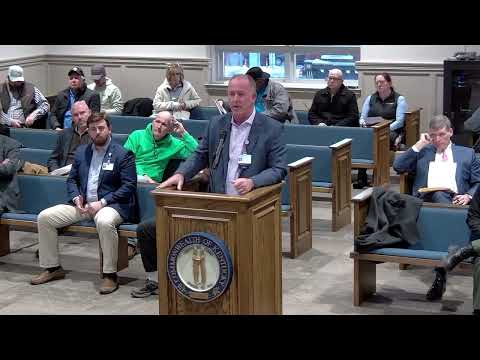
Public commenters and developers: Kimberly Demarest, a property owner, told the court she supports solar in appropriate locations (rooftops, industrial zones, reclaimed mined land) but objected to industrial-scale projects on prime farmland and urged analysis of runoff and property-value impacts. "A moratorium isn't about stopping solar. It's about doing it right," she said.
Lester Morales, senior project developer for NextEra Energy, urged cooperative engagement and noted the company follows state construction-certificate and permitting processes; he said pilot payment agreements and road-use agreements are common elements of project economics and local mitigation. "The planning commission enforces what the fiscal court makes effective," Morales said, noting developers must also meet state siting board and environmental rules.
Mike Sullivan, representing Hillstone Development, said his company has invested significant pre-development funds in a smaller county project and raised concern that an arbitrary acreage cap could halt legitimate projects. He supported requirements for setbacks, screening and decommissioning bonds but asked that the county balance farmland protections with private-property development rights.
Judge Caslin and staff said the first reading and the recently adopted moratorium are intended to create time to refine ordinance language and allow more stakeholder meetings. The court signaled it intends to seek more detailed proposals on bonding calculations, setbacks, screening, pilot/tariff options and precise definitions for prime farmland before the second reading.