Get Full Government Meeting Transcripts, Videos, & Alerts Forever!
Get email alerts on the Renewable Energy topic
No spam. Unsubscribe anytime.
Daviess County fiscal court adopts 12-month moratorium on utility-scale wind and solar applications
Summary
The Daviess County Fiscal Court approved Resolution 03-2025, a 12-month moratorium that pauses processing of conditional use permits, zone changes and related filings for commercial wind and solar while the county updates ordinance language.
The Daviess County Fiscal Court voted 3–1 on Feb. 20 to adopt Resolution 03-2025, placing a 12-month temporary moratorium on applications and approvals tied to commercial utility-scale wind and solar energy systems.
The resolution — read into the record by the court and filed as Resolution 03-2025 — directs the county’s Board of Adjustments and the Planning and Zoning Commission not to accept, process or approve applications for conditional use permits, zone changes, preliminary plats or final development plans associated with commercial wind or solar energy during the moratorium period. The resolution also states the moratorium takes effect immediately and may be extended by the fiscal court.
Why it matters: Court leadership said the measure is intended to give county officials time to update zoning and decommissioning requirements. Daviess County staff had identified what the judge described as inadequate decommissioning bond language and the lack of a required re-evaluation cycle; the judge told the court staff found the bonds could be “drastically inadequate.”
Court debate and vote: Commissioner Cash said he supports solar in appropriate locations but favors updating local rules to protect neighbors and infrastructure. Commissioner Marksberry said he had concerns about potential flooding effects and wanted time to examine the consequences. Commissioner Conder opposed the moratorium, saying it kicks the can down the road and could deter economic development; he said he had attended regional hearings and done independent research. At roll call the votes were recorded: Judge Executive Caslin — yes; Commissioner Caslin — yes; Commissioner Marksberry — yes; Commissioner Conder — no. The motion carried 3–1.
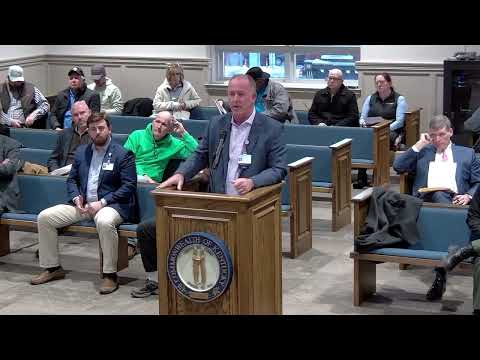
Public comment: Several residents and industry representatives addressed the court before and during the vote. Kimberly Demarest, who identified herself as a nearby property owner, urged a yes vote and said the ordinance lacked protections for neighboring landowners, drainage/runoff, property values and fiscal transparency about tax flows. She said she supports rooftop and brownfield solar but not industrial-scale projects on prime farmland. "A moratorium isn't about stopping solar. It's about doing it right," Demarest said.
Next steps: The judge and planning staff said the moratorium provides time for a more detailed text amendment process at the Owensboro Metropolitan Planning Commission (OMPC) and for joint work between developers, county staff and residents. Several developers said they would continue to engage in the process; representatives asked for clarity on definitions such as "prime farmland" and on how the county would measure acreage caps.
The court recessed the moratorium item for subsequent ordinance work; the moratorium takes effect immediately upon passage.