Get Full Government Meeting Transcripts, Videos, & Alerts Forever!
Get email alerts on the Budget Reports topic
No spam. Unsubscribe anytime.
Finance committee reads and files November and December financial reports; staff projects modest shortfall
Summary
The Finance Committee voted to read and file the city’s November and December 2024 budgetary and financial reports (LM2025-00005 and LM2025-00042). Presenters showed revenue and expenditure projections and flagged school budget variance, overtime trends and vacancy savings.
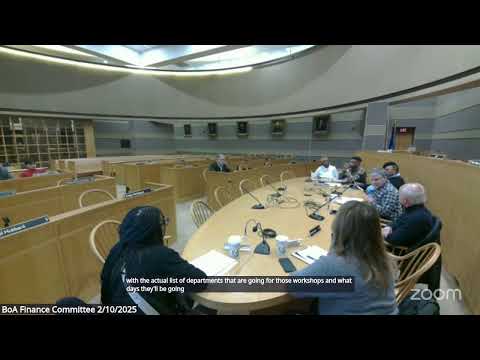
The New Haven Finance Committee on Feb. 10 voted to read and file the city’s budgetary and financial reports for November and December 2024 (LM2025-00005 and LM2025-00042), as required by Article 8, Section 5 of the City Charter.
Why it matters: City staff presented mid-year projections and identified several variances that could affect the fiscal year outcome, including a projected shortfall, a Department of Education budget overage and trends in salary and overtime spending.
What staff presented: Shannon McHugh summarized the December figures and said the city’s revenue and expenditure projections showed a deficit at this point in the year. The presentation identified the Department of Education as the single largest variance, with the schools reporting a projected overrun of $4.9 million in their own report; staff noted $3 million in the school fund balance had been earmarked earlier to help cover part of that variance. McHugh also reported vacancy savings listed in the monthly report at $10.4 million but said staff’s working estimate of realistic year‑end vacancy savings is closer to $4.0 million after accounting for contracted-out services and recently approved contracts.
Staff flagged overtime trends in the police department (an average of about $300,000 per week in overtime historically) and said the police contract and retroactive pay will have budget implications. The report also noted a $1.7 million labor reserve and potential additional revenues from investment income and building-permit activity; investment income was described as tracking above budget and could produce roughly $300,000 in upside compared with the adopted budget.
Committee discussion and follow-up: Alders questioned where discretionary savings could be achieved and urged staff to supply more detailed line-item options. Staff said they are reviewing accounts payable and energy bills, pursuing billing corrections and refunds, and examining utility-contracting options (including some forward purchasing and alternative suppliers for commodity portions of electric accounts). Committee members asked for more detail on school reimbursements and for historical context on overtime and vacancy trends.
Formal action: A motion to read and file items 2 and 3 (LM2025-00005 and LM2025-00042) was moved by Mister Short, seconded, and carried by voice vote. The reports will be transmitted to the Board of Alders as read-and-file items.
What's next: Finance staff will continue monitoring overtime, vacancy savings and school budget trends and will provide additional detail to the committee and Alders as part of the FY26 budget process starting next month.