Get Full Government Meeting Transcripts, Videos, & Alerts Forever!
Get email alerts on the Tobacco Licensing topic
No spam. Unsubscribe anytime.
Committee backs ordinance to require New Haven tobacco and vaping retail permits, fines and enforcement
Summary
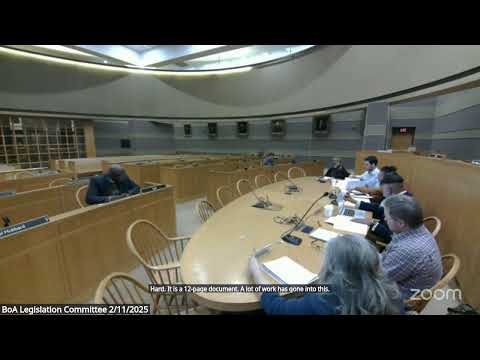
The New Haven Board of Alders’ legislative committee on Feb. 11 voted to forward to the full Board a revised ordinance that would require city permits for retailers that sell tobacco, vaping and other nicotine products, set tiered fines and suspensions for violations, and authorize unannounced compliance checks and a local appeal process.
The New Haven Board of Alders’ legislative committee on Feb. 11 voted to forward to the full Board a revised ordinance that would require city permits for retailers that sell tobacco, vaping and other nicotine products, set tiered fines and suspensions for violations, and authorize unannounced compliance checks and a local appeal process.
Alder Ellen Kubo, chair of the Legislative Committee, said the ordinance would let New Haven “monitor and regulate the activities of these establishments” and address complaints about illegal sales, marketing near youth and neighborhood quality-of-life problems.
The ordinance, filed as OR-2025-003, would amend Chapter 17 of the New Haven Code of Ordinances to require all tobacco and smoking-product retailers to obtain a city permit and to complete annual licensing through the city’s licensing system. Director Von of the New Haven Health Department said the city counted 195 tobacco dealers in May 2024 and identified 212 by October 2024 as more smoke shops opened.
"By establishing a permit system, we will be able to monitor and regulate the activities of these establishments to ensure they comply with all rules and regulations applicable to them," Director Von said during the committee presentation.
Under the proposed enforcement scheme, the ordinance would use a tiered penalty schedule: a first violation would carry a fine of $150; a second violation within 36 months would carry a fine of $500 and may include a seven-calendar-day suspension of the tobacco permit; a third violation within 36 months could carry a fine of $1,000 (or the maximum allowed by state law) and revocation of the permit. The Health Department would also be authorized to enlist underage decoys (ages 18–20) for purchase attempts, conduct unannounced inspections, and publish compliance-check results.
The ordinance would require that new businesses obtain a permit before beginning operations. Existing establishments would have a compliance deadline established in the ordinance text (committee discussion referenced October 1, 2025 as the target date for existing businesses, with members debating a possible later effective date to allow additional implementation time). The ordinance also describes an appeal process: a retailer would have 10 days after receiving a violation to file an appeal to a hearing officer appointed by the mayor; appeal hearings are to be scheduled within a defined timeframe in the ordinance.
Assistant Corporation Counsel Michael Pinto described planned technical reorganizations of the draft language and said the city’s counsel would submit substitute language before the ordinance moves out of committee. Committee members and staff said they borrowed language from other Connecticut municipalities—particularly Bridgeport—and cited Westport’s simpler zoning prohibition on new smoke shops when discussing other local options.
Committee members questioned several implementation details, including: whether the city may set an age higher than the state minimum (members were told municipalities can be more stringent but not less restrictive than state law); how the ordinance would interact with existing state tobacco dealer licenses; whether and how zoning changes would affect a revoked license at a fixed location; and practical steps for educating hundreds of retailers. Director Von said the Health Department will provide multilingual written notices, webinars, in-person outreach and an online guidance page and expected to prioritize the roughly 212 identified smoke shops while also notifying other retailers (convenience stores, delis, gas stations) that sell tobacco products.
Captain Pumeyati of the New Haven Police Department emphasized local authority: "What I like about this ordinance in particular is [it] allows the city to police the city… and allow us to address those issues in a timely manner rather than having to leave it to state agencies," he said.
Committee debate produced two floor amendments to the draft: a substitute redline version offered by the majority leader that reorganized and clarified definitions and language, and a proposed new penalty item to cover "violation of any federal, state, or local law." The sponsor withdrew the broader "any federal, state, or local law" amendment after colleagues and counsel cautioned that language as written was overbroad and could apply to unrelated regulatory failures; committee members directed counsel to draft narrower language if they wished to target specific criminal activity (for example, illegal controlled-substance sales) in subsequent revisions.
The committee adopted the substitute redline language and then voted to give the amended ordinance a favorable recommendation to the full Board of Alders. The committee recorded the approvals by voice vote and did not record a roll-call tally in the transcript. Committee members said additional technical edits and structural rewording would be supplied by city counsel before the ordinance returns for full Board consideration.
The committee also discussed enforcement logistics: notices of violation would be mailed and recorded with the city clerk within 30 days of a violation; failure to remove tobacco products after a suspension could expose a retailer to a per-day fine; and the Health Department intends to coordinate with the Connecticut Department of Consumer Protection, the Connecticut Department of Revenue Services and the New Haven Police Department when making enforcement recommendations to the state. Several members asked about the availability and independence of hearing officers; counsel said the hearing officer role is provided by state administrative procedure statutes and the city has been appointing hearing officers to avoid past implementation delays.
The committee’s action forwards a revised Chapter 17 ordinance to the full Board of Alders for further consideration and possible final adoption. The full Board will receive the substitute language and any additional technical revisions from city counsel before the ordinance’s next reading.
Ending: The committee recommended the ordinance for approval by the full Board; the full Board’s calendar, any final redline language from counsel, and the final effective date (the committee discussed October 1, 2025, and some members proposed allowing additional implementation time into 2026) remain to be resolved at future readings.