Get Full Government Meeting Transcripts, Videos, & Alerts Forever!
Get email alerts on the Materials Management topic
No spam. Unsubscribe anytime.
City staff seek state grant to build food-scrap sorting facility at New Haven transfer station
Summary
City sustainability staff told the City Services and Environmental Policy Committee the administration has applied for Connecticut DEEP materials-management infrastructure funding to build a food-scrap diversion sorting facility at the New Haven transfer station.
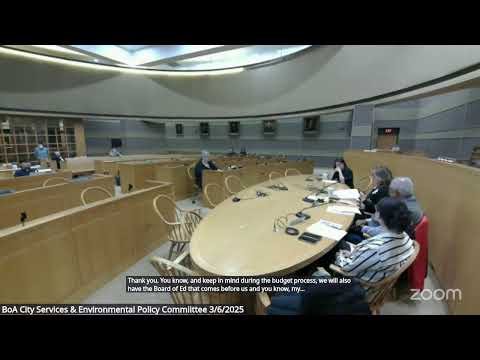
New Haven officials told the City Services and Environmental Policy Committee they have applied for Connecticut Department of Energy and Environmental Protection (DEEP) materials-management infrastructure funding to build a food-scrap diversion sorting facility at the city transfer station.
Hannah Zoh, Sustainability Policy Analyst and engagement coordinator for the city of New Haven, described the proposal as a way to separate co-collected organics from the mixed waste stream at the transfer station using a sorting pit, conveyor and bays where workers would remove food-scrap bags before the remaining waste continues to disposal. "Connecticut is currently in a waste disposal crisis due to the closure of Materials Innovation and Recycling Authority at Hartford with tipping fees reaching at least at last count $119 per ton of disposable trash," Zoh said, explaining the financial pressure behind the application.
Steve Winter, executive director of climate and sustainability, said the city applied before a tight deadline and has not yet heard whether it will receive an award. He characterized the program as a rare, large-scale opportunity: "This is a really unique opportunity. There's $15,000,000 available," Winter said, noting the city would seek roughly $3,340,000 from that statewide pool and that the grant is state bond funding with no required federal cost share.
City staff showed a site schematic placing the sorting facility at the New Haven transfer station and noted an existing old incinerator foundation on the lot could cut construction costs. Winter said the project would also include a second weigh scale to speed commercial traffic flow at the authority site. Next steps, staff said, include working with a mayoral resident advisory group and securing approval from the solid waste authority board, which operates the transfer station under a contractor.
Committee members asked about program costs, collections and public education. Zoh and Winter said organizers expect the program to require operational funding for public outreach and enforcement and that schools are already piloting food-scrap diversion in several cafeterias. Winter estimated the city is paying about $119 per ton to incinerate trash; he told the committee the city disposed roughly 33,780 tons from single-family and small multi-family residences last year, and said incineration costs alone were "over $4,000,000." Staff also discussed potential downstream processing: some organics could be sent to an anaerobic digester (producing biogas and compost) in Southington, and the city has pursued EPA funding for community-scale composting shipping containers.
Staff described likely operational roles if the facility is built — two to four line workers pulling bags, equipment operators, two all-electric loaders and additional enforcement and education staff — and said private haulers and small curbside composter businesses in the region could be partners or complementary services.
After discussion the committee voted to approve the order authorizing the mayor to apply for and accept the DEEP materials-management infrastructure grant and to enter associated agreements if awarded.