Get Full Government Meeting Transcripts, Videos, & Alerts Forever!
Get email alerts on the Immigration Enforcement topic
No spam. Unsubscribe anytime.
Senate committee debates SB250, a bill to limit local use of resources for federal immigration enforcement
Summary
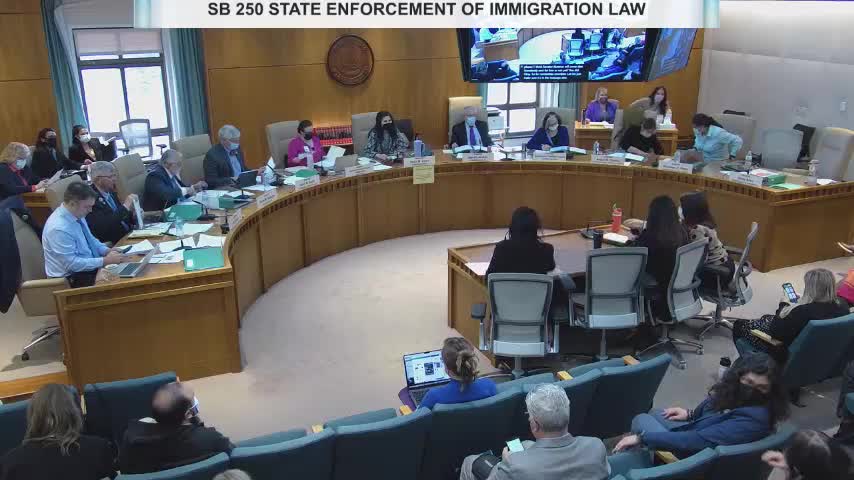
Senate Bill 250, which would limit the use of state and local resources to assist federal immigration enforcement, drew sustained debate in the Senate Health Public Affairs Committee on Jan. 21.
Senate Bill 250, which would prohibit state and political subdivisions from using public funds, personnel, property or equipment to identify, detect, apprehend, arrest, detain or prolong the detention of a person solely because of suspected civil violations of federal immigration law, was the central, contested item in the committee's Jan. 21 hearing.
Senator Nava summarized the sponsor's intent: “Senate bill 2 50 will ensure that all local and state jurisdictions do not use local resources to aid federal agencies in the enforcement of immigration laws. Resources include, but are not limited to public funds, personnel time, and use of property and equipment.” She added the bill “will ensure that only people with criminal warrants are being detained for federal immigration purposes in local jails.”
Committee members pressed a range of questions about likely effects. Senator Gallegos asked whether the bill could “affect federal resources” and cited analyses from county and state agencies suggesting possible fiscal or operational consequences. Committee witnesses and the sponsor pointed to court rulings and legal interpretations discussed in the hearing, noting that federal attempts to compel state or local enforcement can run afoul of the anti‑commandeering principle, and that several courts have found 8 U.S.C. §1373 unconstitutional in particular circumstances. As the sponsor summarized: “Nothing in section 1 prohibits police or any other state resources to deal with criminals who have felony warrants or with persons who were suspected of criminal activity.”
Several members raised operational and fiscal concerns. Senators asked whether state police and local jails would still be able to cooperate with federal authorities on criminal investigations, human‑trafficking task forces and other joint operations; proponents repeatedly said the bill does not prevent criminal investigations or federal agents from operating in New Mexico. Committee members also cited fiscal-impact reports submitted by agencies and counties; proponents said at least one county analysis cited the wrong bill and that the committee should not conflate those figures with SB250.
Public safety and oath-of-office arguments were prominent. Senator Block asked directly whether the state or local governments would be sued or lose federal funding if the legislation became law; proponents said courts have limited the federal government's ability to withhold funds for nonparticipation in federal immigration enforcement, and that past administrations did not cut off funding in similar circumstances.
A formal motion for a due‑pass recommendation was made in committee (mover: Senator Pinto; seconder: Senator Nava and Senator Gallegos were listed as supporting a second). A roll-call occurred and several members explained their votes on the record. The transcript records named votes during roll-call (for example, Senator Block recorded “Nay”; Senator Boone recorded “No”; Senator Sergio Lopez recorded “Yes”), but the final tally and the committee's formal outcome are not explicitly stated in the segment of the transcript provided.
Committee debate documented detailed legal references and procedural clarifications but left some fiscal questions unresolved on the record. Committee members asked staff to verify statutory cross‑references and contract impacts cited in agency fiscal analyses.
The committee hearing transcript captures extended exchanges but does not contain a clear, explicit final tally or disposition for SB250 within the provided excerpt; the motion, substantive questions and roll‑call statements are recorded.