Get Full Government Meeting Transcripts, Videos, & Alerts Forever!
Get email alerts on the Special Education Services topic
No spam. Unsubscribe anytime.
Educational Services for the Deaf and the Blind requests staff to meet enrollment growth and plans campus cottages to house students
Summary
Agency officials told the committee outreach enrollments have more than doubled in 15 years and campus residential demand is increasing; requests include career‑ladder equivalents and new outreach positions to reduce caseloads and cover travel costs.
Boise — The state’s Educational Services for the Deaf and the Blind (IESDB) briefed the Joint Finance‑Appropriations Committee on March 4 about steady enrollment growth in both its campus program and its outreach services, staffing shortages and planned campus expansions to address residential demand.
Jared Tetrault presented fiscal data for the program, saying the campus program serves about 122 residents ages 3 to 21 and the outreach program serves just under 2,600 students from birth to 21. "If you go back to the 2010 school year, the campus had 77 students and they are currently serving 122," Tetrault said, and outreach counts rose from about 1,100 in 2010 to roughly 2,600 today.
Analysts and agency leaders identified recruitment and retention as a primary budget pressure. Tetrault outlined standard requests such as career‑ladder equivalent adjustments (to align campus instructional staff placements with salary movement typical in district career ladders) and additional compensation aimed at recruiting and retaining specialized staff. The agency also requested two outreach positions — an early childhood outreach administrator and a Region 4 consulting teacher — plus one‑time vehicle purchases to support the outreach workload.
IESDB Superintendent Darcy (introduced at the hearing as the agency’s superintendent) told the committee the campus frequently has a waiting list because the program lacks housing capacity; the agency plans to build cottages to add residential capacity. "The cottages should take care of the wait list that we have because right now we could accept those kids into our classrooms. We just don't have bedding and they're from other places across the state," Darcy said. He added that construction of new cottages would increase capacity and should ease that constraint.
Committee members asked about pay and recruitment. Darcy said filling openings is challenged both by pay and by the national shortage of specialists qualified to work with sensory‑impaired students; he offered to provide comparative salary data. Officials reported several current vacancies, including teacher roles, a speech‑language pathologist and multiple interpreting positions.
The IESDB briefing also reiterated the agency’s statutory responsibility to serve students from birth to age 21 and explained the rationale for early intervention: staff provide specialized early education and parent support after newborn hearing screenings and other early identifications. "If we get to the child earlier, and studies have shown forever that if we get as early as we could get intervention in, the better off they are later on," Darcy said.
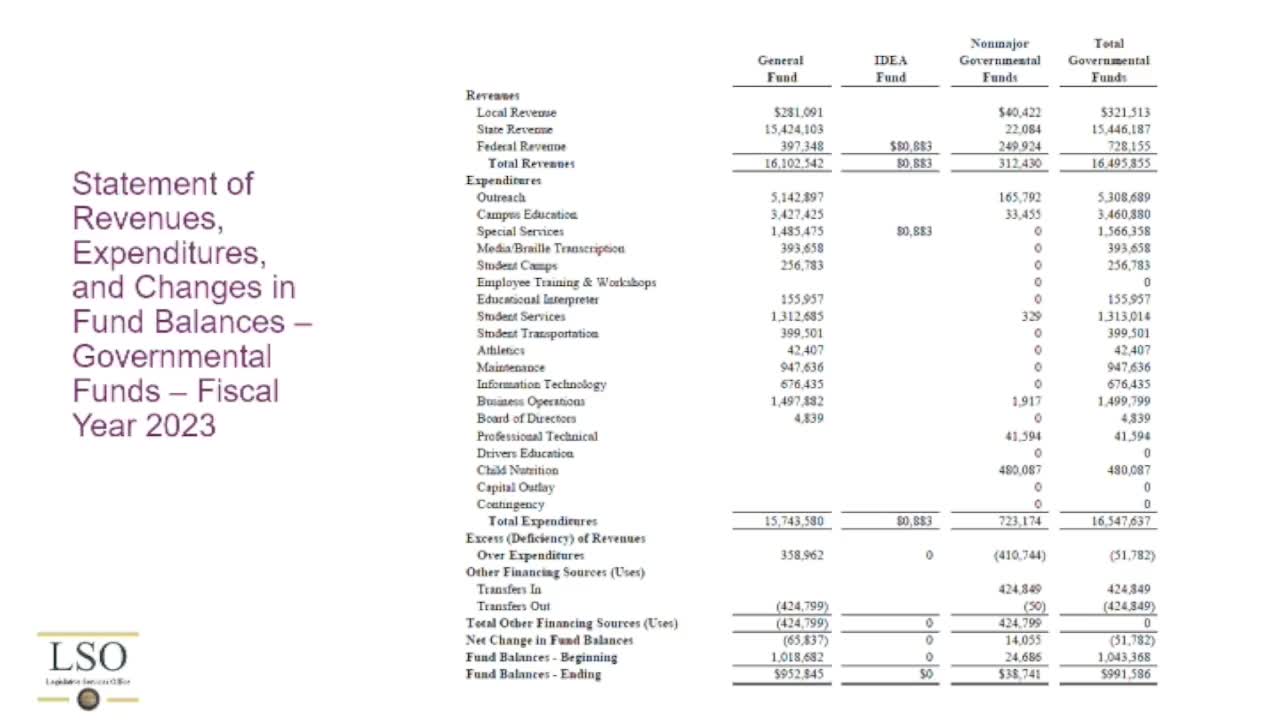
Analysts said the agency’s FY2024 financials show the outreach and campus programs are independently audited and that the programs maintain an operating cash balance consistent with other state agencies. The committee accepted the briefing and asked for follow‑up salary comparators, updates on cottage planning and any metrics the agency can provide about caseloads per staff member.
Sources: Presentation by Jared Tetrault, Legislative Services Office Budget and Policy Analysis Division; testimony by Darcy, Superintendent, Idaho Educational Services for the Deaf and the Blind; Q&A, March 4.