Get Full Government Meeting Transcripts, Videos, & Alerts Forever!
Get email alerts on the School Consolidation topic
No spam. Unsubscribe anytime.
Highlands board hears mixed reaction to Lake Placid 6–12 consolidation proposal
Summary
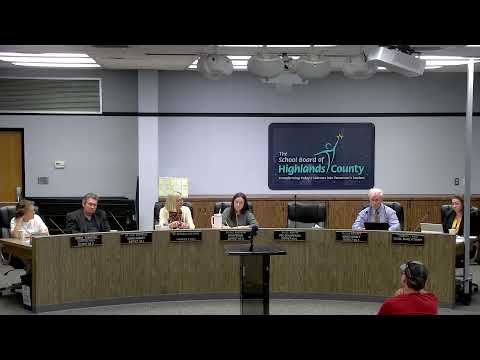
The Highlands County School Board held a public workshop on Feb. 24 to discuss a proposed consolidation that would combine Lake Placid Middle School and Lake Placid High School into a single 6–12 school and to outline next steps, including interim leadership arrangements.
The Highlands County School Board held a public workshop on Feb. 24 to discuss a proposal to combine Lake Placid Middle School and Lake Placid High School into a single 6–12 school and to outline next steps, including interim leadership arrangements.
District staff and outside presenters framed the proposal as a way to reduce transitions for students and expand academic and career options. Kevin Tooning, principal at Lake Placid High School, told the board the plan would “eliminate a transition between eighth grade and ninth grade” and allow staff to “build relationships from a 6–12 perspective.” He said the merged campus would be roughly 1,300 students combined and that administrators would be reallocated (one principal and additional assistant principals) rather than eliminate teaching positions.
The meeting included a 40-minute presentation from Craig Damon of the Florida High School Athletic Association on how combined schools handle athletics. Damon described two FHSAA models: a “type 1” combination that fields only high school teams (allowing sixth–eighth graders to play up) and a “type 2” model that preserves middle school teams while permitting eligible younger students to play at high school levels. He said seasons and contest limits are managed at the association level and that the FHSAA is reviewing contest-count flexibility for some combination schools.
Frostproof Middle–Senior High School Principal Kyle Wyndham (Frostproof) described his 26 years working in 6–12 settings and said the model can raise opportunities for students, including earlier access to industry certifications and dual‑enrollment or AP pathways. “I wouldn't have it any other way,” Wyndham said, citing academic and cultural continuity across grades.
Public commenters and several teachers urged caution. Erin Hatton, a parent of a rising sixth grader, asked whether younger students would be safe on athletic teams where they might face much larger opponents and whether social and emotional needs would be met. Katie Wilson, who identified herself as a Lake Placid graduate and parent, said community members feel the plan was announced too quickly and wrote that the district letterhead and flyers give an impression the change is already decided: “It seems to me like it's just done.” Several commenters and staff asked for more time, data and local town‑hall meetings in Lake Placid.
Teachers and staff raised operational concerns about scheduling and supervision if the schools remain on separate campuses connected by a road. Lake Placid Middle School teachers warned a move to alternating block scheduling could be difficult for sixth graders; Frostproof and other presenters described different campus layouts where middle and high school spaces are consolidated under one roof, not separated by a public street.
Board members and the superintendent said they heard the community’s concerns and outlined next steps. The board did not take a formal vote; members instructed administration to continue outreach, gather comparative data from other Florida districts with combination schools, and keep Kevin Tooning in an oversight role for both Lake Placid campuses while the district studies options. Superintendent Nicole Longshore said staff would schedule additional community meetings and provide requested metrics (attendance, discipline, course acceleration counts, ESE placements and school‑grade components) to the board and the public.
Speakers who provided on‑record remarks included district and school administrators, the FHSAA representative, the Frostproof principal, teachers and multiple parents. No final vote or binding administrative change was recorded at the workshop; several residents requested a Lake Placid‑based town hall before any final decision.
The workshop also included repeated questions about special‑education services, staffing allocations, and how the district would maintain separate middle‑school wings (sixth, seventh, eighth) and supervision if the schools were administratively combined. District staff noted allocation formulas and certification/position rules would be applied and that some administrative details (exact allocations, assistant principal staffing) would be finalized as part of the annual allocation process if a formal consolidation moves forward.
Board members said they will continue the public conversation, gather the data residents requested and report back to the community. Several asked staff to research other Florida districts that operate combination schools on separated campuses and to return with a clearer implementation timeline, cost/allocations analysis and proposed safeguards for younger students and for students receiving specialized services.