Get Full Government Meeting Transcripts, Videos, & Alerts Forever!
Get email alerts on the Vision Zero topic
No spam. Unsubscribe anytime.
SDOT frames Vision Zero work around ‘safe systems’ approach; committee hears latest data and planned countermeasures
Summary
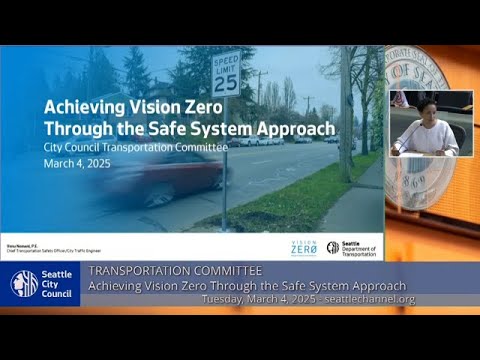
SDOT officials briefed the Transportation Committee on using the federal safe‑systems framework to pursue Vision Zero. The department highlighted an action plan with 20 strategies, a federal SS4A grant to scale proven countermeasures citywide, and a focus on safer streets, speeds, vehicles and post‑crash care.
The Seattle City Council Transportation Committee on March 11 heard a detailed briefing from Seattle Department of Transportation (SDOT) safety staff on how the city will use a “safe systems” approach to pursue Vision Zero — the city’s stated goal to end traffic deaths and serious injuries.
SDOT Chief Transportation Safety Officer and City Traffic Engineer Vinu Nemani outlined the department’s Vision Zero Action Plan, described the five elements of the safe‑systems framework, and said the plan identifies 20 broad strategies and more than 80 specific actions to be pursued over the coming years.
“Seattle is a thriving and equitable community powered by dependable transportation,” Vinu Nemani said, introducing the safety framework. He told the committee the department is treating Vision Zero as a multi‑departmental, proactive effort that blends engineering, speed management, vehicle safety policy and post‑crash emergency care.
Why it matters: SDOT staff told the committee that since adopting Vision Zero the city has recorded more than 1,800 people with severe injuries and roughly 250 traffic deaths. The department said that those numbers and collision data drove its choice to scale a set of federally endorsed, evidence‑backed countermeasures — such as leading pedestrian intervals at signals, protected left turns, improved corridor lighting, intersection daylighting and arterial traffic-calming — and to pair federal grant dollars with local levy funding.
Major program elements presented
- Safe systems and action plan: SDOT described the safe‑systems approach (safer streets, safer speeds, safer vehicles, safer people and post‑crash care) and presented the department’s three-pronged Vision Zero delivery approach: responsive (fixing high‑collision locations), proactive (scaling proven countermeasures) and opportunistic (baking safety into other capital projects). The action plan is structured as a three‑year, annually tracked roadmap.
- Federal and local funding: SDOT said it had recently obligated a federal Safe Streets and Roads for All (SS4A) grant worth more than $25 million and plans to match it with roughly $6 million in local funds to focus countermeasures in underserved areas.
- 2025 deliverables: SDOT listed near‑term work funded by the levy and other grants: construction on safety corridors (including a North 130th Street project and a South Henderson project), spot improvements at more than a dozen high‑collision locations, an expanded school‑zone camera program (SDOT said it plans to double the school zones program with about 35 cameras at 19 locations), and continued rollout of leading pedestrian intervals at signals (SDOT said over 80% of signals already have LPIs).
- Speed management and enforcement cameras: SDOT emphasized speed’s role in crash severity and said the department is exploring how to expand traffic‑safety camera deployments equitably across the city while also pursuing engineering and traffic‑calming strategies to reduce operating speeds.
Public comment and council questions
Public commenters urged expedited work on high‑injury corridors such as Aurora Avenue North and Rainier Avenue and raised concerns about e‑scooter injuries and sidewalk access. Several speakers emphasized pedestrian safety, including a legally blind resident who described personal experiences crossing busy streets.
Council members asked for more data, clearer timelines and assurance that SDOT will prioritize equity. Council Member Teresa Rivera pressed SDOT for details on how new levy programs will be stood up and how the department will partner with other agencies, including King County Metro and Sound Transit, for projects that affect transit stops. SDOT staff said they coordinate with Metro and Sound Transit on bus‑stop and transit‑access improvements.
Notable data points and clarifications
- SDOT cited “more than 1,800 people” severely injured and “about 250” fatalities on city streets since Vision Zero began (SDOT presentation). - SDOT said 90% of the SS4A grant projects will be in underserved areas (SDOT presentation). - SDOT said it aims to implement at least 12 safety corridors during the levy’s eight‑year life and to continue annual construction and design phases so there is a steady pipeline of projects.
What the committee directed or decided
There were no formal committee votes on Vision Zero during the briefing. Committee members broadly supported SDOT’s safe‑systems approach and pressed the department for transparency on sequencing, staffing needs, and metrics that will show whether the city is reducing deaths and serious injuries.
Quotes from the hearing
“Vision 0 is my why,” SDOT Interim Director Adrienne Emery told the committee, referencing personal loss and the department’s priority on road safety. Chief Safety Officer Vinu Nemani told the committee, “The safe systems approach is about designing streets that reduce harm when mistakes occur,” and described the program’s emphasis on engineering, speed management and post‑crash care.
Next steps
SDOT said it will continue to roll out countermeasures this year and to coordinate with council offices on district‑level priorities. The department also pledged to provide annual tracking tied to the action plan and to work with partners on data collection and emergency‑response coordination to improve post‑crash care and measurement of outcomes.