Get Full Government Meeting Transcripts, Videos, & Alerts Forever!
Get email alerts on the Appropriations—Judiciary topic
No spam. Unsubscribe anytime.
Subcommittee reviews judiciary budget; one-time $150 million case-management funding noted
Summary
House Fiscal Agency analyst Robin Risco briefed the subcommittee on the judiciary's $373.4 million fiscal 2025 budget, highlighting a one-time $150 million appropriation in 2023 for a statewide judicial case-management system and the composition of funds that support courts and grant programs.
Robin Risco, fiscal analyst with the House Fiscal Agency, told the House Appropriations Subcommittee on Corrections and Judiciary that the judiciary branch's fiscal 2025 budget totals $373.4 million and is funded primarily with state general fund and state-restricted revenues.
Risco emphasized that the judiciary is a separate branch of government and reminded members the legislature cannot mandate judicial actions. She cited Article 6, Section 1 of the Michigan Constitution as the authority for the judicial branch.
The nut graf: while smaller than other state departments, the judiciary budget supports courts, judicial salaries and grant programs that defray local trial-court costs; a large, one-time appropriation in fiscal 2023 for a new case-management system accounts for much of short-term growth in past years.
Risco provided a breakdown of appropriations and fund sources: the FY25 judiciary budget totals $373.4 million in gross appropriations and $266.1 million in general fund. She said about 97% of the budget is financed with state general fund and state-restricted funding and listed major state-restricted sources including the court equity fund ($50.4 million), judicial electronic filing fund ($12.0 million), state court fund ($8.4 million) and juror compensation fund ($6.6 million). Federal funding (about $7.1 million) largely comes from multiple grant sources including the U.S. Department of Health and Human Services and the National Highway Traffic Safety Administration.
Risco noted that 81% of the budget — about $302.2 million — supports judicial salaries and court operations: 33% for judicial salaries, 24% for the Supreme Court and 24% for trial court operations. She said the state spent about $101.3 million on judges' salaries in fiscal 2024, plus associated FICA and retirement costs.
She described the statutory and constitutional framework for judge compensation: the State Officers' Compensation Commission sets salaries for Supreme Court justices; salaries for Court of Appeals and trial court judges are determined under the Revised Judicature Act of 1961 and subsequent amendments that changed how judicial salaries are calculated. Risco also noted an amendment effective Oct. 1, 2022, that required district court judges' salaries to equal probate court judges'.
Grant programs that support local courts received attention. Risco said $60.8 million in court equity fund reimbursements assist local trial courts with operational expenses and that problem-solving courts are funded through specific appropriations: about $5.7 million for mental health courts (39 courts), funding for 134 drug treatment courts, roughly $1.1 million for 27 veterans treatment courts, and about $3.4 million for the swift, sure, sanctions probation program (21 circuit courts participating as of Dec. 31, 2024). She emphasized that participation in grant programs is at the discretion of judges and cannot be mandated by the state.
Risco outlined other components: $22.2 million for the State Appellate Defender Office, which handles indigent appeals, and $2.9 million for the Judicial Tenure Commission, which investigates complaints against judges.
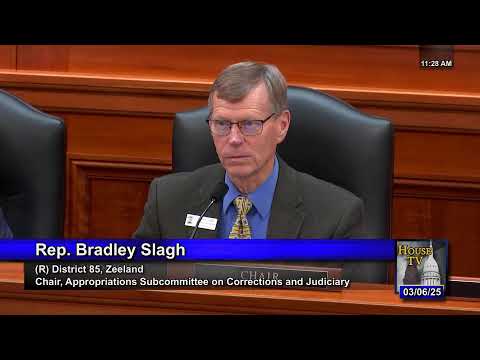
Committee members asked clarifying questions: Chair Slaw asked whether National Highway Traffic Safety Administration funds are targeted; Risco replied they are used for drug treatment courts and drunk-driving programs. Members also asked about last recommendations to change Supreme Court justice pay; Risco recalled a House resolution passed in the prior session that recommended increases but said it did not pass the Senate.
No formal committee votes were recorded during the briefing. The presentation concluded and the subcommittee adjourned after a short question-and-answer period.