Get Full Government Meeting Transcripts, Videos, & Alerts Forever!
Get email alerts on the Appropriations Boilerplate Review topic
No spam. Unsubscribe anytime.
Appropriations subcommittee reviews broad changes to budget boilerplate across agencies
Summary
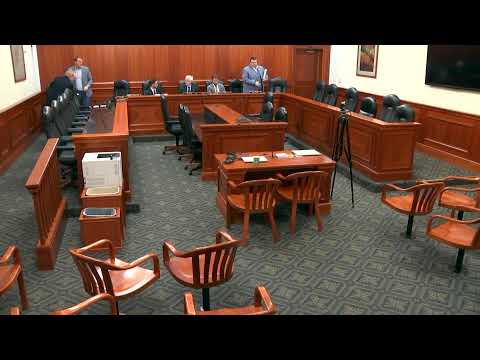
House Appropriations Subcommittee on General Government heard a House Fiscal Agency presentation comparing fiscal-year boilerplate language and highlighted additions, deletions and reporting changes across the Attorney General’s office, Civil Rights, Legislature, Department of State and DTMB.
The House Appropriations Subcommittee on General Government on April 1 reviewed a House Fiscal Agency comparison of budget boilerplate language across fiscal years 2023, 2025 and the governor’s executive recommendation for fiscal 2026.
Michael Knausson of the House Fiscal Agency told members the comparison identifies sections that changed, were added or were removed and said the packet presents three-way columns showing the 2023 enacted language, the current budget and the executive recommendation. “This document also does not include the ‘200’ standard sections that are found in every budget,” Knausson said.
The presentation covered dozens of boilerplate sections and several recurring themes: some reporting requirements were removed in the executive recommendation, contingency and receive-and-spend authorizations were adjusted in several agencies, and a handful of one-time appropriations or earmarks were added or retained.
Why it matters: boilerplate language controls reporting, transfer authority and limits on how agencies may use certain funds. Subcommittee members said the comparison gives oversight tools to track legacy costs, litigation proceeds and contingency authorizations that affect agency budgets.
Major changes summarized
- Attorney General: Sections authorizing specific uses of litigation proceeds were reorganized. A prior authorization to reimburse the Third Circuit Court in Wayne County up to $400,000 for food-stamp fraud diversion was removed because those court-ordered diversions ended, Knausson said. The boilerplate that previously treated tobacco-settlement receipts as appropriations was broadened in the current budget to include opioid-litigation revenues. A new section earmarks $500,000 to the Center for Civil Justice to provide legal assistance to low-income and marginalized populations; Knausson said that corresponds to an equal increase in Part 1 of the Attorney General budget. A $2.7 million appropriation of settlement proceeds previously directed to the Flint water investigation was rewritten in the executive recommendation for more general uses related to litigation costs, settlements and related legal expenses.
- Civil Rights: A prior authorization to spend up to $85,000 in private revenues for training and related activities was increased in the current-year boilerplate to $600,000, a jump Rep. Kelly questioned as large relative to recent receipts. The current-year text also adds several reporting requirements on complaint investigations and revenues; the executive recommendation removes some of those reports.
- Legislature and redistricting: New 2025 sections had required an internship allocation and weekend Capitol access; several redistricting-related administrative and reporting sections that applied while the independent citizens redistricting commission was active are removed in the executive recommendation because the commission is not expected to operate in fiscal 2026.
- Department of State (Secretary of State functions): Multiple receive-and-spend and reporting authorizations were removed in the executive recommendation. Examples include deletion of a reporting requirement on lookup-fee revenue (fees for record lookups), removal of a branch-office-closure notification requirement and elimination of some election-related reporting provisions that had required detailed HAVA (Help America Vote Act) and absentee-voting expenditure reports. Knausson noted that some sections were removed because the activity had been codified in statute or because the governor’s office deemed the boilerplate unenforceable.
- DTMB and Make It in Michigan: The Department of Technology, Management & Budget (DTMB) saw some of the largest changes. Contingency authorization levels tied to the Make It in Michigan competitiveness fund were substantially increased in the current-year budget text (from millions to hundreds of millions in some lines) and then reduced in the executive recommendation to reflect lower remaining balances, Knausson said. Several IT reporting requirements tied to IT modernization funds (ITIF) and project metrics were deleted or moved, and the executive recommendation removed some previously required reports on IT lifecycles and project-level transparency.
Questions and context
Rep. Kelly asked about the Civil Rights private-revenue increase to $600,000, noting the department’s historical receipts were far lower. Knausson replied the department requested higher authorization ($1 million in a prior year) to support strategic planning and event growth, though receipts remain well below that level. On the Department of State, members questioned why reporting on in-person branch services and reimbursement timing were removed; Knausson said the governor’s office often deems some operational directions unenforceable because they could interfere with executive control of day-to-day operations, and that departments sometimes argued some reporting was duplicative or costly to produce.
Votes at a glance
Rep. Maddock moved to approve the minutes of the Feb. 27, 2025 meeting; there were no objections and the chair declared the minutes approved. (Motion: approve minutes of 02/27/2025; mover: Rep. Maddock; outcome: approved by unanimous voice; exact roll-call tally not specified in the transcript.)
What was not decided
Knausson described the differences and the committee discussed questions; the committee did not take formal votes on any of the boilerplate changes themselves. Several sections noted for deletion in the executive recommendation — such as DTMB and Department of State reporting items — remain available for member questions and potential restoration in later budget or implementation bills.
Ending
Committee members asked staff to submit notes and suggested changes; the chair asked members and staff to send suggested boilerplate edits for consolidation. The meeting adjourned with the committee scheduling further discussion of revenue-sharing and Treasury-related materials at a future date.