Get Full Government Meeting Transcripts, Videos, & Alerts Forever!
Get email alerts on the Appropriations—Corrections topic
No spam. Unsubscribe anytime.
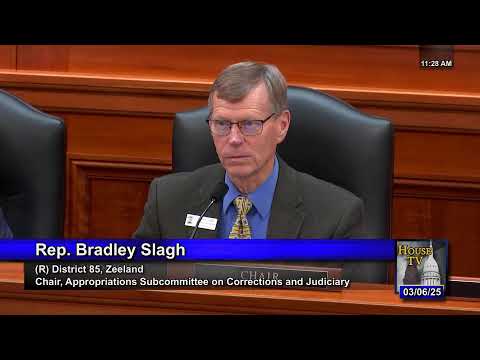
Subcommittee hears $2.1 billion corrections budget; staffing, health care drive costs
Summary
Robin Risco, fiscal analyst with the House Fiscal Agency, told the House Appropriations Subcommittee on Corrections and Judiciary that the Department of Corrections' fiscal 2025 budget totals about $2.1 billion and is largely financed with state general fund/general purpose revenue.
Robin Risco, fiscal analyst with the House Fiscal Agency, told the House Appropriations Subcommittee on Corrections and Judiciary that the Department of Corrections' fiscal 2025 budget totals about $2.1 billion and is largely financed with state general fund/general purpose revenue.
Risco said corrections accounts for roughly 14% of the state's general fund and that prison operations — including custody, transportation and behavioral programming — make up about 77% of the department's budget. "The fiscal year 25 corrections budget totals $2,100,000,000," Risco said during the committee's presentation.
The nut graf: the department's personnel costs and an aging prisoner population are the main drivers of budget growth, while staffing shortfalls have raised overtime and contract costs and remain a central pressure on the budget.
Risco walked the panel through five-year trends and specific line items. She said the department received roughly $1.8 billion in federal COVID-relief funds across fiscal years 2020–2023 that were used to offset what would otherwise have been general fund spending for payroll and frontline costs. She also described facility closures that reduced FTEs and produced one-time savings, including the Michigan Reformatory and a portion of the Gus Harrison Correctional Facility.
Key budget and population figures cited by Risco include: total state workforce of 49,088 active classified employees, of which 10,638 (22%) are employed by the Department of Corrections; 2,239 total vacancies across MDOC, including 967.4 corrections officer vacancies and 183.5 registered nurse vacancies; 2,572,496 overtime hours worked in fiscal 2024 costing about $118.2 million; and an offender population under department supervision of 73,397 as of Feb. 1, 2025, including 32,574 prisoners.
Per-prisoner costs also drew attention: Risco reported a daily per-diem of $137.44 in fiscal 2024 and an approximate annual per-prisoner cost of $46,000 when operations and health-care costs are combined. She noted that health-care spending has risen in part because the prison population is aging: in 2024, 52.1% of prisoners were over age 40 and 28.2% over age 50.
Risco described health-care demand inside facilities: about 12 prisoner deaths per month on average, leading medical causes including cancer and cardiovascular disease, roughly 201 active oncology patients, 86 prisoners in hospice care, 59 receiving dialysis, and an estimated 100,000 prescriptions filled monthly for about 21,000 prisoners. She added that under the U.S. Constitution and federal court orders the state must provide health care in a manner that is not deliberately indifferent.
On alternative programming and reentry, Risco said the fiscal 2025 budget includes $94.2 million for offender-success programs, of which $58.8 million is dedicated to education, job training and career-readiness while incarcerated. She described three vocational villages (Richard A. Handlon Correctional Facility in Ionia; Parnall and Jackson; and Women's Huron Valley in Ypsilanti) offering trades and higher-education partnerships with postsecondary institutions.
Committee members asked a series of follow-up questions during the presentation. Representative Cam asked whether local ambulance services are reimbursed for runs to correctional facilities; Risco replied that the department contracts for health-care providers and that recent contract disputes are in litigation, and that the budget provided funding for the contracted provider. Members also asked for geographic definitions of numbered prosperity regions; a Department of Corrections representative clarified Region 1 is the Upper Peninsula, Region 4 is West Michigan anchored by Kent County, and Regions 2, 7 and 8 span other western-to-eastern parts of the state including the capital region (Clinton, Ingham and Eaton counties).
Risco said the department has taken steps to bolster staffing — increasing recruit academy enrollment (the first two academies of fiscal 2025 started with 278 recruits) and exploring traveling staff units, recruitment efforts, bonuses and pay-step acceleration — but that vacancies and overtime remain a material budget pressure.
No formal committee votes were taken during the presentation portion of the meeting; members directed staff to follow up with additional detail on specific questions, including the geographic definition of prosperity regions and details on mandated versus discretionary overtime when departmental leadership appears before the committee.
Ending: The committee adjourned after the presentations and a brief question-and-answer session; staff indicated they would supply more detailed data when agency leadership is present for subsequent hearings.