Get Full Government Meeting Transcripts, Videos, & Alerts Forever!
Get email alerts on the Zoning And Planning topic
No spam. Unsubscribe anytime.
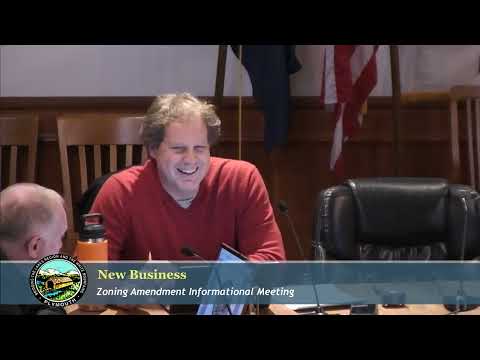
Plymouth planning board reviews zoning ballot items and launches housing chapter work
Summary
At its March 6 meeting, the Plymouth Planning Board reviewed a citizen-petitioned amendment and four planning-board zoning amendments that will appear on the March ballot, discussed wetlands and state law constraints, and began planning work for a state-funded Housing Opportunity Planning (HOP) grant and a housing master-plan chapter.
The Plymouth Planning Board on March 6 reviewed a citizen-petitioned change to uses in the town’s Agricultural (AG) zone and four zoning amendments the board placed on the ballot, and the board also outlined the start of a housing master‑plan chapter funded by a round‑two Housing Opportunity Planning grant.
Why it matters: Voters will decide next week whether to adopt changes to the zoning ordinance that would alter what commercial activities are allowed in the AG zone, add a stand‑alone use category for commercial storage, update parking standards to conform with recent state law, and remove ambiguous permissive-language from the ordinance. The board also signaled it will begin a year‑long process to prepare a housing chapter that must be integrated with Plymouth’s 2018 master plan.
The board began by explaining logistics for town election and town meeting: the ballot and election will be held Tuesday, March 11, 8 a.m.–7 p.m., at Plymouth Elementary School; the in‑person town meeting is Wednesday at 7 p.m. Board members emphasized published materials and short explanatory videos available on the town website and the Kenny Baker TV YouTube channel for voters who want details.
Petitioned amendment on Agricultural zone uses A citizen petition seeks to change the table of uses for the Agricultural zone so that several commercial uses now permitted by right would become either not permitted or permitted only by special exception. The amendment covers a long list of commercial categories and is framed as a line‑by‑line change to the ordinance’s use table.
Board members said the intent of the petition and related planning‑board amendments is to protect the rural and residential character of much of the AG zone while allowing the community and the zoning board to review certain commercial proposals through the special‑exception process. David Kent, a Plymouth resident who identified himself as a member of the Zoning Board of Adjustment, urged the planning board to favor special exceptions for borderline commercial uses so neighbors receive notice and a formal opportunity to comment: “A special exception…gives all of the interested parties notice that this is what’s going to occur,” Kent said, adding that a well‑prepared proponent who works with neighbors often succeeds while proposals out of character do not.
ICD/Industrial‑Commercial District boundary amendment One planning‑board amendment (zoning amendment number 1) would redraw and slightly expand the Industrial Commercial District (ICD) along Tenney Mountain Highway (the strip that contains Riverside Landing and Market Basket). Board members said the ICD boundary change is intended to reduce the number of existing commercial uses that would become legally nonconforming if the petitioned AG‑zone use restrictions pass.
Planning‑board members explained that, in practice, the map change would affect parcels that have road frontage in the ICD so that, even where the ICD extends only a few hundred feet into a lot, zoning rules for that frontage could effectively apply more broadly across parcels (subject to environmental protections). The board acknowledged conservation and wetland concerns: state Shoreland Protection Act requirements and Plymouth’s environmentally sensitive‑zone provisions will still limit buildable land along rivers, and any project in or near wetlands would require approvals from New Hampshire Department of Environmental Services (DES) and likely additional local review. Board members noted the Conservation Commission flagged wetlands and recommended waiting for a new natural‑resource inventory before larger expansions.
Commercial storage facilities (zoning amendment 2) The planning board proposed creating a separate use category for commercial storage facilities, splitting them out from the current “commercial service” catch‑all. Under the proposed language, commercial storage would be permitted in the ICD, allowed by special exception in the Highway Commercial and Agricultural zones, and otherwise regulated separately so the town can address siting, buffers, and proximity to residences. Board members said the change responds to several recent storage proposals that raised neighborhood concerns; speakers noted there are already multiple storage facilities in and near town (Route 3, Tenney Mountain Highway and other locations).
Parking requirements and state law (zoning amendment 3) One amendment would revise Article 4, Section 411 to conform parking rules with recent state law changes. Among the changes cited by board members: a new parking category for multifamily developments with 10 or more units, carrying a minimum requirement of 1.5 spaces per unit, and a statutory process that allows certain residential developments to propose alternative parking strategies instead of providing all off‑street spaces on site. Board members framed this amendment as necessary to avoid legal exposure: they said denying applications that meet the state’s statutory alternatives could prompt appeals and potential court rulings against the town.
Permissive‑ordinance language removal (zoning amendment 4) The planning board recommended removing a sentence from Article 3, Section 304 that could be read to allow uses not listed in the ordinance if the board deemed them “sufficiently similar” to allowed uses. The board’s rationale, supported by the town attorney, is to make Plymouth’s ordinance explicitly permissive—meaning only uses named in the ordinance are allowed—so as to reduce ambiguity and preserve the ordinance’s clarity and enforceability.
Citizen petition to elect planning board members A separate citizen petition on the ballot would change how planning board members are chosen, moving from select‑board appointments to direct election. Board members expressed mixed views in the discussion: some said election could strengthen accountability and encourage public support for members; others warned that elected boards can politicize planning and reduce the pool of willing volunteers. The board did not take a formal position in the meeting.
Housing Opportunity Planning grant and master‑plan context The board updated members and the public on a round‑two HOP grant the town received to develop a housing master‑plan chapter. Board members said round‑one work led to regulatory audits and zoning changes; round two will focus on preparing a housing plan (an element intended to be incorporated into the town’s overall master plan). The board reviewed the timeline and the need to examine the 2018 master plan for consistency: the housing chapter must be integrated with the broader plan rather than drafted as a stand‑alone document.
Outside consultant Judy (planning consultant) cautioned that producing a housing chapter in 2025 requires close attention to how recommendations fit with the 2018 master plan and with prior planning choices: “the challenge we’re gonna have…is we’re doing this in 2025, and we need to achieve consistency with something that was completed in 2018,” she said (paraphrased from the meeting). The board and consultant discussed forming a small working group or using the planning board itself to track implementation of past master‑plan recommendations and to identify groups not reached in earlier outreach (manufactured‑housing communities, tenants, and others).
Public engagement and next steps Board members reiterated that voters who want more information should consult the posted ordinance language, the videos on the town and Kenny Baker TV channels, or contact town staff (Joseph) or the town clerk for election‑day registration details. The board also encouraged participation in upcoming planning training: the Office of Planning and Development conference (virtual) on May 10, 2025, and noted newly published resources including the 2024 planning board handbook and a 2024 planning and zoning case‑law summary.
Ending: procedural votes The only formal actions at the March 6 meeting were the approval of the minutes from Feb. 20, 2025, and a motion to adjourn. The board adjourned after the votes and closed the session.