Get Full Government Meeting Transcripts, Videos, & Alerts Forever!
Get email alerts on the Residential Landlord Tenant Ordinance topic
No spam. Unsubscribe anytime.
Evanston officials outline changes to Residential Landlord–Tenant Ordinance, effective Jan. 1
Summary
City of Evanston staff and Metropolitan Tenants Organization representatives presented the recently revised Residential Landlord–Tenant Ordinance (RLTO), summarizing who is covered, prohibited lease terms, limits on fees and deposits, notice periods, entry rules, repair remedies and anti-retaliation protections.
City of Evanston housing staff and representatives of the Metropolitan Tenants Organization on a city-hosted presentation summarized major changes to the city’s Residential Landlord–Tenant Ordinance (RLTO), which the City Council approved Nov. 25, 2024 and which took effect Jan. 1.
The presentation, led by Ana Lizárraga, housing and economic development analyst for the City of Evanston, and Javier Ruiz of the Metropolitan Tenants Organization, reviewed who the ordinance covers and the new limits and obligations placed on landlords and tenants. Phil De Vont, also listed as representing the Metropolitan Tenants Organization, joined the presenters.
The presenters said the RLTO does not apply to certain institutional or non‑permanent housing types, including medical or geriatric institutions, religious educational housing (such as college dorms), hospitals, hotels or motels not used as permanent residences, owner‑occupied cooperatives, and units occupied by buyers under land‑sale contracts. Presenters said landlords must disclose whether a unit is covered by the RLTO in marketing materials and in written lease agreements.
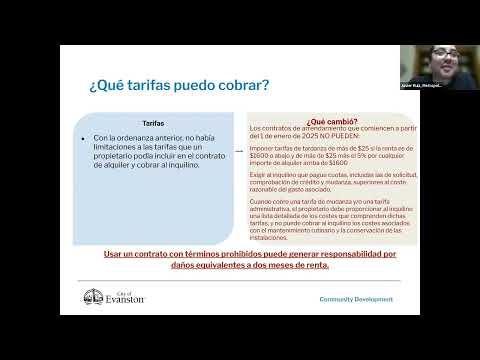
Among the changes summarized: - Prohibited lease terms: Leases that waive notice requirements, waives a jury trial, or require tenants to give false or misleading statements about the landlord are prohibited. Landlords may not limit tenants’ ability to call emergency services or require tenants to pay the landlord’s attorney fees by contract. - Fees and deposits: Late fees are limited to $25 for monthly rent at or below $1,600. For rent above $1,600, the late fee is $25 plus 5% of the portion of rent that exceeds $1,600. Application, credit‑check and move‑in fees cannot exceed the landlord’s reasonable cost. Security deposits are capped at 1.5 times monthly rent; if a landlord demands more than one month’s rent, the tenant may pay the excess in installments over six months. Security deposits must be kept in a separate federally insured account at a financial institution located in Illinois and returned within 21 days after tenancy ends, with an itemized written statement if deductions are made. - Repair remedies and withholding: If a landlord fails to maintain premises in compliance with building and other local codes, a tenant may hire a professional to make repairs, present the bill to the landlord, and deduct the cost from rent after providing notice. The presenters said the ordinance raises the cap for such “repair and deduct” remedies to $500 or one‑half of monthly rent, whichever comes first, replacing a previously lower limit. Tenants may also withhold a portion of rent that reasonably reflects decreased value of the unit after proper written notice and following cited code violations; the presentation emphasized changed notice periods to 10 days in many cases. - Entry and notice: Landlords must give at least two days’ written notice (text or other written message) before entering a unit for routine purposes, and entry between 8 a.m. and 8 p.m. is considered reasonable. Landlords may enter without consent in emergencies and must notify the tenant within two days after an emergency entry. For showing a unit prior to vacancy, a 90‑day window may apply for repeated showings when tenants have given notice to move. - Essential services: If a lease promises utilities or services such as air conditioning or internet access, the presentation said the ordinance treats those as essential services the landlord must provide without interruption. - Eviction and cure periods: For nonpayment of rent, landlords must provide a 10‑day notice before filing for eviction. Tenants have one opportunity per tenancy to cure such a 10‑day notice by paying the owed rent and fees. For other material lease violations (for example, unauthorized pets or smoking), landlords must provide a 30‑day written notice allowing the tenant to cure the violation before pursuing eviction. - Anti‑retaliation and self‑help prohibitions: The ordinance bars landlords from retaliatory acts—such as threatened eviction, service termination, increased rent, refusal to renew or legal action—taken because a tenant reported code violations or sought legal rights. Landlords are also prohibited from self‑help evictions or actions including shutting off utilities, changing locks, removing personal property or using threats or force to remove tenants. - Required disclosures: Landlords must disclose owner/agent contact information, recent code violations, any foreclosure or notice of default, known lead risk, and known infestations (for example, bedbugs), if applicable. If a landlord pays or receives utility payments on behalf of tenants, certain payment histories over the prior 12 months must be disclosed.
Presenters repeatedly emphasized that the ordinance requires many disclosures to be written and provided to tenants at lease start or upon change of ownership, and they encouraged landlords and tenants to consult the city’s summary materials and model lease posted online. Resources listed during the presentation include the city’s RLTO summary, a sample lease, a dedicated helpline at 205‑736‑0293, and the Evanston 311 service line.
The presentation ran about 20 minutes followed by time for questions; presenters said the slide deck and the recorded presentation will be posted to the City of Evanston’s YouTube channel and the city website. The session was informational; the presenters did not undertake any binding action during this presentation.