Get Full Government Meeting Transcripts, Videos, & Alerts Forever!
Get email alerts on the Investment Benchmark topic
No spam. Unsubscribe anytime.
OCA frames focused behavioral‑health investment benchmark, tentatively targeting in‑network outpatient and community services
Summary
OCA outlined options for a focused investment benchmark to increase in‑network outpatient and community behavioral health spending among commercial and Medicare Advantage plans, using Rhode Island's 200% baseline example as a model while excluding pharmaceutical spend and planning phased expansion to Medi‑Cal.
The Office of Health Care Affordability resumed work on a behavioral health investment benchmark, proposing a focused approach that would target increased in‑network outpatient and community‑based behavioral health services paid by commercial carriers and Medicare Advantage plans.
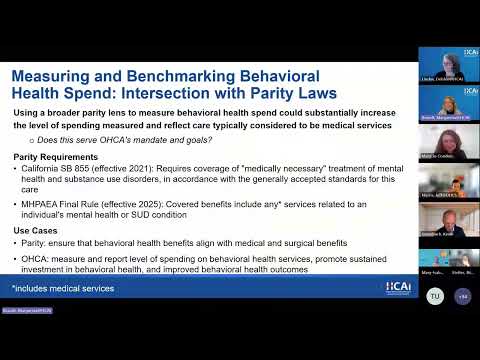
Debbie Lindes, manager for the Healthcare Delivery System Group at OCA, described the distinction between comprehensive behavioral health spending measurement and a narrower investment benchmark that would be used to drive policy action. As an example, she summarized Rhode Island's benchmark set by the Office of the Health Insurance Commissioner: a requirement for carriers to raise community‑based behavioral health spending for children and adolescents covered by commercial carriers to 200% of 2022 baseline dollars by 2025, with the state setting the market average after 2025.
OCA’s current proposal and scope - The benchmark would focus on in‑network outpatient and community‑based settings (professional and outpatient facility services, primary care with behavioral health services, telehealth, mobile clinic/community services) and would exclude pharmaceuticals for now. - The benchmark would initially apply to commercial and Medicare Advantage members; OCA would consider Medi‑Cal inclusion later when methodology and data permit. - OCA described three design decisions to resolve in coming meetings: whether the benchmark should be expressed as a percent of total medical expense or a per‑member‑per‑month amount; whether it should target incremental short‑term improvement or a longer‑term target; and the timeline for achieving the benchmark.
Why OCA favors a focused benchmark OCA staff said a focused benchmark directs new investment toward upstream, community‑based services that expand in‑network access, reduce out‑of‑pocket costs and have high potential to improve outcomes. The Rhode Island illustration showed that a modest baseline per‑member per‑month dollar amount can double under such a benchmark (the example: if baseline were $0.50 per member per month, a 200% target would require moving to $1.00 per member per month over the stated period).
Stakeholder issues and next steps - Participants asked detailed measurement questions about which non‑claims payments would count for the benchmark; OCA said that determination is part of the ongoing non‑claims discussion and will be clarified when defining the benchmark more granularly. - OCA plans to continue deliberations and present a recommended benchmark to the OCA board in July 2025.
Ending: OCA framed the benchmark as a policy lever to prioritize in‑network outpatient and community behavioral health spending and asked the work group to weigh in on the remaining design choices ahead of future meetings.