
Pacific Council pauses work on cumulative‑impacts framework and will review California Energy Commission sea‑space report
Get AI-powered insights, summaries, and transcripts
Subscribe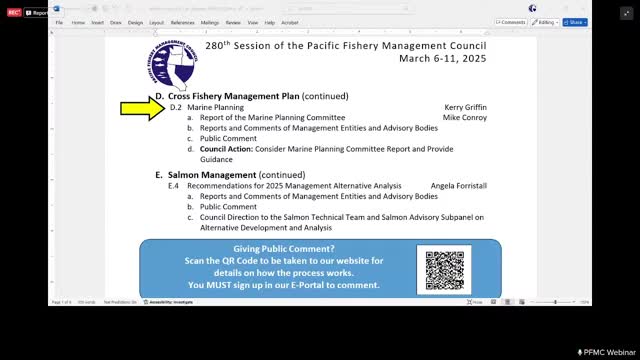
Summary
The Pacific Fishery Management Council on its marine planning agenda paused further work on a council-developed cumulative impacts framework and told staff to review a California Energy Commission draft identifying "suitable sea space" for wave and tidal energy before deciding whether to send comments.
The Pacific Fishery Management Council opened its marine planning discussion by reviewing recent federal and state actions affecting offshore renewable energy and sea‑space planning.
Council staff member Carrie (overview) and planner Mike Conroy told members the council’s Marine Planning Committee (MPC) has tracked several developments, including a presidential memorandum that "temporary[ly] withdraw[s] all areas on the [outer] Continental Shelf from offshore wind leasing" and that "forbids the issuance of new or renewed approvals, rights of way permits, leases, or loans for onshore or offshore wind projects pending the completion of a comprehensive assessment and review of federal wind leasing and permitting practices." Conroy said the memo "has no immediate impact on the leases off California."
Why it matters: the memorandum pauses any new BOEM leasing and the identification of new call areas while a Department of Interior‑led review is completed, which could slow or change the federal offshore wind planning schedule on the West Coast.
The council also received an overview of the California Energy Commission (CEC) work to identify suitable sea space for wave and tidal energy under Senate Bill 605. Conroy summarized CEC staff assumptions for wave energy: developers will likely consider sites "within 10 nautical miles of the California shoreline and in waters less than 55 ish fathoms, a hundred meters in depth," and the draft consultant maps show overlap between potential wave resource areas and important fishing grounds, including Dungeness crab and commercial salmon grounds. Conroy said the CEC expects a phase‑2 consultant draft to be released near the end of this month, with a 30–45 day comment period that will overlap the council’s April meeting.
Advisory bodies and council direction: the Habitat Committee (Dr. Corey Green), the Salmon Advisory Subpanel (Megan Waters) and the Marine Planning Committee recommended pausing further development of the council’s cumulative impacts framework (CIF) given the federal pause on offshore wind and the difficulty of getting federal agencies to participate in recent MPC meetings. The Habitat Committee said it "does not see a need to provide comments from a habitat perspective on the CEC draft phase 2 consultant report until there is an actionable item." The SAS and Habitat Committee both suggested holding off further CIF work until there is clarity on federal policy and on whether projects will move forward.
Council discussion and next steps: council members and staff agreed the council should "stand by" for the CEC draft and asked staff and the MPC/Habitat Committee chairs to review the consultant report when it is released and recommend whether the council should submit comments via the council’s quick‑response process. Council staff summarized the action as: the council appreciates the work on the CIF but will not proceed further on it now; staff will review the CEC consultant report on release and, working with committee chairs as appropriate, recommend whether to develop a comment letter.
Other updates: the MPC also noted two Department of Energy laboratory reports on offshore wind transmission planning for the West Coast, status updates on the PacWave project (onshore construction through spring; operations forecast next spring), and that several state and local processes (including a Washington coastal roundtable and a proposed Grays Harbor concept) remain at an early, conceptual stage.
Ending: Council staff and the MPC will monitor the DOI review and the CEC draft report; advisory bodies recommended pausing CIF development until there is greater regulatory certainty and federal participation.
Sources and attribution: quotes and attributions in this article come from council staff and advisory body representatives who spoke at the meeting: Carrie (staff overview), Mike Conroy (MPC presentation), Dr. Corey Green (Habitat Committee), Megan Waters (SAS), and Travis Hunter (GAP).