
TAG declines to alter "chapter" phrasing for change-of-occupancy language in existing-buildings section
Get AI-powered insights, summaries, and transcripts
Subscribe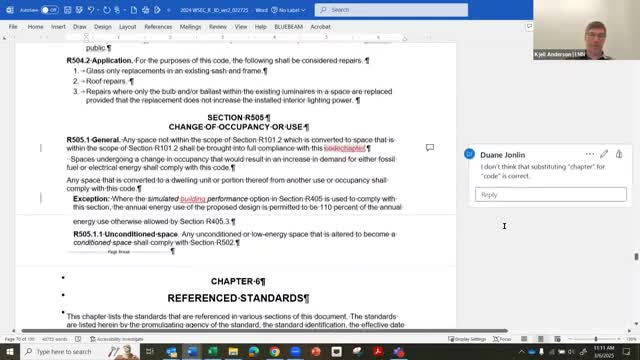
Summary
The TAG considered a model-code edit that replaced the residential code—s word "code" with "chapter" in the existing-buildings change-of-occupancy provision. After debate and a roll-call, the motion to replace the model-code wording with the prior 'code' phrasing failed; the TAG retained the model-code 'chapter' wording in the integrated draft.
The TAG reviewed proposed language in the existing-buildings chapter that affects when a change in occupancy or use triggers energy-code upgrades. The IECC 2024 phrased the provision using the word "chapter," while Washington—s prior 2021 state language used "code."
Some members argued "chapter" narrows the requirement to chapter 5 (existing buildings) rather than to the entire code, which could reduce the number of situations requiring full-code compliance when a change of occupancy occurs. Others said the difference was largely semantic because subsequent paragraphs already reference full compliance where appropriate. Members asked staff whether the revised language intended to limit applicability; staff explained the IECC phrasing focuses the requirement on the existing-buildings chapter and that a separate sentence already requires full-code compliance when conditioned spaces are converted to dwelling units.
The TAG voted on a motion to revert the IECC wording back to the Washington state language using "code." The roll-call vote failed (motion did not pass). As a result, the integrated draft retained the IECC wording using "chapter." Several members indicated they would prepare code-change proposals if they felt the model-code language later caused unintended reductions in stringency during the proposal review process.
Ending: The existing-buildings language remains the IECC phrasing in the integrated draft; members may submit targeted code-change proposals later in the public proposal window if they want to change that wording.