Get Full Government Meeting Transcripts, Videos, & Alerts Forever!
Get email alerts on the Permitting Completeness topic
No spam. Unsubscribe anytime.
Bill labeled 5729 would force jurisdictions to ‘deem’ many permit applications complete; SBCC members warn of reduced plan review
Summary
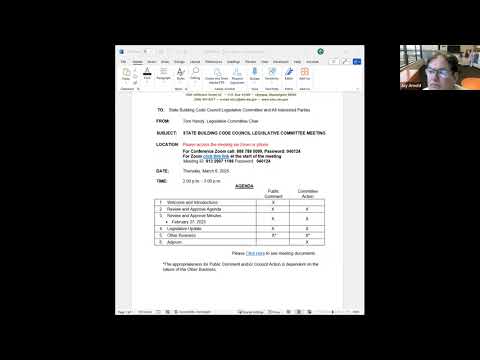
SBCC Legislative Committee members spent the bulk of their March 6 meeting raising concerns about legislation identified in the transcript as “5729,” a bill that would change permit completeness and approval rules.
SBCC Legislative Committee members spent the bulk of their March 6 meeting raising concerns about legislation identified in the transcript as “5729,” a bill that would change permit completeness and approval rules.
The bill’s main change, as explained by Micah, a staff member, is that when an application includes “a set of plans, set of computations, or specifications prepared or stamped by a professional engineer,” the application would be “automatically required to deem that that application is complete.” Micah said the language would remove a jurisdiction’s ability to require other documents and could create situations where “you’re gonna deem them as being there just based off this legislation.”
Committee members said that deeming an application complete on receipt of a stamped document could limit or eliminate local plan review. Micah pointed to a related provision that would require approval if a jurisdiction issues three requests for more information without resolution, saying: “If you review it 3 times and you’re ignored as a jurisdiction, you’re automatically required to approve this project.”
Architect and committee participant Chuck said the bill would create a “race to the bottom,” arguing client pressure can push designers to stamp marginal work and that professional licensure alone will not prevent unsafe projects. A plans examiner on the call described the proposal as “a dangerous bill” and warned bluntly, “this could cost lives.”
Members discussed how the bill interacts with existing law. One attendee noted RCW language requiring local jurisdictions to enforce the building code (cited in the meeting as RCW 19 27050) and suggested that SBCC could frame comments around the council’s enforcement duties. Others pointed to project-permit provisions in the land-use RCW (discussed in the meeting as RCW 36.70B.030) and said the bill’s language would also remove some review authority from planning departments.
The committee explored options for responding. Jay Arnold and other council members discussed whether to call a special SBCC meeting or prepare testimony for hearings in the opposite chamber. The committee did not take a formal position during the March 6 meeting; members instead asked staff to monitor the bill and suggested preparing materials to submit to legislative committees if hearings are scheduled.
Why this matters: Committee members framed the change as fundamentally altering who verifies that building plans meet minimum code standards. Several participants said that removing or limiting jurisdictional review would reduce the safety backstop that plan reviewers and inspectors currently provide.
Meeting context and next steps: Committee members noted the bill moved quickly into the legislative process and that a substitute had been dropped late in the session. No public hearing position or vote was recorded by the committee on March 6; members discussed preparing comments for later committee hearings and whether a special meeting is warranted.