TAG rejects proposal to insert IECC ERI path into Washington integrated draft
Summary
The Residential Energy Code technical advisory group voted against adding the IECC 2024 Energy Rating Index compliance path to Washington—s integrated draft, citing a lack of demonstrated equivalency to the state—s existing credit-based approach.
The Residential Energy Code technical advisory group for the Washington State Building Code Council voted down a motion to include the IECC 2024 Energy Rating Index (ERI) compliance path in the integrated draft used to accept code-change proposals.
The vote was 6 in favor and 7 opposed. The motion was made by Patrick Hanks, policy and research manager for the Building Industry Association of Washington, and seconded by Jason (surname not specified in the transcript).
The group—s discussion focused on whether ERI would provide an equivalent level of energy performance to Washington—s current prescriptive and credit-table approach. Supporters, including Hanks and builder Damon Doyle, argued ERI would give builders a simpler, more flexible performance metric and encourage use of ERI raters. Hanks said adding the path would make ERI an available compliance option and help the industry develop the rater pool that future code cycles might require.
Opponents said past modeling had not demonstrated equivalency. Dwayne Johnlin, energy code adviser for the City of Seattle, and others said prior code cycles had not produced convincing analysis that ERI yields the same aggregate efficiency as Washington—s existing credit tables; they preferred to treat ERI as a formal code-change proposal that includes modeling and verification studies.
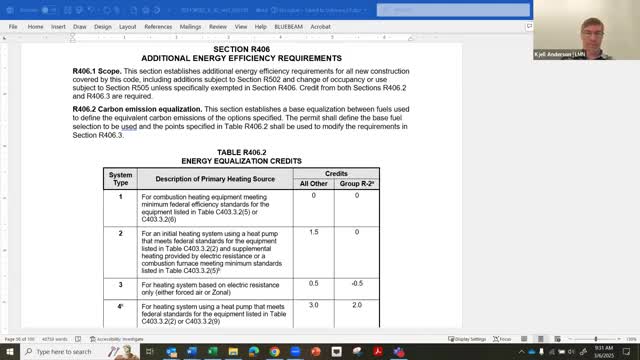
Staff and multiple members also discussed implementation questions: Krista (SBCC staff) explained the integrated draft shows existing state language in black and IECC insertions in red, and she noted that if the ERI path is less stringent than Washington—s baseline, the ERI point values would need recalibration against the state baseline. Several members urged that any ERI adoption be accompanied by third-party modeling to set credit values so the new path does not reduce overall stringency.
Kjell Anderson, TAG chair and Building Code Council member, presided over the roll-call vote. The motion failed; the integrated draft remained without the ERI path.
The TAG discussed follow-up actions: some members proposed forming a technical work group to model and adjust ERI credit values before resubmitting ERI as a code-change proposal, while others insisted the burden of proof should remain with ERI proponents.
The TAG will accept formal code-change proposals during the public proposal period; ERI advocates were advised to submit a fully supported code-change package (including energy modeling and proposed table values) if they wish to revisit the path in this cycle.
Ending: With the ERI motion defeated, the TAG resumed review of the integrated draft, and members noted that future proposals could still add an ERI path if they supply the equivalency analysis the TAG requested.