SBCC staff seeks schedule shift as code-cycle reports lag; warns of December deadlines
March 08, 2025 | Building Code Council, Governor's Office - Boards & Commissions, Executive, Washington
This article was created by AI summarizing key points discussed. AI makes mistakes, so for full details and context, please refer to the video of the full meeting. Please report any errors so we can fix them. Report an error »
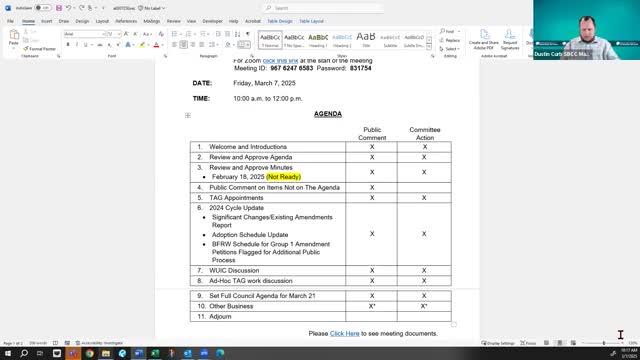
Dustin, the council staff presenter, said the practice of having volunteers draft report frameworks during the prior cycle proved time-consuming and led staff to take on more of the initial drafting work this cycle to speed tag review. He told members the IRC reports were about 50% complete and that staff was compiling state amendments in a spreadsheet and tracking rationales for past amendments. The staffer said the current schedule (posted on the council’s 2024 adoption page) needs “one more month” in several places so committee and council meetings can align with report completion.
Staff warned that the council has limited ability to compress the end of the cycle because Administrative Procedures Act timelines and regular meeting dates constrain the process. Dustin said December 1 is the council’s target for adopting all codes except the commercial energy code, which must be final-adopted by Dec. 15, and that missing those deadlines could push the entire 2024 code package back a year and affect the 2027 cycle. The staffer said group 2 petition windows may be opened earlier in a limited way (as was done in group 1, when a 90-day window was used) and proposed directing petition submissions that staff deems complete directly to tags to allow earlier tag review.
Committee members raised concerns about compressing tag review because volunteers and stakeholders may not be able to meet more frequently or for extended sessions. Members also asked about economic-impact analysis capacity: staff said procurement and contracting constraints mean an outside economic analysis contract is unlikely to be in place in time for group 2 work and that staff can perform limited review of economic data submitted with proposals.
Don't Miss a Word: See the Full Meeting!
Go beyond summaries. Unlock every video, transcript, and key insight with a Founder Membership.
30-day money-back guarantee
Sponsors
Proudly supported by sponsors who keep Washington articles free in 2026

