Get Full Government Meeting Transcripts, Videos, & Alerts Forever!
Get email alerts on the Parkland Dedication topic
No spam. Unsubscribe anytime.
Laredo staff seek major changes to parkland-dedication rules, higher fees and longer build timelines
Summary
City staff presented an ordinance amendment to the parkland-dedication sections of the Laredo Land Development Code and the commission voted to close the public hearing and support the ordinance after extended discussion.
City staff presented an ordinance amendment to the parkland-dedication sections of the Laredo Land Development Code and the commission voted to close the public hearing and support the ordinance after extended discussion.
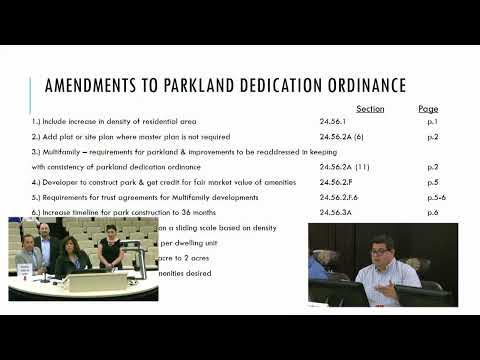
The proposal would change several sections of the city’s parkland-dedication rules (Article 3, sections 24.56.x). Among the largest policy shifts presented, staff proposed increasing the “level of service” requirement from about 1 acre per 1,000 people to 2 acres per 1,000; raising the cash-in-lieu value used in calculations from $45,000 per acre (adopted in 2008) to $55,000 per acre; and lengthening the allowed time to complete developer-built park improvements from the prior standard to a 36-month completion window.
Why it matters: city staff said population growth and higher construction and equipment costs have widened a gap between current parks and the level recommended in the parks master plan. “Population has grown,” Anita Stone, parks staff, told the commission, and the master plan recommended moving away from small “pocket parks” toward larger neighborhood parks with more amenities. The proposed changes, staff said, are intended to increase acreage and the types of facilities the city can deliver.
Key provisions and how they would work
- Land requirement and level of service: The staff presentation said the city’s parks master plan and updated household figures support increasing the requirement to 2 acres per 1,000 residents. Staff cited a population rise from about 176,000 to about 257,000 and an updated persons-per-household figure used in the calculation (an overall average presented as about 3.04 persons per household).
- Cash-in-lieu value: The ordinance would change the per-acre cash-in-lieu figure used when developers pay instead of donating land from $45,000 (adopted in 2008) to $55,000, which staff said reflects current market averages. Anita Stone summarized the change as an update intended to align the city’s cash calculation with current market conditions.
- Park-improvement fee schedule by lot size: Instead of a single flat fee per dwelling unit, the proposal would differentiate park-improvement charges by lot-size categories. In the staff presentation the slide showed per-dwelling-unit assessment examples: “extra small” lots at $3.75 (slide language), “small” at $666.67, “medium” at $1,000 and “large” at $1,500 per dwelling unit. Staff explained developments would be charged based on the actual mix of lot sizes submitted with the plat or site plan rather than a single flat rate.
- Developer-built parks and credit: Staff said developers may build required improvements and receive credit equal to the fair market value of the completed improvements. “We would actually prefer the developer to be able to build the park himself,” Anita Stone said. The parks department said inspections and receipt documentation would be used to verify that required amenities were installed to the city’s specifications; staff said inspectors would check items (for example concrete thickness, seating, playground elements) rather than relying solely on a developer’s cost sheet.
- Trust agreements and multifamily developments: Under the proposed change, a landowner submitting a multifamily plat or site plan must post a financial guarantee (a trust agreement) to ensure the construction of required recreation amenities. Staff said if a developer cannot complete the improvements, the city would assess the park-improvement fee and use those funds to build amenities at a nearby park.
Questions and concerns raised in the meeting
Commissioners asked for benchmarks and comparisons to other cities to justify changing the level of service from 1 to 2 acres. Anita Stone said the parks master plan consultant recommended moving away from numerous small pocket parks toward larger neighborhood parks to improve maintenance efficiency and the variety of amenities offered.
Commissioners also pressed staff on how donated land would be evaluated and whether the city could accept additional acreage beyond the ordinance’s credit caps. Staff said credits for more-than-required acreage would require a separate agreement with management and legal review and are outside the ordinance’s automatic-credit provisions.
A legal/process question arose over whether dedicated parks may be removed from the city’s inventory without voter approval. A commissioner referenced a Texas law that can require a referendum to remove dedicated parkland; staff said they would research the specific statute and report back.
Vote and next steps
After discussion the commission closed the public hearing and moved to recommend approval of the ordinance as presented. The motion to close the public hearing and support the ordinance carried on a voice vote; the record shows the chair called for “Aye” and the motion passed.
Votes at a glance
- Agenda item 6a — Ordinance amending parkland-dedication sections of the Laredo Land Development Code (sections cited in staff presentation). Outcome: motion to close public hearing and support the ordinance — passed by voice vote (recorded in the transcript as “Aye; motion passes”).
- Agenda item 8b — Preliminary replat of Lot 1A Block 1 (Fire Station No. 12) and variance request to reduce the primary access-easement width from 50 feet to 30 feet. Outcome: motion to approve the variance subject to staff comments — motion seconded; passed (voice vote recorded in the meeting).
- Agenda item 9a — Final plat, Alexander Commercial Subdivision, Phase 15 (commercial). Outcome: approved (motion/second; passed by voice vote).
- Agenda item 9b — Final plat, Santa Barbara Subdivision (residential and commercial). Outcome: approved (motion/second; passed by voice vote).
What remains unresolved: staff committed to provide clarifications requested during the hearing, including (1) the exact statutory requirements and any referendum process for removing dedicated parkland from inventory, and (2) additional benchmarking and the market-value methodology used to set the $55,000 per-acre cash-in-lieu figure. Staff also said they will correct minor typographical gaps in lot-size categories shown in the ordinance appendix before finalization.
The commission’s recommendation will be forwarded to the next legislative step required by the city’s code for final action.