Get Full Government Meeting Transcripts, Videos, & Alerts Forever!
Get email alerts on the K 12 Education topic
No spam. Unsubscribe anytime.
Orting Elementary outlines math, reading and engagement goals as part of school improvement plan
Summary
Orting Elementary School staff presented their Continuous School Improvement Plan to the district board, focusing on a new Reveal math curriculum, increased family volunteer programs, self‑efficacy supports and expanded Tier 3 reading interventions including SIPs and 95% RAP.
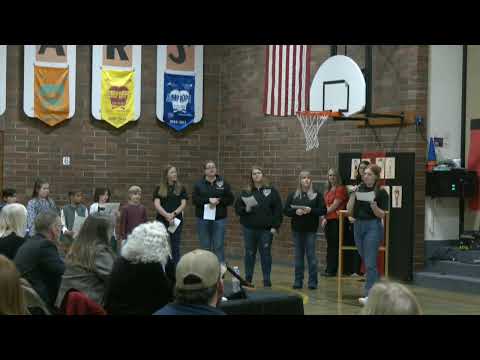
Orting Elementary School staff presented their Continuous School Improvement Plan to the Orting School District board, describing new curriculum choices, expanded interventions and family‑engagement goals intended to raise student outcomes across K–5.
The presentation, led by Abigail Finney, assistant principal, and classroom teams, described four main goals: math proficiency with the new Reveal math curriculum; growing family and volunteer participation through Watch Dogs and an Art Docent program; improving student self‑efficacy measured by the Panorama survey; and increasing reading achievement through expanded Tier 3 interventions including SIPs and the 95% RAP program.
Finney said the building’s theme for the year is “Rally and Rise,” and noted Orting Elementary is now a full K–5 school with about 580 students. “We want students to know what they are supposed to be learning and to feel empowered to track their own data,” Finney said, describing the school’s emphasis on student goal‑setting and teacher PLCs (professional learning communities).
Second‑grade teacher Nicole Grisham described the team’s Reveal math unit and its SMARTIE goals (specific, measurable, achievable, relevant, time‑bound, inclusive and equitable). Grisham reported that of 105 second‑grade students, 30 scored below standard on the preassessment and 37 were approaching standard. The team set progress and proficiency targets and a timeline that included a preassessment on Jan. 9 and a summative assessment on Feb. 4. Grisham said, “To measure success throughout the unit, we progress monitored the student's data by reviewing our common formative assessments that we gave during the unit and adjusted instruction as needed.” She reported that 68 percent of the class met the progress goal and about 15 percent met the proficiency goal, with roughly 20 percent still not meeting the standard.
On family engagement, staff described a target to increase volunteer participation by 50 percent over last year. The Watch Dogs father‑volunteer program and an Art Docent volunteer program were highlighted as strategies to bring families into classrooms; one presenter said last year’s Watch Dogs roster included 14 dads and current signups were lower, prompting active outreach at conferences and through ParentSquare.
Britney Smith, the student council advisor, described student leadership projects including community service, an annual food drive and school assemblies. She said eight students serve as elected officers and help plan monthly activities, which staff present as part of the school’s community‑partnership goal.
On social‑emotional learning, Finney and partner Megan Foley presented Panorama survey results for grades 3–5 used to measure self‑efficacy. Finney said the question “How sure are you that you can complete all the schoolwork that is given to you?” rose from 53 percent favorable in the fall to 56 percent in winter; the item “How sure are you that you can do the hardest work that is given to you?” moved from 33 percent to 35 percent. Finney and Foley described teacher training on growth mindset and classroom visuals that reinforce goal‑setting; Finney said she ran self‑advocacy groups for fourth and fifth graders and hoped those interventions would show larger gains in spring data. “Self‑efficacy means to me is to think about what you can do,” a student featured in the presentation said.
Whitney, the school’s MTSS (Multi‑Tiered System of Supports) specialist, together with Stacy (special education resource teacher) and Stephanie (Title/Lab teacher), presented Goal 4: a plan to increase the percentage of students scoring at level 1 or 2 on state screens, with an aim of a 27 percent increase in ELA by June. They described restructuring Tier 3 reading intervention, expanding group sizes, and using triangulated criteria (AIMSweb, i‑Ready and fluency measures) to place students.
Whitney reported current Tier 3 group counts as 23 students in third grade, 19 in fourth grade and 9 in fifth grade and said groups meet about 30 minutes a day for reading intervention plus 15 minutes for i‑Ready pathways. She described SIPs (a structured phonics/word‑work program) and introduced 95% RAP, a technology‑assisted program the special education team piloted in summer school. The presenters said roughly 55–65 students across K–5 participate in 95% RAP with small group limits (generally four students per instructor and a hard cap of five). Staff gave examples of students who gained 25–40 words per minute on oral reading fluency after the intervention and said 19 of 51 students in RAP/SIPs had already exceeded the goal of 25 words per minute growth.
Board members asked how progress monitoring, grade‑level fluency checks (ORF/DIBELS) and i‑Ready comprehension tasks are being coordinated. Staff said the elementary team uses both grade‑level texts for fluency practice and individualized skill lists from the RAP system, and that i‑Ready comprehension scores improved after encouraging students to use the i‑Ready reading pathways. On placement, staff said some students move out of Tier 3 back to Tier 2 when progress data indicate.
No formal board action or vote was recorded in the transcript excerpt; the meeting segment presented school staff reports and allowed questions from board members. Presenters asked board members to visit classrooms and encouraged community volunteers to join Watch Dogs and Art Docent efforts.
The school provided multiple timelines, assessment dates and counts during the presentation; several presenters noted that winter Panorama data predated some of the recently completed counseling group interventions and expected further gains in spring assessments.
Looking ahead, staff said they will continue progress monitoring, adjust Tier 3 placements every few weeks, and report updated Panorama and reading fluency results to the district later in the year.