Planning Commission approves In‑N‑Out conditional use permit with hours, delivery and sign conditions
March 08, 2025 | Planning Commission , Reno, Washoe County, Nevada
This article was created by AI summarizing key points discussed. AI makes mistakes, so for full details and context, please refer to the video of the full meeting. Please report any errors so we can fix them. Report an error »
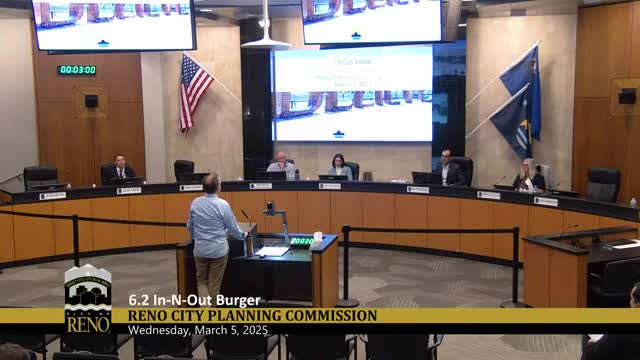
Case LDC25‑00006 (In‑N‑Out Burger) was presented by Jeff Foster, associate planner, and recommended for approval of a conditional use permit to allow operations beyond standard hours, a 42‑foot pole sign adjacent to a major arterial, an Alternative Equivalent Compliance (AEC) for ground‑floor transparency, and a major deviation to exceed the 100,000 lumens per acre site‑lighting standard by less than 50%.
Project summary: The applicant proposes a single‑story, 3,887 sq. ft. In‑N‑Out restaurant with indoor seating for 84 and a covered outdoor patio for about 40 customers on a 2.52‑acre consolidated site. The design shows 67 parking spaces (code requires 25) and a dedicated drive‑thru queue for 34 vehicles (extendable to 42 without blocking parking). The future Starbucks on an adjacent 0.57‑acre parcel was included in the project traffic analysis as a separate entitlement.
Key technical issues: Staff reviewed compatibility with nearby land uses (principal arterials to the north/east, residential about 275 feet to the south across Margrave Drive), the AEC request (north facade transparency will be replaced with architectural treatments), site operations (parking, queuing, employees monitoring the drive‑through), lighting (major deviation requested to exceed 100,000 lumens per acre; applicant reduced lighting concentration to the building’s north side and staff found photo metrics meet code for targeted safety lighting), and traffic mitigation (the traffic study accounted for the Starbucks build‑out; mitigation measures include an eastbound Plum to southbound Kietzke turn improvement and other intersection improvements coordinated with NDOT and RTC).
Public hearing and applicant remarks: Peter Kolmaticki, development manager for In‑N‑Out, summarized company operations, community donations and proposed site details, including a 42‑foot sign and extended hours. Kimley Horn traffic engineer Devin Moore described coordination with NDOT and the recommended slip lane improvement for the eastbound Plum to southbound Kietzke movement to address sight‑distance and safety concerns.
Commission discussion and negotiated conditions: Commissioners questioned queuing, spillover into Margrave Drive, sign illumination, and late‑night deliveries. The applicant and staff described operational measures (employees taking tablet orders at the menu board when the queue reaches a threshold, on‑site procedures to prevent queue spill onto public streets) and agreed to operational restrictions. In response to commissioner concerns, the Planning Commission approved the requested CUP/AEC/major deviation with the following additional conditions (added during the hearing):
- Limit public hours of operation to 1:00 a.m. Sunday–Thursday and 1:30 a.m. Friday–Saturday; no public access outside those hours.
- After those hours, on‑site activities may be limited to deliveries, maintenance, and other internal operations only (no public service).
- Deliveries during after‑hours operations shall approach via Plum→Orange (and/or Kietzke→Orange) and shall not use Margrave Drive except for exigent circumstances.
- The primary 42‑foot pole sign illumination shall be turned off when restaurant operations end (consistent with the after‑hours lighting restriction that limits non‑essential exterior illumination).
Motion and vote: The Planning Commission made findings for the CUP, AEC and major deviation and approved the application subject to staff conditions in the staff report plus the four conditions listed above. The motion was moved and seconded; the chair announced the motion carried.
Why it matters: The approval allows an additional fast‑food restaurant with a substantial dedicated drive‑through queue in a busy corridor, but it includes conditions intended to limit late‑night public activity, direct overnight deliveries away from residential streets, and reduce illumination impacts on nearby housing. The traffic mitigation measures were coordinated with NDOT and RTC and were incorporated as conditions in the staff recommendation.
Ending: The commission approved the entitlements subject to the conditions described; the transcript captures detailed operational commitments by the applicant and staff coordination on traffic mitigation, but final engineering and permit conditions will be verified at the building permit and public‑works review stages.
Project summary: The applicant proposes a single‑story, 3,887 sq. ft. In‑N‑Out restaurant with indoor seating for 84 and a covered outdoor patio for about 40 customers on a 2.52‑acre consolidated site. The design shows 67 parking spaces (code requires 25) and a dedicated drive‑thru queue for 34 vehicles (extendable to 42 without blocking parking). The future Starbucks on an adjacent 0.57‑acre parcel was included in the project traffic analysis as a separate entitlement.
Key technical issues: Staff reviewed compatibility with nearby land uses (principal arterials to the north/east, residential about 275 feet to the south across Margrave Drive), the AEC request (north facade transparency will be replaced with architectural treatments), site operations (parking, queuing, employees monitoring the drive‑through), lighting (major deviation requested to exceed 100,000 lumens per acre; applicant reduced lighting concentration to the building’s north side and staff found photo metrics meet code for targeted safety lighting), and traffic mitigation (the traffic study accounted for the Starbucks build‑out; mitigation measures include an eastbound Plum to southbound Kietzke turn improvement and other intersection improvements coordinated with NDOT and RTC).
Public hearing and applicant remarks: Peter Kolmaticki, development manager for In‑N‑Out, summarized company operations, community donations and proposed site details, including a 42‑foot sign and extended hours. Kimley Horn traffic engineer Devin Moore described coordination with NDOT and the recommended slip lane improvement for the eastbound Plum to southbound Kietzke movement to address sight‑distance and safety concerns.
Commission discussion and negotiated conditions: Commissioners questioned queuing, spillover into Margrave Drive, sign illumination, and late‑night deliveries. The applicant and staff described operational measures (employees taking tablet orders at the menu board when the queue reaches a threshold, on‑site procedures to prevent queue spill onto public streets) and agreed to operational restrictions. In response to commissioner concerns, the Planning Commission approved the requested CUP/AEC/major deviation with the following additional conditions (added during the hearing):
- Limit public hours of operation to 1:00 a.m. Sunday–Thursday and 1:30 a.m. Friday–Saturday; no public access outside those hours.
- After those hours, on‑site activities may be limited to deliveries, maintenance, and other internal operations only (no public service).
- Deliveries during after‑hours operations shall approach via Plum→Orange (and/or Kietzke→Orange) and shall not use Margrave Drive except for exigent circumstances.
- The primary 42‑foot pole sign illumination shall be turned off when restaurant operations end (consistent with the after‑hours lighting restriction that limits non‑essential exterior illumination).
Motion and vote: The Planning Commission made findings for the CUP, AEC and major deviation and approved the application subject to staff conditions in the staff report plus the four conditions listed above. The motion was moved and seconded; the chair announced the motion carried.
Why it matters: The approval allows an additional fast‑food restaurant with a substantial dedicated drive‑through queue in a busy corridor, but it includes conditions intended to limit late‑night public activity, direct overnight deliveries away from residential streets, and reduce illumination impacts on nearby housing. The traffic mitigation measures were coordinated with NDOT and RTC and were incorporated as conditions in the staff recommendation.
Ending: The commission approved the entitlements subject to the conditions described; the transcript captures detailed operational commitments by the applicant and staff coordination on traffic mitigation, but final engineering and permit conditions will be verified at the building permit and public‑works review stages.
Don't Miss a Word: See the Full Meeting!
Go beyond summaries. Unlock every video, transcript, and key insight with a Founder Membership.
✓
Get instant access to full meeting videos
✓
Search and clip any phrase from complete transcripts
✓
Receive AI-powered summaries & custom alerts
✓
Enjoy lifetime, unrestricted access to government data
30-day money-back guarantee
