Get Full Government Meeting Transcripts, Videos, & Alerts Forever!
Get email alerts on the County Budget topic
No spam. Unsubscribe anytime.
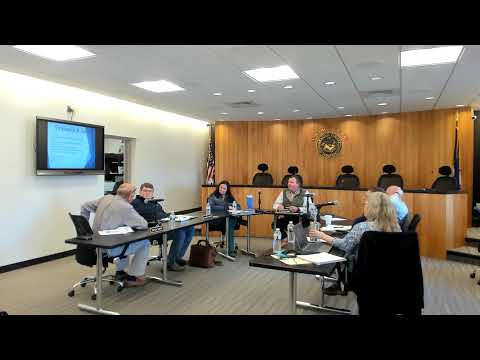
Grayson County budget workshop flags EMS costs, broadband and Baywood School designation as top priorities
Summary
Grayson County officials on Oct. 12 discussed a conservative revenue forecast for fiscal year 2026 and identified emergency medical services funding, completion of Western End broadband and the Baywood School designation as the most urgent budget issues facing the county.
Grayson County officials on Oct. 12 discussed a conservative revenue forecast for fiscal year 2026 and identified emergency medical services funding, completion of Western End broadband and the Baywood School designation as the most urgent budget issues facing the county.
County staff presented estimates showing an expected decline from the county's 2025 revenue estimate of about $29.0 million to a preliminary 2026 estimate near $28.1 million, a reduction the presenter said is budgeted at roughly $436,006. The presentation singled out decreases in new-construction revenue, local taxes and charges for services (including refuse tipping fees) as drivers of the projected drop, while intergovernmental revenue was expected to rise because of participation in a day-reporting program.
The nut graf: The board framed the workshop as the stage to set priorities and trade-offs for the upcoming fiscal year, noting limited one-time funds (including ARPA) and that large, ongoing costs 'particularly a move toward a full, countywide paid EMS model'could require a levy increase unless offset by other reductions or new revenues.
Officials emphasized three immediate priorities. First, 9-1-1 stabilization and completion of broadband work in the Western End remained a top goal. Second, supervisors returned repeatedly to the cost and structure of EMS going forward, with multiple members warning that converting to a fully paid, professional countywide EMS could sharply increase recurring costs and may be unaffordable without tax increases. Third, the board revisited a prior tax-levy designation that had set aside two pennies for the Baywood School project (referred to in materials as the Baywood Technical School) and discussed whether to retain, undesignate or divest the property.
Budget details and constraints presented at the workshop included:
- Revenue estimates: staff recast the county's 2026 revenue estimate at about $28.09 million from a 2025 baseline the presenter said was about $29.00 million (figures read aloud in the meeting were imprecise in places and presented as estimates). The presentation identified about $6.8 million in new construction previously forecast but noted a downward trend in that category at the time of the workshop.
- Specific line items: charge-for-service revenue (notably refuse/tipping fees) was cited as trending down, contributing materially to the charge-of-services decrease the presenter flagged. Bids and forfeitures were also described as significantly down. The presenter noted miscellaneous receipts can be sporadic and pointed to an example: an unbudgeted sale of judicial property that resulted in about $36,000 in cash received after the prior budget was set.
- One-time and restricted funds: ARPA funds were discussed as largely committed and subject to timing rules; staff reported encumbrance deadlines and that spending must be completed by the federal timeline (encumbrance by Dec. 31 and expenditure by June 30 in the staff's description). The county also continues to receive annual amounts from opioid settlement distributions and regional partnerships; staff reported roughly $289,000 annually from opioid settlement-related funds plus smaller regional shares, and noted those monies are restricted to eligible programs such as education and treatment.
- Designated cents on the levy: the presenter reviewed previously designated levy cents: roughly 1¢ designated to broadband (about $190,000 per year), 2¢ to economic development (about $308,000 per year) and 2¢ designated for the Baywood School project. The presenter said the Baywood designation has accumulated money but not at the full projected pace; at the workshop a county figure for the Baywood-designated fund balance was read aloud as approximately $303,250 (presenter's phrasing was unclear and the figure should be treated as an estimate until confirmed in the finance records).
Board members pressed staff on whether the Baywood designation should continue while no active county-led construction project is underway. Staff explained that because the levy cents are recorded as "committed funds" under the county's fund-balance policy, undesignating the funds requires the same board action used to create the designation.
Economic Development Authority (EDA) funding and expectations were also discussed. Supervisors said the EDA should be prepared to demonstrate outcomes (jobs created, measurable tax impact) before being asked to continue—one supervisor explicitly said the board will expect performance metrics if the EDA requests additional county funding.
On EMS, multiple supervisors described the volunteer emergency system as strained and cautioned that immediately converting to a fully professional EMS system would substantially increase recurring costs and could require a levy increase large enough to be politically and fiscally difficult to sustain. Several board members urged seeking creative, phased approaches that preserve volunteer participation and stretch local dollars while developing longer-term options.
Procedural and next-step items: the board set its next budget workshop for April 3 (same time) and directed staff to prepare expenditure detail and to present updates on broadband and EMS planning at subsequent meetings. Board members also agreed to add a closed-session item to an upcoming budget workshop to discuss Baywood School options and any related negotiations.
Why it matters: the workshop put the county on record that EMS and broadband remain the largest recurring and near-term budget pressures. With one-time COVID-era or federal funds waning and several categories of local revenue under pressure, supervisors face a choice among raising taxes, reducing services or shifting responsibilities for specific assets such as Baywood School.
The board did not adopt final budget decisions at the workshop; staff will return with department-level expenditure presentations (supervisors requested heads for schools, sheriff's office and EMS be scheduled) and more detailed forecasts ahead of formal budget adoption.
Ending: The county's next budget workshop is scheduled for April 3; staff will bring updated revenue and expenditure detail and an update on broadband implementation and EMS cost scenarios for further deliberation.