Get Full Government Meeting Transcripts, Videos, & Alerts Forever!
Get email alerts on the Transportation Sales Tax Roads topic
No spam. Unsubscribe anytime.
Charleston County outlines $1 billion in roads work, warns borrowing may be needed as projects ramp up
Summary
Public Works Director Eric Adams told County Council the roads portion of the transportation sales tax has funded more than $1 billion in work and that cash-flow timing may force new borrowing as multiple large projects move into construction.
Eric Adams, Charleston County Public Works Director, briefed County Council at a public meeting on the roads portion of the county's transportation sales tax, saying the program has funded more than $1 billion in projects and that the county may need to borrow to match construction schedules with available revenue.
Adams said the program has delivered 55 miles of sidewalk, 16 miles of multi-use path, 12 miles of bike lane, 46 miles of drainage pipe and about 492,000 tons of asphalt, and that the county has treated just under 880 miles of roadway through its pavement-management program. "If we were to break that down by truck or load of asphalt, that would be about 31,000 trucks," Adams said, illustrating program scale.
The transportation sales tax program is made up of several funding streams, Adams said, including an annual allocation program for bike-and-pedestrian projects, intersection improvements, rural roads and local paving; larger bonded projects that began under an earlier (2004) program; and the 2016 feature projects that require more complex permitting and design. Adams estimated the program represents "over $1,000,000,000 of work" and walked council through category-by-category statistics and upcoming schedules.
Why it matters: Adams emphasized cash-flow management as projects shift from design and permitting into construction. He showed revenue and expenditure timelines, noting the county borrowed three times in the earlier program and has borrowed a total of about $261,000,000 for the sales-tax projects, with roughly $110,000,000 in projected interest costs. "There's a cost to borrow money and bring that money forward," Adams said, and added that improperly timed borrowing increases interest payments and reduces funds available for work.
Adams described the difference between a pay-as-you-go approach and bonded financing, and warned that a large cluster of projects moving to construction in fiscal years around 2026'27 will push expenditures higher and could require borrowing to avoid shortfalls. "You can hopefully see under the graph there where the yellow line and the green line are getting very close in our projection in FY 20 seven-twenty 8. So that means we're projecting we may need to, to borrow at some point," he said.
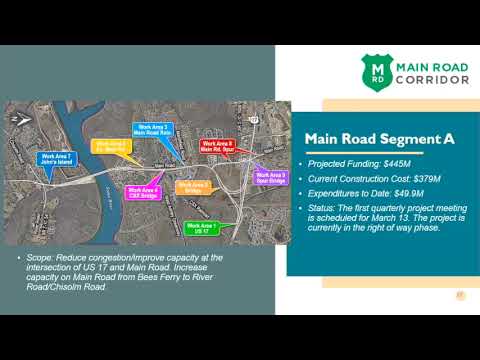
Project highlights and schedules - Glen McConnell Parkway: Completed, reported at about $20.5 million; Adams said construction was "on time and under budget." - Palmetto Commerce Interchange: Under way; Adams described it as a roughly $90 million job and said construction is on time and expected to be complete Feb. 5 of the next calendar year. - Main Road Segment A: Described as the largest infrastructure project undertaken by Charleston County; Adams said the project is under way and that the first quarterly public project meeting is scheduled for March 13 (date given in the presentation). - Airport Connector Road: Being coordinated with South Carolina Department of Transportation (SCDOT) and the Federal Highway Administration as part of the Lowcountry corridor; Adams said a record of decision from Federal Highway Administration is needed before right-of-way acquisition can begin. - James Island intersections: Fort Johnson at (transcript: "Succession Bill") and Camp Road roundabout are being combined and will be bid together after right-of-way work to attract more bidders; Adams noted the county twice received only one bidder on a recent intersection job and that "we're getting 0 bids on some sidewalks" because market conditions and contractor availability have tightened. - Volley Road (bike and ped): Out for bid; bids expected later in the month. - Savannah Highway capacity improvements: Includes three intersections; City of Charleston is leading right-of-way acquisition in one Avondale area intersection; other intersections (Dupont, Stinson and Wappoo) are planned for advertisement this year. - Highway 41: Right-of-way plans under review and being submitted to the U.S. Army Corps of Engineers for environmental permitting. - Highway 78 (Ladson Road/College Park area): Consultant engaged for detailed design focusing on congestion relief. - Dorchester Road corridor: Adams described three phased areas (A, B and C) and said timing may vary depending on coordination with Dorchester County, Joint Base Charleston and other variables; he noted phasing could let Area C tie into Airport Connector Road for earlier benefits. - Palmetto Commerce Parkway Phase 3: Described as one of the most complex projects because of airport clear zones and runway adjacency; Adams said the county meets biweekly with Joint Base Charleston to secure easements and agreements.
Adams also reviewed the program's pavement-management results: two national awards in the past three years and treatment of nearly half the county's roads (excluding county transportation committee work), and previewed near-term delivery expectations, including roughly 40 allocation-program projects valued at about $31 million in the coming year. For bike-and-pedestrian work he said the county expects to advertise 18 projects in 2025 with an anticipated value of about $3.1 million.
Market and delivery challenges Adams outlined steps that lengthen project timelines: federal funding eligibility and matching, environmental permitting and public involvement, design permitting, utility relocations, and right-of-way acquisition. "Construction is often the shortest component to any transportation infrastructure project. It's often the shortest, but it's often it's definitely the most expensive phase of the project," he said, noting bids vary and true costs show up only when bids are returned.
Public outreach procurement Adams said the county is ready to advertise an RFQ for public outreach, education and engagement to help communicate program accomplishments, brand messaging and public involvement. He said the Public Information Office will lead the initiative with Public Works providing data and that procurement and legal review are complete.
The presentation concluded with Adams offering to take questions from council members.