Get Full Government Meeting Transcripts, Videos, & Alerts Forever!
Get email alerts on the Stormwater Funding topic
No spam. Unsubscribe anytime.
Tequesta officials consider using water-utility tax to fund stormwater projects, tie in vulnerability study
Summary
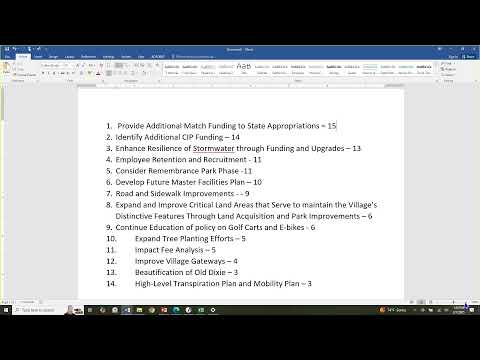
Village staff recommended dedicating part of the water utility tax to stormwater to avoid large one‑time assessment jumps, and councilors agreed to fold the recently completed vulnerability assessment into stormwater planning and grant-seeking.
Village of Tequesta staff on March 7 proposed using a portion of the village’s water utility tax — which is collected into the general fund — as an ongoing funding source for stormwater projects now that the local surtax is scheduled to sunset in 2025.
The recommendation, presented by a staff facilitator, is intended to provide predictable revenue for identified stormwater priorities and reduce the need for sudden, large rate or assessment increases to pay for repairs and projects.
The proposal comes after several years of one-off emergency repairs that have drained the village’s stormwater reserves. Staff told the council the surtax that has been funding many capital projects will stop after December 2025 and that the village currently receives about $600,000–$700,000 a year from that surtax. "We don't want to have huge rate jumps," staff said while explaining the water‑tax transfer as an alternative funding approach. Councilors pressed for details about the legal and accounting differences between enterprise funds and the general fund; staff responded that the water utility tax is collected into the general fund rather than as an enterprise transfer.
Councilors also agreed to formally fold the village’s recently completed vulnerability and resiliency assessment into stormwater priorities. The resiliency study — funded through grants and completed after roughly $140,000–$145,000 in grant work, staff said — identified a range of projects, from low‑cost items such as elevating generators above a flood plane to larger stormwater management improvements. Staff recommended packaging those projects for grant applications once the council prioritizes which items to pursue.
What was discussed - Why: The village’s surtax is expiring at the end of 2025. Staff said the surtax has supplied roughly $600,000–$700,000 per year that has paid for roads, sidewalks and other projects. Staff noted the village shifted some items from the surtax-funded account into the general fund in anticipation of the sunset. - Proposal: Dedicate part of the water utility tax revenue (a municipal tax already placed on water bills and deposited in the general fund) to stormwater projects so the village can pay for a set of prioritized projects without sudden large assessments to households. - Grant strategy: Use the completed vulnerability assessment as the basis to pursue state grants and other outside funding sources for resiliency and stormwater projects. Staff pointed to recent examples in neighboring towns that secured millions from the state after completing resiliency studies. - Numbers discussed: Staff cited $710,000 for roads and $170,000 for sidewalks in recent general fund allocations; the vulnerability assessment was funded with roughly $140,000–$145,000 in grant awards; staff said they had identified “about five” mid‑priority stormwater projects that could be funded with the proposed revenue stream.
What council decided and next steps Councilors signaled support for moving forward with the concept and asked staff to add specific action items and budget language so the council can track the funds and projects during the coming budget process. Staff said they would return with more detailed language tying the vulnerability assessment recommendations to the proposed tax allocation and with a list of specific stormwater projects for prioritization and grant submittal.
Why it matters Without a dedicated funding source, Tequesta faces either continuing to defer critical stormwater work or asking residents for large, sudden rate increases or assessments. The proposed approach aims to spread the cost more predictably and to use the vulnerability assessment to compete for outside grant dollars that could reduce the village’s local share.