Get Full Government Meeting Transcripts, Videos, & Alerts Forever!
Get email alerts on the Zoning Housing topic
No spam. Unsubscribe anytime.
Committee debates UDO amendments on group homes, proposing five-year renewals, inspection language and pre-filing review
Summary
Members discussed a proposed Unified Development Ordinance amendment covering group homes, including shortening special-exception terms from 20 to five years, options for renewal inspection requirements, limits on hearing-officer decision-making, and a new pre-filing meeting and documentation list for planned unit developments (PUDs).
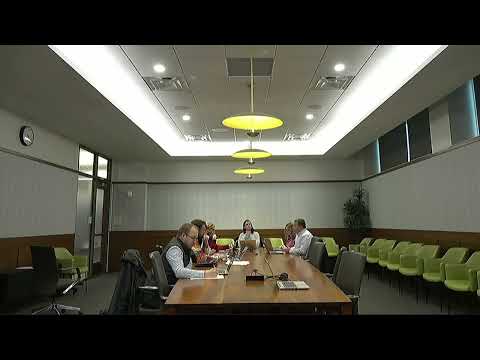
The Carmel Land Use and Special Studies Committee discussed March 5 proposed amendments to the Unified Development Ordinance (UDO) affecting group homes, special exceptions, short-term-rental hearing processes and a new pre-filing review for planned unit developments (PUDs).
Sergei, city attorney and counsel, reviewed legal constraints that shaped the draft language, citing federal Fair Housing Act and Americans with Disabilities Act considerations and HUD guidance. Sergei said those federal laws and court decisions — including reference to a recent case colloquially described as Willow Haven — limit how the city can treat group homes and require tailoring consistent with state and federal protections.
Committee members agreed to shorten the special-exception term for group homes from 20 years to five years for future approvals to provide more frequent review of operations and safety. Members discussed whether renewal should require an inspection; some favored an annual safety inspection, while counsel advised caution because group homes are typically considered residential uses and local rules cannot impose requirements that would not apply to similarly situated residential properties. The committee discussed a renewal process tied to the Board of Zoning Appeals (BZA) and a proposal to require petitioners, as part of renewal, to demonstrate compliance with public-safety plans and to coordinate fire and code-enforcement review.
Members pressed for safeguards on retrofitted two-story homes used as group facilities, citing a local example on Horseshoe where a second-floor retrofit raised questions about structural load, egress and emergency access. The committee recommended the ordinance include a mechanism that would require structural-engineering sign-off on retrofits and an evacuation/safety plan reviewed by the fire marshal for any retrofit that alters occupancy or load. The city attorney said building-code and fire-code classifications will determine which retrofits require specific upgrades such as elevators or alternate egress.
The draft also eliminates hearing-officer authority for special exceptions and, as written, would send those decisions to the BZA; the committee discussed whether to exclude certain low-risk, annual renewals (for example, short-term-rental renewals) from full BZA review to avoid unnecessary workload. Committee members recommended keeping renewals for group homes under BZA review but exempting routine one-year renewals for other categories where appropriate.
The committee debated distance-based limits on the concentration of group homes. Counsel noted that HUD guidance warns against rules that effectively exclude entire neighborhoods and that many municipalities use a 1,000-foot standard; some committee members proposed much larger buffers (one mile or 5,000 feet), and others recommended neighborhood-based approaches instead of a fixed radial buffer.
Members also recommended removing a catch-all clause that would require BZA members to review "all applicable state and federal law," arguing that the burden of legal compliance should rest with petitioners rather than lay BZA members. The committee instructed counsel to revise the draft so the petitioner demonstrates compliance with applicable laws and the BZA assesses compliance with local standards.
Separately, the committee reviewed and generally supported a proposed PUD pre-filing meeting and a short list of materials petitioners would submit to city counsel before formal applications. The proposed list includes a written summary of the PUD, a preliminary concept plan, a vicinity map, a description of proposed uses (acreage and percentage allocation), building-type and architecture summaries, open-space and amenities descriptions, and character renderings. The intent is to reduce wasted engineering expense and give council members nonbinding feedback earlier in the process; the draft language emphasizes that pre-filing comments are advisory and commitments are finalized only at the later ordinance or rezoning stage.
No formal votes were recorded. Committee members asked counsel to revise the draft UDO language to: change the special-exception renewal term to five years; clarify renewal and inspection procedures while respecting federal/state law; shift legal-compliance burden to petitioners; refine the BZA/hearing-officer pathway for renewals; and detail the pre-filing documentation list. The committee scheduled further discussion at a subsequent meeting.