Get Full Government Meeting Transcripts, Videos, & Alerts Forever!
Get email alerts on the Zoning Fences topic
No spam. Unsubscribe anytime.
Glendale planning commission recommends tighter front-yard fence rules to common council
Summary
The Planning and Architecture Review Commission voted to send a zoning text amendment on front-yard fencing and permissible front-yard uses to the Common Council after a staff presentation, commissioner questions and one public comment about a recent neighbor-installed fence.
The Planning and Architecture Review Commission of the City of Glendale voted to recommend a zoning text amendment that would tighten front-yard fence standards and change when fence permits are required.
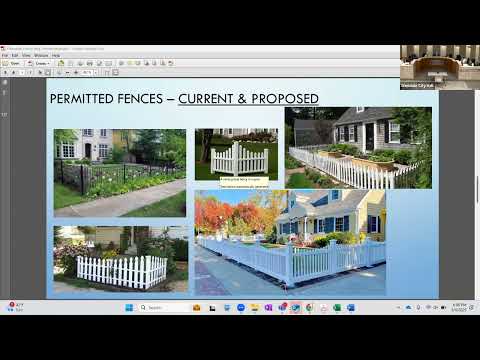
Staff member Meredith summarized the changes, saying the amendment clarifies design standards for residential and nonresidential fences, refines the municipal definition of a fence, establishes a 5-foot maximum setback from the property line for front-yard fences and would require a permit for certain shorter fences that run long distances. "The staff recommends that the Planning and Architectural Review Commission recommend the proposed text amendment to the common council for approval," Meredith said.
The amendment keeps current height distinctions — three feet maximum in front yards and six feet in side/rear yards — but adjusts permit thresholds. Under current practice, staff said, a permit is sought for fences three feet or taller; the proposed text would additionally require a permit for fences three feet or shorter if they extend more than 20 linear feet. The proposal would also require that front-yard fences, if installed, enclose the full front yard rather than creating a small fenced "island" inside the yard; staff said the rule is intended to prevent small, partial enclosures such as isolated dog runs or temporary rabbit-fencing around vegetable plots. The draft also lists prohibited materials for front-yard fences including snow fences, chain link, barbed wire, bamboo and fully opaque panels, and it asks that front-yard fence designs preserve some transparency ("slots between" pickets) so the yard is at least partially visible from the street.
Commissioner Seligman asked why bamboo was singled out. Meredith said bamboo and other nonfinished materials are commonly listed in front-yard standards because they often form fully opaque installations and do not meet the desired front-yard aesthetic and safety standards. Seligman and other commissioners pressed for clarity that the rule would not ban gardens; Meredith responded that the amendment regulates fences, not uses, and that a property owner may place a garden in a front yard but could not surround just a garden with a small temporary fence without fencing the entire frontage if the owner wants a fence.
One resident, Judy Geiger of 926 West Bender Road, testified during the public hearing that a neighbor had recently installed a fence that she said left some of her windows obstructed. Geiger said city staff initially told her approval by the adjacent owner was required and later informed her the neighbor could proceed without her consent; she said the new draft ordinance would have required a three-foot front-yard limit in the affected area. "I would strongly suggest there be revision of where a neighbor's fence encroaches upon a prior owner's windows," Geiger said.
Commissioners discussed whether the draft should explicitly require gates or explicit emergency access language; Meredith said the current draft does not include gate-specific language but staff could consider adding language to ensure fences do not block access to the home. Commissioners also noted that the draft reorganizes prior text to separate residential and nonresidential standards and clarifies windbreak and fence definitions.
After the discussion, Commissioner Story moved to refer the draft zoning text amendment to the Common Council with a recommendation to approve; Commissioner Cone seconded. The motion carried with the Commission voting in favor; staff noted one resident spoke at the public hearing and that the amendment had previously been discussed at a City Council informational session.
The amendment will go to the Common Council for final action; staff recommended the referral and the commission closed the public hearing after receiving the resident comment.