Get Full Government Meeting Transcripts, Videos, & Alerts Forever!
Get email alerts on the Sunset Review Committee topic
No spam. Unsubscribe anytime.
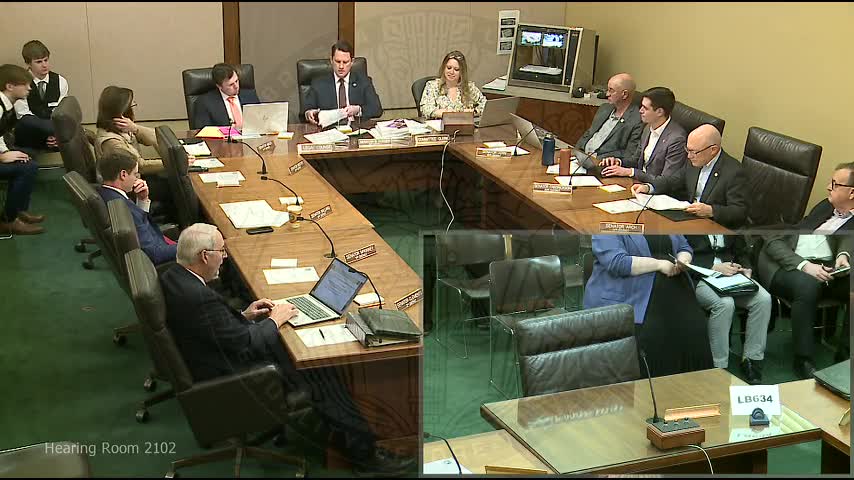
Senators hear bill to replace Legislative Planning Committee with Sunset Review Committee
Summary
Sen. Ben Hansen introduced LB 634 to create a Legislative Sunset Review Committee that would review boards, commissions, funds and programs on a regular schedule; proponents cited efficiency and accountability while agencies warned of duplicated workload and the need to align with existing review statutes.
Senator Ben Hansen, chair of the Executive Board, introduced LB 634 at an Executive Board hearing to replace the Legislative Planning Committee with a Legislative Sunset Review Committee that would review boards, councils, commissions, funds and programs created by the Legislature.
The bill would require each reviewable entity to submit a report with three years of performance data, budget usage, statutory authority, program outcomes and identified overlaps. Beginning in 2026 the Sunset Review Committee would establish a schedule so that entities are reviewed every five years; reports could prompt recommendations to continue, reorganize or sunset an entity. Reports would be examined by the State Auditor and the Appropriations Committee, and the committee would present findings and proposed legislation to the Speaker by Dec. 15 of the review year.
Hansen told the committee he drafted the measure to strengthen accountability and efficiency: "I see this as an opportunity for us to do our job above and beyond, representing our constituents with excellence by valuing taxpayer dollars and limiting legislation that manipulates indispensable resources." He said the bill intentionally excludes agencies, rules or regulations that would cross into another branch of government.
Committee members questioned logistics and workload. Several senators asked how the committee would handle an estimated 1,000 reviewable entities (Hansen estimated about 200 reports per year under the five-year schedule). Members discussed options including meeting during the interim, increasing report thoroughness to shorten hearings, or extending the review interval to seven years if necessary. Hansen acknowledged the schedule could be adjusted: "If it becomes too much of a burden, that could be the option to maybe extend it to 9, every 7 years instead of 5."
Nicole Barrett, director of Legislative Services at the Department of Health and Human Services, testified in support of the concept but warned of duplicative obligations. She told the committee the bill overlaps with existing statutory review duties under Nebraska Revised Statute Section 50-1302 and the Occupational Board Reform Act (OBRA), and asked to be consulted on developing performance measures and report questions. Barrett said the agency provided dozens of board and OBRA surveys in 2024 and that compiling that information consumed substantial staff time: "The compilation and review of these survey answers conservatively took an average of 4 hours each to complete, which is the equivalent of 1 FTE working solely on the surveys for 10 consecutive weeks."
John Gage, state director for Americans for Prosperity, urged adoption and cited out-of-state examples of sunset reviews producing savings and reorganizations.
Senators and witnesses discussed how the Sunset Review Committee would interact with standing committees. Hansen said section language envisions the Sunset Review Committee recommending actions to the standing committee with subject-matter jurisdiction and that standing committees could still review or comment on recommendations; the Sunset Review Committee would make determinations about recommended changes to entities. The committee also discussed that any substantive changes recommended by the Sunset Review Committee would still require introduction as legislation and a full vote of the Legislature.
No formal committee vote was recorded at the hearing; members took testimony from proponents and asked questions about scope and logistics. Senator Hansen closed the LB 634 portion of the hearing and the board proceeded to consider the next bill on the agenda.