Get Full Government Meeting Transcripts, Videos, & Alerts Forever!
Get email alerts on the School Property Tax Relief topic
No spam. Unsubscribe anytime.
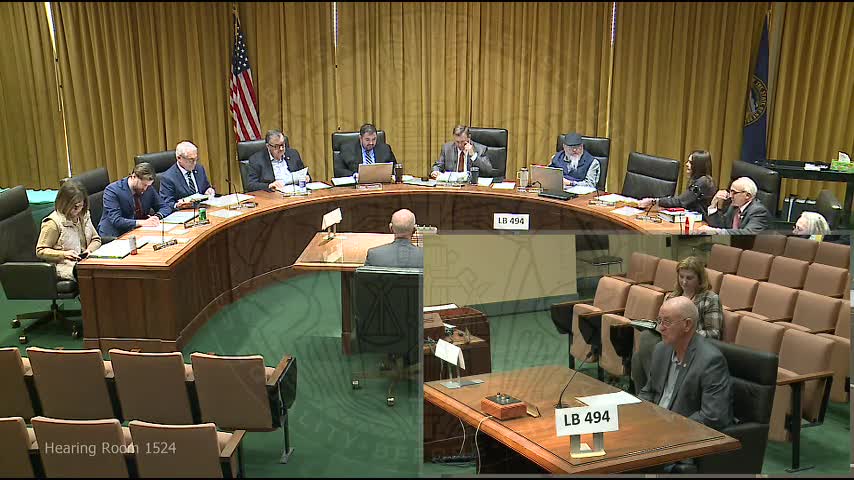
Sen. Myron Dorn introduces LB494 to clarify calculation for school property tax credit transfers
Summary
A Revenue Committee hearing on LB494 focused on technical changes to how excess general fund growth is calculated and carried into the school property tax relief fund, aiming to prevent one‑time or timing-driven revenues from creating ongoing transfer obligations.
Senator Myron Dorn introduced LB494 at a hearing of the Nebraska Legislature’s Revenue Committee to clarify how the state calculates transfers to the school district property tax relief credit fund and to prevent one‑time or timing‑driven revenues from becoming part of the permanent base.
The bill matters because language adopted in last year’s special session (LB34) sets statutory transfer amounts through fiscal year 2029–30 and then directs the base to grow thereafter; proponents said that without precise rules, spikes in revenue—such as federal ARPA money or the timing of pass‑through entity tax (PTET) payments—could improperly inflate later base calculations and strain the general fund and cash reserves.
Senator Myron Dorn, who represents District 30 and introduced LB494, told the committee the bill “does not change any growth in revenue above 3% that will go to the tier 2 school property tax relief fund. It doesn't change any of that.” Dorn said Section 1 clarifies how “actual” receipts and certified forecasts are aligned for automatic transfers, and Section 2 prevents a one‑time excess transfer from becoming a permanent addition to the statutory base after the 2029–30 period listed in LB34.
Dorn used recent experience to illustrate the issue: when revenue spiked in fiscal years that included ARPA money, the certified forecast and actual receipts did not line up in a way that reflected policy intent. He also pointed to the timing of PTET payments, which are sometimes remitted in December and returned on later personal returns; that timing can make revenue appear higher in one fiscal year and lower in the next, creating a misleading picture if the law treats the one‑time timing effect as ongoing growth.
Tom Briese, former senator and a neutral testifier, said the bill’s language “limits the amount of excess growth” by tying transfers to the amount by which actual receipts exceed estimates, and described the change as a technical clarification intended to protect future budgets while preserving the policy that growth above 3% be used for school property tax relief.
Hunter Trainor, testifying for the Nebraska Chamber of Commerce and industry chambers in Omaha and Lincoln, described LB494 as “necessary technical fixes” that prevent what he called “budgeting hallucinations” and congratulated the bill sponsor and Legislative Fiscal Office for drafting language to avoid unintended consequences.
Committee members asked for clarification about whether the bill simply replaces the word “net” with “actual” in the statute and pressed staff and the sponsor on how certified forecasts and later recertifications are used in the calculation. Dorn and other witnesses said the bill preserves the core policy that excess revenue above the 3% threshold is allocated to the school property tax credit fund while creating sharper rules for how one‑time or timing‑driven receipts are treated when establishing future bases.
The hearing record shows proponents and neutral witnesses from the fiscal office and interested parties; no committee vote was taken at the hearing. The introducer and fiscal staff said the bill responds to technical questions the Legislative Fiscal Office raised after implementation of LB34.