Get Full Government Meeting Transcripts, Videos, & Alerts Forever!
Get email alerts on the Short Term Rentals topic
No spam. Unsubscribe anytime.
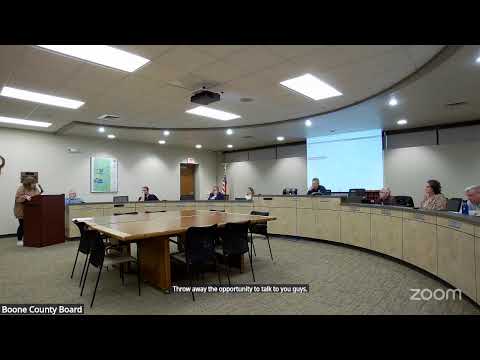
Boone County committee rejects zoning text to permit short‑term rentals subject to licensing
Summary
The Boone County Administration Committee on March 6 debated a zoning text amendment, TA‑03‑2025, that would have allowed short‑term vacation rentals in A‑1 agricultural zoning if property owners obtained a county license; after extended debate the committee voted down the text amendment, though staff will prepare licensing language and the full county board will consider the change at its next meeting.
The Boone County Administration Committee on March 6 debated a proposed zoning text amendment, TA‑03‑2025, that would have added short‑term (vacation) rentals as a permitted use in A‑1 agricultural zoning subject to a county licensing program; after extended public comment and board discussion the committee voted to reject the text amendment and the measure failed at the committee level, though the matter will still be considered by the full county board.
The proposal began under review after a referral from the Zoning Board of Appeals, which had recommended allowing the use via a special‑use permit. Committee chair Carl Johnson moved to amend that approach and treat short‑term rentals through an administrative license rather than a special use; the committee approved that procedural change earlier in the discussion. Staff then presented a draft licensing framework to apply if the board adopted the zoning change.
Why it matters: The amendment would have created a county‑level pathway for homeowners or property owners to offer rentals for stays of less than 30 days in unincorporated Boone County. Supporters said a licensing approach would give the county a regulatory tool to require safety inspections, septic capacity checks and occupancy limits; opponents warned it could encourage property purchases for rental use, reduce long‑term housing availability and create enforcement burdens for county departments.
Public comment illustrated the divide. Christine Jarvik of Shaw Road, speaking during public comment, said she opposed TA‑03‑2025 and told the committee she had submitted materials to the zoning board demonstrating resident opposition and arguing that vacation rentals had raised home prices and caused disruptive behavior near her property. Jarvik said, “I am here to comment on my opposition to text amendment 03‑2025,” and asked the board to “please consider first the residents of Boone County before changing the table of permitted uses.”
The applicant, Jared Winkelman, addressed the committee after discussion and said he bought the property as a private rural residence, not as an investment, and described how short‑term rentals had helped him cover costs. He told the panel his operation had roughly 40 bookings since 2023 and that, after an early problematic booking, he changed practices (for example, requiring direct messaging and deposit language) to reduce risks. “We were not aware that we weren't allowed to do short‑term rentals at the time,” Winkelman said, adding that he’s willing to comply with county rules.
Staff presentation and draft terms: Development staff and the health department described a licensing draft that would have required: a defined occupancy limit (the draft used “two persons per bedroom plus two additional persons per building, not to exceed a maximum of 16” as an example), verification that the on‑site septic system can support the intended occupancy, a prohibition on parking in public rights‑of‑way, a required initial inspection and an annual renewal inspection, and an administrative process that would allow suspension or revocation of a license if conditions were violated. Staff said the zoning text amendment itself would only insert a definition and allow the use in A‑1; the detailed licensing ordinance would be placed in the county code and developed separately.
Board debate: Commissioners voiced competing priorities. Supporters of a licensing approach — including Chairman Carl Johnson and others — argued a license would give the county quicker enforcement options than a special‑use process and allow staff to require safety, septic and occupancy safeguards. Opponents — including several committee members — said the proposal raised too many unanswered questions about inspection capacity, enforcement costs, tax collection, effects on housing stock, and potential public‑safety impacts (for example, where large gatherings could stress emergency services). Several board members urged more time for staff to refine fees, inspection responsibilities, enforcement penalties and license caps.
During the meeting a variety of additional options were discussed, including: a temporary numeric cap on the number of licenses (Chairman Johnson proposed an initial cap of 10, later withdrawn so staff could draft fee/licensing language), limiting licenses by parcel size, requiring stricter documentation for health and septic capacity, and using the county code to allow flexible adjustment (for example, to change a numerical cap without another zoning text amendment).
Final action and next steps: The committee voted on the zoning text amendment as drafted (to permit short‑term rentals in A‑1 subject to licensing and excluding platted subdivisions). The motion failed on roll call at the administration committee. The committee chair said the item will nonetheless proceed to the full Boone County Board for consideration at the next county‑board meeting; staff also will prepare draft licensing language and fee options for further review if the full board moves the amendment forward.
What was not decided: The committee did not adopt any license fees, a license cap, or a final inspection/appeal procedure at this meeting. Committee members repeatedly clarified that if the zoning change were approved, no licenses would be issued until a county code ordinance establishing the licensing program and inspection process was adopted.
Votes at a glance (committee level): - Motion to amend the approach from a ZBA special use to an administrative licensing framework — approved by committee earlier in the meeting (procedural amendment carried). - Motion to approve TA‑03‑2025 as drafted (permit short‑term vacation rentals in A‑1, subject to county licensing; exclude platted subdivisions) — failed at committee (roll‑call recorded in transcript; outcome: failed). The matter will be on the full county‑board agenda for final action.
Context and reaction: Developers and county staff said the licensing route would make enforcement faster and allow staff to revoke privileges for repeat violations. Residents who spoke opposed the change on neighborhood‑impact and housing‑supply grounds. Multiple committee members said they wanted detailed written licensing language (including fee structure, inspection schedule, enforcement penalties and staffing costs) before approving permit language at the zoning level.
Next steps: Staff and the county state's attorney were asked to refine a draft county‑code licensing ordinance (initial and annual fees, inspection and appeal procedures, enforcement penalties and a proposal for whether to cap licenses initially). The zoning text amendment will appear on the full Boone County Board meeting agenda for a final vote in two weeks, where the board as a whole will decide whether to adopt the text change that would allow staff to proceed with a licensing ordinance.