Get Full Government Meeting Transcripts, Videos, & Alerts Forever!
Get email alerts on the Civil Rights Enforcement topic
No spam. Unsubscribe anytime.
Nebraska Equal Opportunity Commission warns diminishing federal reimbursements threaten case processing capacity
Summary
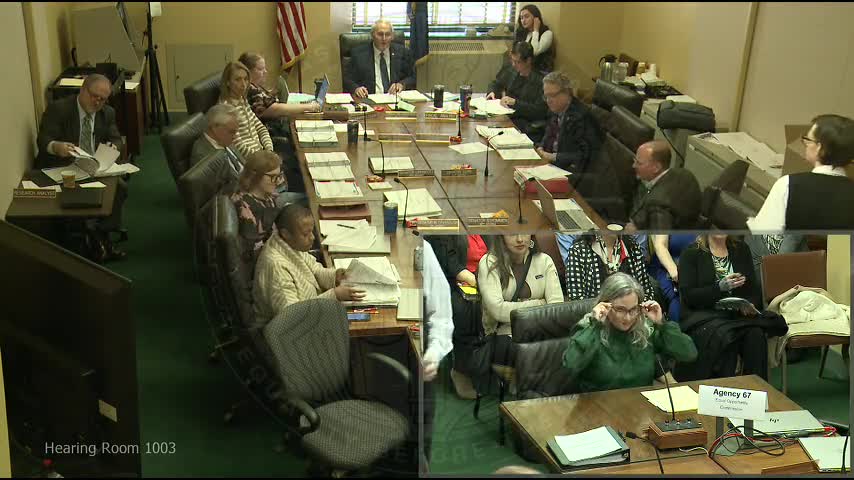
Paula Gardner, executive director, told the Appropriations Committee the commission's caseload and public contacts have risen sharply while federal reimbursements from EEOC and HUD have declined or changed, and the agency requests modest additional general fund support to cover higher insurance costs.
Paula Gardner, executive director of the Nebraska Equal Opportunity Commission, told the Appropriations Committee the agency has seen marked increases in filings, intake and outreach over the past year but faces uncertainty in federal reimbursements that supplement state funding.
Gardner said the commission's investigators handled 1,076 new charges last year, a 31% increase from the prior year, completed 896 complex investigations (a 26% increase) and conducted 1,580 intake appointments. She said outreach and education activities reached roughly 200,000 Nebraskans in the last fiscal year.
Gardner emphasized that the commission relies on federal work-share agreements with the U.S. Equal Employment Opportunity Commission and the U.S. Department of Housing and Urban Development to receive supplemental payments for cases processed under both state and federal law. She said the federal payments are not tied to the agency's actual cost and have diminished, particularly HUD reimbursements, and that the commission currently has no outstanding federal contract receipts from recently completed contracts.
Because of increasing insurance costs and the unpredictability of federal receipts, Gardner asked for an additional $9,154 in general funds for fiscal year 2026 and $10,886 for fiscal year 2027 to cover operating cost increases. She said the agency works "to be good stewards of state dollars" and returns unspent funds to the general fund.
Gardner described how federal guidance and litigation can affect investigations: she referenced the Supreme Court's Bostock decision concerning Title VII and explained HUD's guidance on housing complaints has differed from prior practice about whether to evaluate housing claims using Title VII precedent.
Committee members asked about the federal funding outlook and agency staffing. Gardner said the commission operates "very lean" with 18 investigators across offices in Lincoln, Omaha and Scottsbluff and that staff turnover and training time reduce investigation capacity. No committee vote or formal action was recorded at the hearing.