Get Full Government Meeting Transcripts, Videos, & Alerts Forever!
Get email alerts on the School Board Elections Partisan topic
No spam. Unsubscribe anytime.
Legislative hearing on SB 287 examines move to partisan school board elections and pay change
Summary
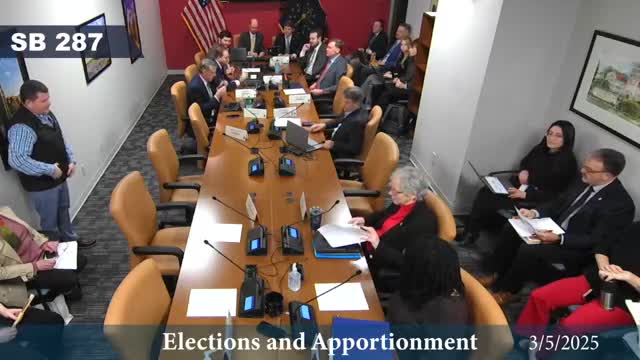
A state legislative committee heard testimony on Senate Bill 287 at a committee hearing on the bill that would require school board candidates to run with party designations, move districts into a primary and general election process, and allow school board salaries to increase to no more than 10% of the lowest-paid teacher in a district.
A state legislative committee heard testimony on Senate Bill 287 at a committee hearing on the bill that would require school board candidates to run with party designations, move districts into a primary and general election process, and allow school board salaries to increase to no more than 10% of the lowest-paid teacher in a district.
The bill’s sponsors and supporters said the changes would increase transparency and voter turnout. Senator Byrne, the bill’s author, said school boards “are 1 of the most important elected offices in our state.” Representative Prescott, who introduced the bill as the House sponsor, described the proposal as one that “simply moves school board elections into the exact same elections process as every other elected official.” The measure would also change the compensation structure for board members, replacing the longstanding flat $2,000 stipend with a cap tied to the district’s lowest teacher salary.
Supporters cited examples and research. Dr. Juanita Albright, president of the Hamilton Southeastern School Board, said school board elections are already political in practice and that a party label would help voters who often lack reliable information about candidates: “What is more transparent than declaring your political party?” Several witnesses also cited a study and comparisons to North Carolina, saying partisan school board contests there were followed by higher turnout in some districts.
Opponents, including many current school board members and statewide civic groups, argued the bill would inject partisan conflict into local boardrooms and discourage qualified candidates. Terry Spradlin, executive director of the Indiana School Boards Association, told the committee the ISBA opposes SB 287 and said most local boards work to build consensus around students’ needs rather than party platforms. Multiple local board members and civic organizations — including Common Cause Indiana, the League of Women Voters of Indiana and the Indiana Coalition for Public Education — urged rejection, saying partisan labels would not reliably convey competence and would invite outside money and national partisan influence.
Federal and state legal constraints were a recurring concern. Witnesses and committee members discussed the federal Hatch Act and the Indiana Code of Judicial Conduct. Several speakers warned that declaring party affiliation on the ballot or seeking party resources could trigger Hatch Act restrictions for some federal employees, and that Rule 4.6 of the Indiana Code of Judicial Conduct can bar judicial-branch employees from running in partisan contests. During testimony, ISBA general counsel Lisa Townsend and others reported guidance from the U.S. Office of Special Counsel indicating that a nonpartisan race can become partisan if candidates seek endorsements or party resources; the committee also heard that OSC has issued a January 9, 2024 advisory opinion addressing when nonpartisan elections may be treated as partisan for Hatch Act purposes.
Committee members asked about practical effects the bill would have on at-large seats, multi-county districts and replacement procedures in ties; sponsors said the bill is intended to apply the same election rules used for other local offices. Lawmakers also queried how primary ballots, county lines that cross districts, and party central committee processes would operate under the change. Several witnesses and legislators warned of unintended consequences, such as discouraging service by career public servants, veterans and others who could be disqualified under federal or state rules.
A large number of public witnesses testified on both sides. Proponents described cases of outside groups spending heavily in school board races and argued party labels would provide a simple heuristic for voters and promote turnout. Opponents described volunteer public servants who would be deterred from running, cited research they said links partisan contests to negative personnel outcomes in some jurisdictions, and proposed alternative transparency steps (for example, required candidate information links on district websites).
No formal committee vote or final action on SB 287 is recorded in the hearing transcript. The committee took testimony from dozens of witnesses and the chair closed the hearing after the sponsor’s closing remarks.
The bill remains under committee consideration; supporters asked the committee to advance it and opponents urged rejection or further study of legal and operational consequences.