Get Full Government Meeting Transcripts, Videos, & Alerts Forever!
Get email alerts on the Ethics Procurement Agile Analytics topic
No spam. Unsubscribe anytime.
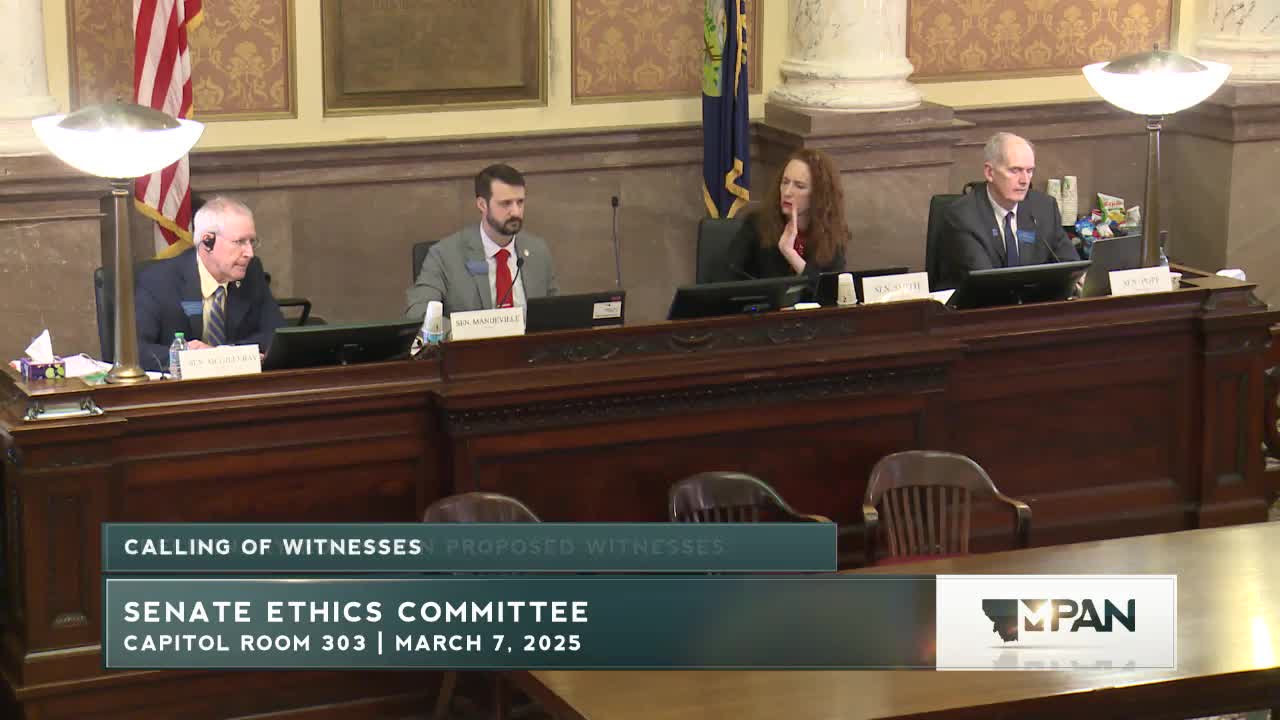
Montana Senate ethics panel examines emergency contracts, hears testimony on Agile Analytics deal
Summary
The Montana Senate Ethics Committee on the morning it convened for an adjudicative hearing continued fact‑finding into a contract that former Senate President Jason Ellsworth signed with Agile Analytics, hearing testimony that the president’s office sent two signed contracts and invoices late in December and that the Legislative Services Division and the Department of Administration later reworked the agreement and did not pay the original invoices.
The Montana Senate Ethics Committee on the morning it convened for an adjudicative hearing continued fact‑finding into a contract that former Senate President Jason Ellsworth signed with Agile Analytics, hearing testimony that the president’s office sent two signed contracts and invoices late in December and that the Legislative Services Division and the Department of Administration later reworked the agreement and did not pay the original invoices.
The committee chairman overruled a string of procedural objections to evidence and procedure and denied a request to extend filing time, then took up witness lists and exhibits before calling two witnesses who described how the contract was handled. The hearing focused on whether the procurement was properly processed, whether a sole‑source or exigency justification applied, and whether any disclosure or private‑interest rules were implicated.
Why it matters: the contract was funded from a time‑limited interagency allotment that, testimony showed, was set to expire Dec. 31, 2024. Committee members and counsel said that timing, the governance of procurement delegation authority, and the absence of typical contract safeguards are central to whether the expenditure and the process met legal and ethical standards.
Angie Carter, the Legislative Branch financial director, testified she received two signed agreements and accompanying invoices on Dec. 27, 2024, after a text and voicemail from then‑President Ellsworth. She told the committee the invoices were marked “due on receipt” and together listed $170,100; she said the documents lacked customary payment schedule language and other terms she would expect. "I was the only person in the office that day," Carter said, describing the post‑holiday timing. She told the committee she raised concerns and that the Legislative Services Division did not pay on the submitted invoices. Carter testified the contracts and invoices prompted consultation with Legislative Services legal staff and outreach to the Department of Administration for procurement guidance.
Jarrett Coles, deputy legal director for the Legislative Services Division, described preparing a Department of Administration sole‑source justification and then turning the matter over to DOA because the amount exceeded the division’s $100,000 delegation threshold. Coles testified he spoke with Ellsworth to gather the factual basis for a sole‑source claim, then transmitted the justification to DOA; he said DOA later returned a letter showing it had reviewed the request. "They most definitely received it because I received a letter back with my name on it saying that the committee had met and approved the sole source justification," Coles said. He also explained the legal distinction between sole‑source and exigency procurement and said the DOA would ultimately be the appropriate office to decide those exceptions.
Committee members and counsel reviewed the two initial signed documents (dated Dec. 26, 2024) labeled in the record as separate proposals (described at hearing as “contract A” and “contract B”), the invoices marked due on receipt, and a later invoice dated in January for $7,087.50. Carter testified the January invoice was attached to a later, retooled contract and that, to her knowledge, no money was ever paid on the earlier invoices: "There was no money ever paid," she said.
The committee made several procedural rulings: it overruled challenges to its evidence rules and admissibility process, denied a respondent’s request for a deadline extension, acknowledged respondents’ reservation of rights to amend disclosures, and reserved final admissibility rulings on exhibits until the close of testimony and deliberations. On witness lists, after discussion the panel voted to call several witnesses suggested by respondents, including Angus McKeever (legislative auditor), Kenneth Barnes (audit counsel), Rhonda Knudson (complainant), President Matt Regier, and Todd Everts; other proposed witnesses were excluded as not clearly relevant to the contract‑specific fact finding or because testimony was duplicative.
The committee repeatedly emphasized the limited scope for this phase of the inquiry. Chairman Mandeville said the panel’s fact‑finding was “limited to . . . the Agile Analytics contract” and that testimony and exhibits should be focused on the facts needed to determine findings. Counsel and members also discussed the interplay of the delegation agreement, Administrative Rules of Montana provisions related to exigency, and relevant statutory conflict‑of‑interest rules (Mont. Code Ann. 2‑2‑112), noting that the committee would not finally determine admissibility of many exhibits until deliberations.
The hearing recessed planning to continue on the next scheduled date; committee staff and counsel agreed to review outstanding subpoena and exhibit requests and to circulate proposed subpoenas and exhibit lists to members for prompt consideration. The committee will resume witness testimony and evidence rulings at the scheduled continuation.
What’s next: the panel will reconvene to continue testimony from DOA and other witnesses and to make final admissibility and evidentiary rulings, then take findings and any recommended actions to the full Senate as required by Senate rules.