Get Full Government Meeting Transcripts, Videos, & Alerts Forever!
Get email alerts on the Pipeline Safety Penalties topic
No spam. Unsubscribe anytime.
Committee clears IURC agency bill that raises pipeline‑safety penalty caps to federal levels
Summary
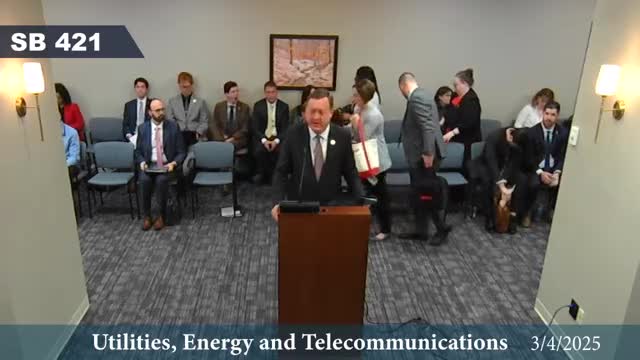
Senate Bill 421, the IURC agency bill, was heard and reported out by the House Utilities Committee. The measure updates notice rules, repeals an unused program chapter and — chiefly — raises state pipeline‑safety civil penalty maximums to conform with federal caps after the federal government assumed enforcement January 1.
Senate Bill 421, the Indiana Utility Regulatory Commission’s agency bill, advanced from the House Utilities, Energy and Telecommunications Committee after a staff presentation and stakeholder testimony. The measure contains several housekeeping provisions and a substantive change to pipeline safety enforcement: it raises state civil-penalty maximums for pipeline safety violations so the state law conforms with federal maximums.
Luke Wilson of the IURC summarized the bill’s main provisions, saying it adds a definition of court reporter that conforms with Indiana court rules, clarifies publication of notice on newspapers’ websites for publications that print fewer than three times weekly, repeals an unused program chapter and raises pipeline‑safety penalties to match federal maximums. Wilson told the committee the federal government notified the state over the summer that the federal Pipeline and Hazardous Materials Safety Administration (PHMSA) would assume enforcement if the state did not raise its penalties; federal enforcement took effect Jan. 1.
Those changes affect how penalties are assessed and who receives penalty funds. Under discussion, witnesses noted the current statutory maximums are $25,000 per violation and $1,000,000 for a series of violations; the bill would raise those maximums to $200,000 per violation and $2,000,000 for a series of violations, figures Wilson said are already in effect because PHMSA is enforcing federal penalties for Indiana projects.
Representative Matt Pierce asked whether overlapping state and federal enforcement risked double penalties; Wilson explained the bill is intended to restore the state’s primacy of enforcement for the covered provisions so that the IURC can resume full oversight and civil penalty assessment where appropriate. Wilson also provided historical counts of pipeline cases and penalties: he reported seven cases in the last year, six in 2023 and an average penalty amount levied of about $1,500,000 for those matters, and said prior penalty proceeds had gone to the state general fund.
Stakeholders speaking in support included the American Petroleum Institute (Maureen Ferguson), which said the bill clarifies regulator-regulated relationships and strengthens enforcement tools. Kerwin Olson of the Citizens Action Coalition said CAC was neutral in the Senate but had concluded the higher penalties for significant violations are appropriate; Hunter Jones and Conservatives for a Clean Energy Future supported IURC improvements and suggested an unrelated amendment on RTO vote transparency (the chair declined to accept the offered amendment at the hearing).
Committee action: Sponsor Senator Cook moved the bill; the committee recorded a roll-call vote of 12-0 to report the bill out. The same committee members who voted on SB 422 recorded affirmative votes on SB 421. The committee noted the increased maximum penalty levels were already effectively in force because of federal enforcement, and the bill would allow the state to continue enforcement and keep penalty proceeds in state control if the state resumed primacy.
What the bill does not do: The bill does not itself create an immediate new fee or appropriation; it aligns state statute with federal penalty levels and updates administrative provisions. The committee discussed whether penalty proceeds should remain dedicated to pipeline safety administration or revert to the general fund; that point was part of committee questioning but the bill advanced.
Next steps: The committee reported the bill with a do‑pass recommendation; members indicated possible future clarifications but moved the measure forward.