Get Full Government Meeting Transcripts, Videos, & Alerts Forever!
Get email alerts on the Education topic
No spam. Unsubscribe anytime.
Lawmakers press administration on special‑education circuit breaker costs and transportation reimbursements
Summary
Committee members told administration witnesses that special‑education costs and inaccurate projections have strained district budgets; administration said FY 2026 funds would raise transportation reimbursement toward the Student Opportunity Act intent and directed local questions to the Department of Elementary and Secondary Education.
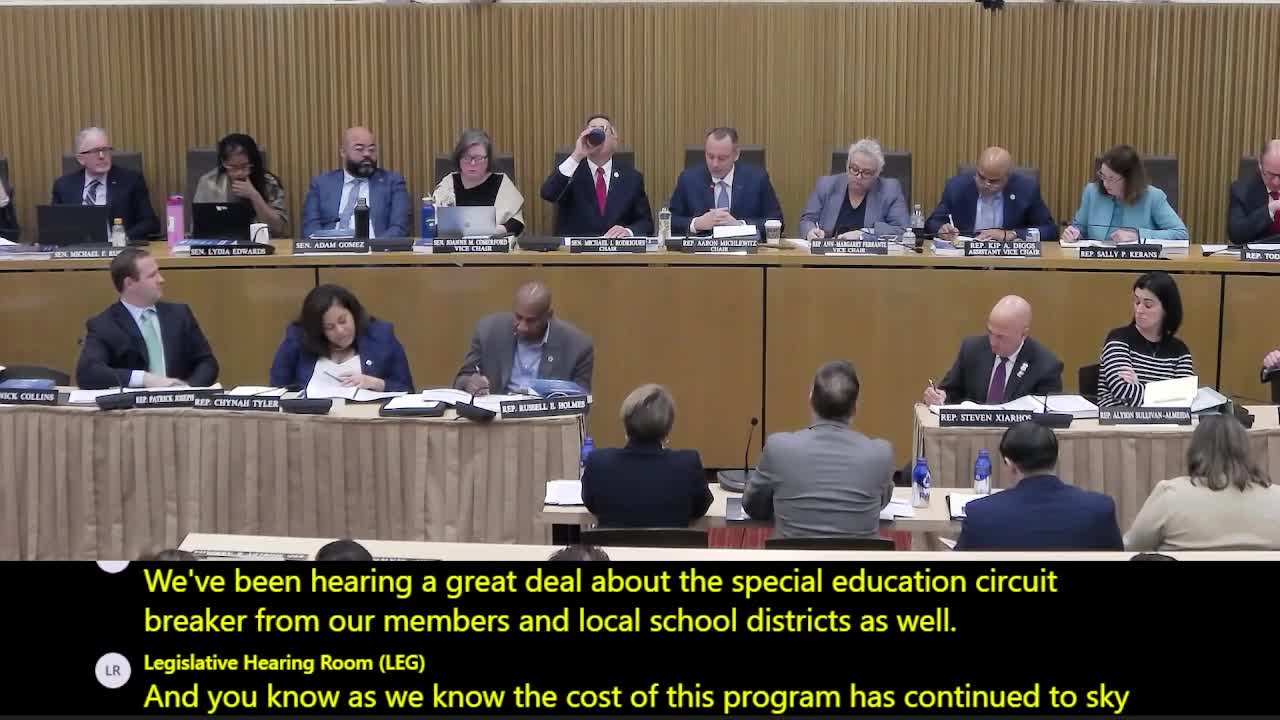
Members of the House side of the Joint Committee on Ways and Means pressed administration witnesses on March 5 about rapid growth in special‑education (SPED) costs and the adequacy of state reimbursements.
Representative Ferrante and others said districts and municipal leaders have told them that the ‘circuit breaker’ for high-cost special education placements has grown faster than DESE estimates and that transportation-related reimbursements are a major driver of the increase.
The administration said House 1 includes about $189 million to increase SPED support in FY 2026 and that the proposal achieves roughly a 75% reimbursement target for SPED transportation — a goal identified in the Student Opportunity Act’s legislative intent. “That was really our goal … to reach the 75% transportation reimbursement,” Secretary Matt Gorkowitz said, adding that transportation is a large and growing component of circuit‑breaker costs.
Gorkowitz and Governor Healey told members the administration plans to direct detailed operational questions about cost containment and alternative local strategies to DESE and to the education secretary at forthcoming hearings. The administration emphasized that the FY 2026 recommendation “fully funds what we think the cost will be for '26,” while urging follow‑up with DESE staff on programmatic containment strategies.
Why it matters: special‑education reimbursements are partially driven by unpredictable out‑of‑district placements and transportation costs. Increases have direct effects on municipal budgets and the demand for state school aid.
What happened next: lawmakers asked the administration to ask DESE and transportation vendors for more detailed data on routes, unit costs and assumptions; DESE was scheduled for a separate hearing. Several committee members tied the urgency of SPED transportation remediation to broader federal risks and budget pressures.
Ending: The committee said it expects DESE to bring operational responses at an education hearing, while the administration defended the FY 2026 funding level as consistent with the Student Opportunity Act intent.