Get Full Government Meeting Transcripts, Videos, & Alerts Forever!
Get email alerts on the State Budget topic
No spam. Unsubscribe anytime.
Healey budget links fair-share surtax to $8 billion transportation, $2.5 billion higher-education investments
Summary
Governor Maura Healey and administration officials told the Joint Committee on Ways and Means that the FY 2026 House 1 budget uses fair-share surtax revenue to leverage long-term borrowing to fund $8 billion in transportation and roughly $2.5 billion for higher-education capital improvements over 10 years.
Governor Maura Healey and administration budget officials told a joint House–Senate Ways and Means hearing on March 5 that the proposed FY 2026 House 1 plan uses excess fair-share surtax revenue to unlock borrowing capacity for large, multiyear capital programs in transportation and public higher education.
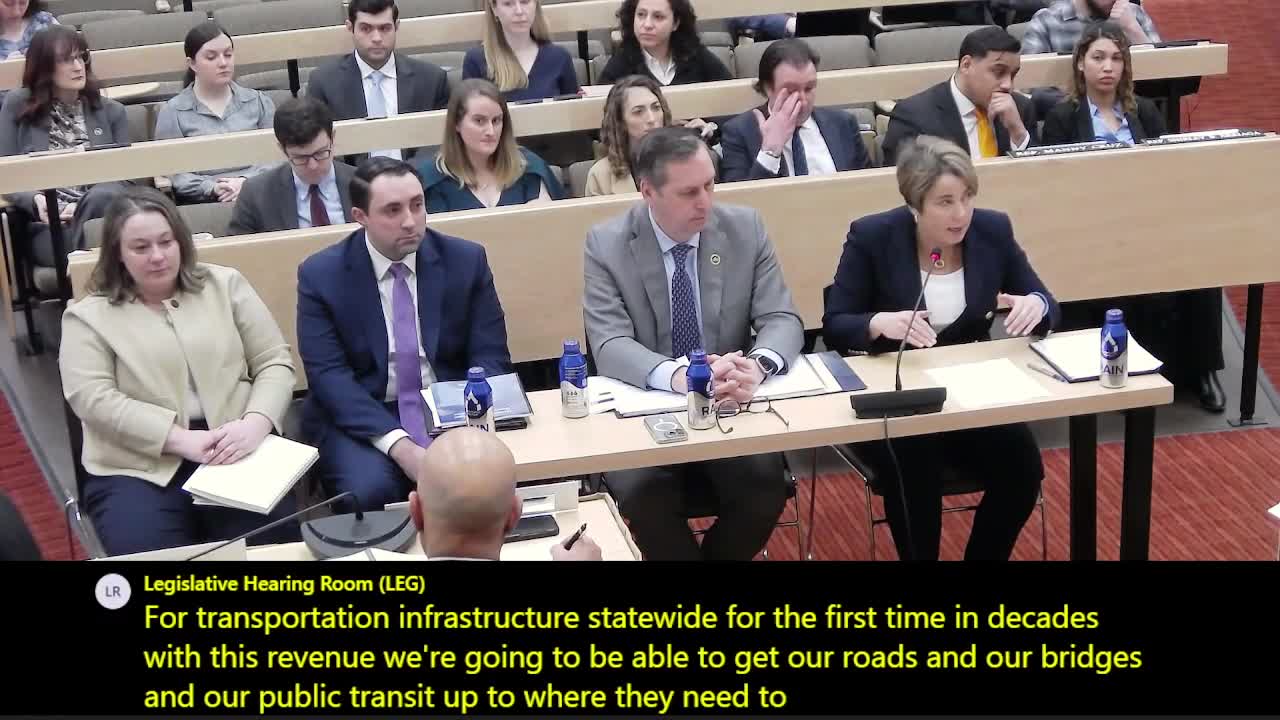
The governor opened the hearing by framing the budget as fiscally prudent and focused on lowering the cost of living and upgrading infrastructure. “We propose using a portion of the fair share revenue to leverage capital, to access more capital like any good business will try to do,” Healey said, saying the approach would support “more than $8,000,000,000 over the next 10 years for transportation infrastructure statewide” and “$2,500,000,000 in our 29 public higher ed institutions.”
Budget director Matt Gorkowitz (appearing with the governor) told the committee the administration filed House 1 with a $59.6 billion bottom line plus $1.95 billion in fair-share surtax spending. He said the plan includes both a FY 2025 supplemental to spend excess surtax and an FY 2026 proposal that dedicates surtax dollars to the Commonwealth Transportation Fund and to higher-education borrowing.
Under the transportation plan Gorkowitz described, $765 million of FY 2025 surtax would flow into the Commonwealth Transportation Fund (CTF), unlocking nearly $5 billion of additional resources over 10 years; the administration’s broader 10‑year transportation strategy totals roughly $8 billion. On higher education, Gorkowitz said the proposal dedicates $125 million of surtax in FY 2026 to support an estimated $2.5 billion in new borrowing for campus infrastructure and pairs that with authorizing language in a companion bond bill (the BRIGHT Act).
Administration officials said the surtax strategy is intended to be multi‑year and to grow the state’s borrowing capacity while limiting operating growth. Gorkowitz said House 1 relies on a mix of ongoing revenue, some one‑time funds and surtax proceeds but “does not raise any new broad based taxes.” He added the fiscal 2026 consensus revenue forecast assumes 2.2% growth not including surtax receipts.
Why it matters: the approach turns a recurring, but volatile, surtax stream into longer-term capital commitments by using surtax receipts to support debt service and thereby multiply the available capital. Supporters argue it allows multibillion-dollar, transformational projects now while capping near-term operating growth; critics warn of building recurring debt supported by a revenue source that has shown volatility in prior years.
What happened next: lawmakers on the committee pressed administration officials about the sustainability and annualization of surtax funding, how much of the surtax should be built into base budgets, and how the administration is layering supplemental and FY 2026 allocations. The administration said it expects roughly $2.4–$2.5 billion of surtax collections in a typical year and that the FY 2026 plan moves toward more annualized uses while preserving a surtax-dedicated rainy day cushion.
Looking ahead: Committee members and the administration agreed the surtax proposals, the companion bond bill, and the supplemental will be topics for follow‑up hearings across the FY 2026 process. The administration repeatedly emphasized willingness to collaborate with the legislature on the design and on the limits placed around annualization and caps.