DBPR secretary outlines regulatory reforms; panelists urge streamlining of local permitting and more flexible inspection options
Loading...
Summary
DBPR Secretary Melanie Griffin told the IPA subcommittee that reforms and efficiency efforts reduced licensing processing times and produced cost savings, and a multi‑trade panel urged the Legislature to streamline local permitting, modernize inspections and expand training pathways to address workforce and fraud issues.
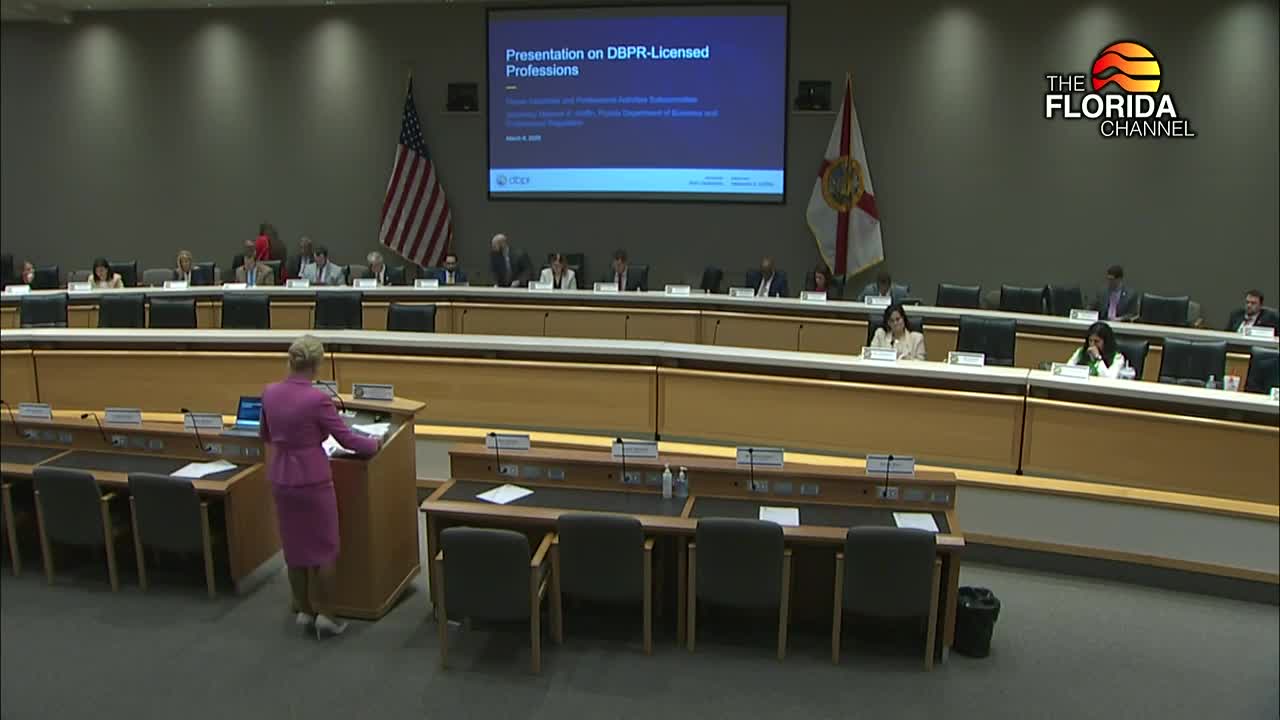
The Department of Business and Professional Regulation’s secretary, Melanie Griffin, briefed the IPA subcommittee on DBPR programs and recent regulatory changes, then a multi‑industry panel urged further deregulation and administrative reforms — particularly at the local permitting and inspection level.
Secretary Griffin described DBPR’s role and scale: the department oversees hundreds of professional license categories and nearly a million licensees across diverse fields. She said DBPR favors education and voluntary compliance when responding to complaints and highlighted enforcement metrics: in the most recent fiscal year the department completed more than 24,000 inspections of barber, cosmetology and veterinary locations and handled more than 24,000 complaints across professions. Enforcement actions last fiscal year included about 1,140 cease-and-desist notices for unlicensed activity, 731 citations, and roughly 3,800 final orders.
Griffin reviewed reforms pursued under previous legislation (HB 1193, the Occupational Freedom and Opportunity Act) and department initiatives to speed licensing and reduce fees. She noted application processing improvements across multiple divisions and cited fee waivers and “fee holidays” as examples of cost reductions the department has recently implemented.
Following the presentation the committee heard from a panel of business and trade representatives including landscape architects, building inspectors, pool contractors, roofing and electrical contractors, general contractors, restaurant and hotel representatives, and auctioneers. Common themes in panel testimony were:
- Local permitting and inspection burdens: Several panelists said local permitting processes and additional municipal requirements — not state licensure — are the greatest impediment to getting projects built and businesses operating. “It’s gotten so bad” that private-provider inspection proposals have been undermined in practice, one builder said, citing delays, waiver requirements and local follow-up inspections that slow projects.
- Workforce shortages and licensing complexity: Witnesses described acute shortages of tradespeople, rising insurance costs for new contractors, and difficulties recruiting building officials. Panelists urged more options to expand pathways into licensed trades, including internships and tiered licensing that allow firms to start with limited scopes and grow.
- Inspection modernization: Several panelists urged wider use of technology (photographs, geo-tagged videos, virtual inspections) to reduce the need for in-person inspections for non-structural work and to reduce scheduling delays that burden homeowners and contractors.
- Scope and reciprocity concerns: Roofing and other trades said Florida’s code and local practices differ from other states; witnesses asked for careful reciprocity approaches to ensure contractors working in Florida understand the state code and local requirements. Several trade witnesses urged allowing certain limited electrical or mechanical tasks tied to a contractor’s core trade — for example, allowing mechanical contractors to replace shore‑side pool heat pumps or allowing pool contractors to handle low-voltage lighting — if consumer protection safeguards are preserved.
- Fraud and unlicensed activity: Industry witnesses and DBPR staff said fraud in certain training and licensing pathways remains a problem, and panelists and the secretary discussed background checks and fingerprinting as tools to reduce fraudulent licenses and fake schools.
Committee members asked detailed questions. Members sought data on complaint volumes by profession and on DBPR’s complaint-processing timelines (DBPR staff said investigations are generally handled within 60 days). Several members and witnesses emphasized the difference between state licensing and local ordinances and asked for better alignment to reduce duplicative permitting and fees.
The panel session closed with members thanking DBPR and the trade witnesses; no committee action was taken on the presentation itself during the hearing.