Get Full Government Meeting Transcripts, Videos, & Alerts Forever!
Get email alerts on the Interventions And Supports topic
No spam. Unsubscribe anytime.
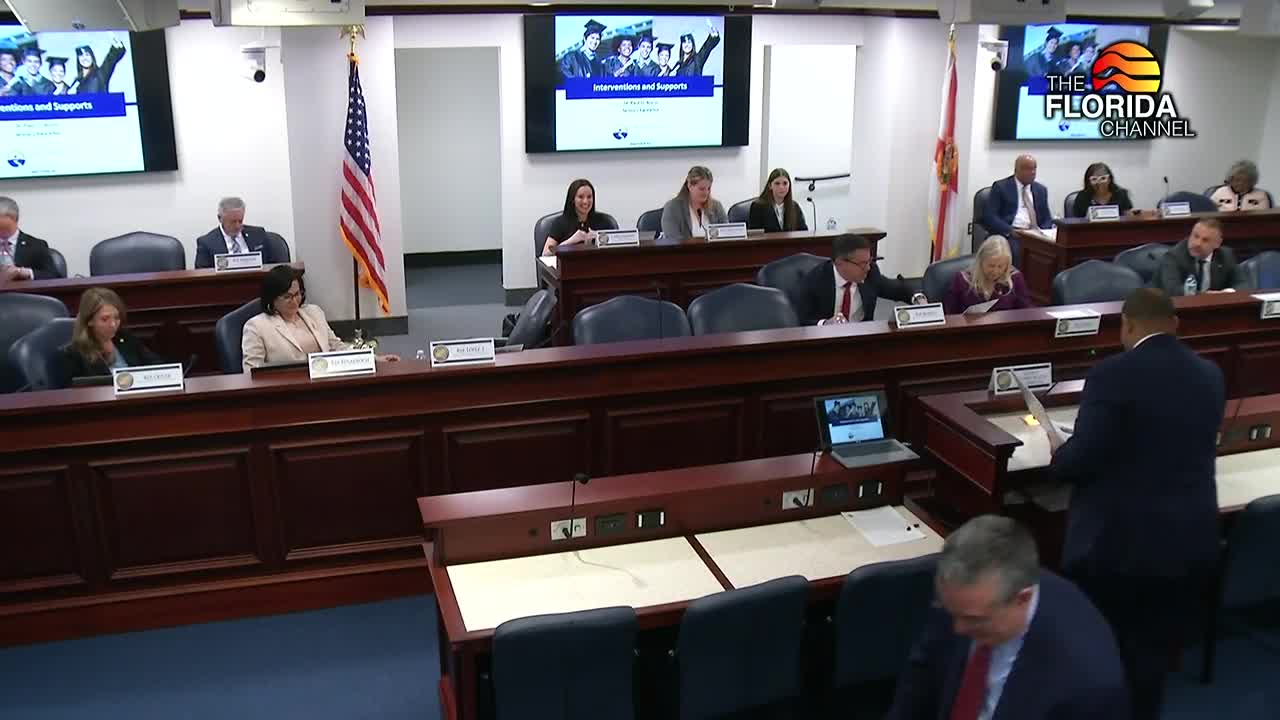
Florida education officials outline tiered interventions, parental notices and dyslexia supports
Summary
Chancellor Paul Burns and department staff described the state's tiered instruction model (Tier 1 core instruction; Tier 2 supplemental; Tier 3 intensive) and legal requirements for interventions, parental notification and individualized progress‑monitoring plans for students with substantial deficiencies in reading (K–3) and math (K–4).
Chancellor Paul Burns told the Student Academic Success Subcommittee that Florida’s approach to helping students who are not meeting grade‑level standards centers on a three‑tier model of instruction and legally required interventions and family notifications.
Burns said the state frames instruction as tiered rather than students: “we don’t tier students, we tier instruction,” he told the committee. Under the model, Tier 1 is high‑quality, on‑grade‑level core instruction for all students; Tier 2 is targeted, small‑group supplemental instruction; and Tier 3 is intensive, frequently one‑on‑one or very small‑group instruction for students with substantial gaps.
State law and State Board of Education rules require targeted action when a student is identified with a substantial deficiency. The department outlined the principal legal points:
- Reading: districts must identify and provide interventions for students in VPK through grade 3 who meet the rule’s criteria for a substantial deficiency (the department cited percentile cutoffs in the rule and said kindergarten through grade 3 identification varies by grade and administration window). Schools must notify parents, provide an individualized progress‑monitoring plan within 45 days of FAST results, and send monthly written progress updates. Tier 3 reading instruction must be delivered by staff with a reading endorsement, certification, or an approved micro‑credential.
- Mathematics: students in VPK through grade 4 identified with a substantial deficiency or characteristics of dyscalculia must receive systematic, explicit math interventions in addition to Tier 1 instruction. Parents must be notified in writing, receive descriptions of services and planned interventions, and be given monthly written progress updates.
Burns and his team emphasized that districts use multiple data sources — not a single test score — when placing students into tiers and when deciding whether to continue or end interventions. He said the individualized progress‑monitoring plan must list the student‑specific deficiency, goals and benchmarks, the evidence‑based instruction to be used (grounded in the science of reading for literacy plans), strategies and home resources, and expected duration. He told members the plan must be developed within 45 days after FAST results are available.
The department also flagged supports for students with characteristics of dyslexia or dyscalculia. Schools must offer screening and, where appropriate, individualized plans; those students may also be served through an IEP when applicable. Burns said the department offers professional learning, regional literacy directors and a summer literacy institute to help districts implement interventions and to coach school leaders.
Why it matters: the tiered framework and statutory parental‑notification rules determine which students receive extra instruction and how districts must document and communicate progress. Committee members asked for district‑level counts and samples of plans and the department agreed to provide follow‑up materials.
Ending: Burns said the department is developing a mathematics resource portal and additional home‑based materials for parents; the portal was expected to go live by the end of summer 2025.