Get Full Government Meeting Transcripts, Videos, & Alerts Forever!
Get email alerts on the K12 Assessments topic
No spam. Unsubscribe anytime.
Florida reports gains under new progress-monitoring assessment system, but national NAEP results prompt questions
Summary
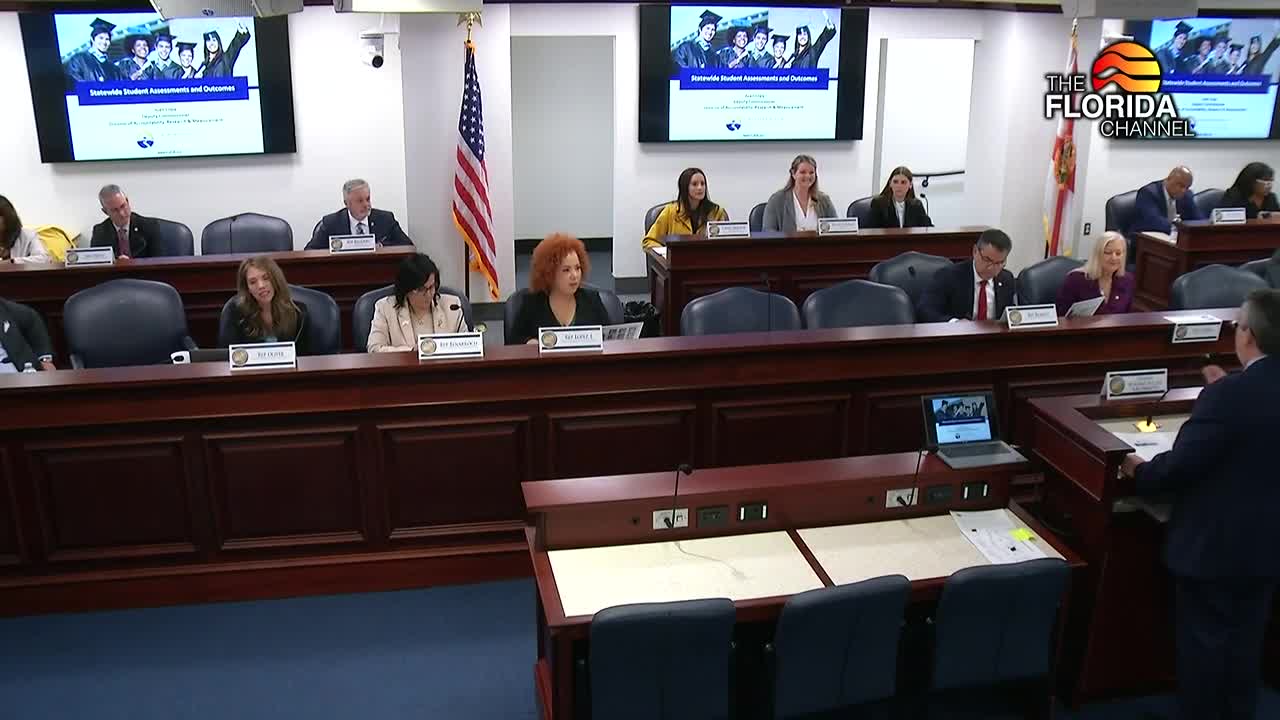
Deputy Commissioner Juan Copa told the Student Academic Success Subcommittee on May 20 that Florida’s new progress‑monitoring assessment system — known as FAST — produced measurable gains in statewide student performance and provides immediate, in‑year data for teachers, parents and students.
Deputy Commissioner Juan Copa told the Student Academic Success Subcommittee on May 20 that Florida’s new progress‑monitoring assessment system — known as FAST — produced measurable gains in statewide student performance and provides immediate, in‑year data for teachers, parents and students.
Copa said the system, adopted after Senate Bill 1048 (2022), assesses students at three checkpoints (beginning, middle and end of year) and returns scores quickly. “Gone are the days of waiting 6 weeks to 2 months for results to come in,” Copa said, noting teachers now receive baseline, midyear and end‑of‑year information they can use to guide instruction.
The department reported substantial year‑over‑year increases in 2023–24. Copa told the committee that English language arts improved by about 20 percentage points during a school year in the most recent administration — from roughly 33 percent at the beginning of the year to 53 percent at the end — and mathematics rose from about 14 percent to 56 percent in the same period. Year‑to‑year end‑of‑year comparisons showed smaller increases (Copa cited a 4 percentage‑point end‑of‑year increase in ELA and roughly a 3 percentage‑point increase in math comparing 2022–23 to 2023–24).
Copa described other changes tied to the progress‑monitoring system: statewide end‑of‑course (EOC) assessments were redesigned for immediate scoring in 2023–24 so high schools no longer needed to wait weeks for EOC results to finalize grades, and progress monitoring was added for VPK and grades K–2 to provide a common early‑grade metric across the state. He said VPK readiness at the end of the program was roughly 70 percent this year (up from 69 percent in the baseline year), and cautioned that comparisons with kindergarten readiness measures can differ because the populations are not identical (some VPK participants attend private kindergarten and some public‑school kindergarten students never attended VPK).
Committee members pressed the department about how the FAST results relate to the National Assessment of Educational Progress (NAEP). Copa and members noted that Florida ranked near the bottom in grade‑8 NAEP reading and math in the latest NAEP release, but Copa cautioned against treating NAEP and FAST as directly comparable: NAEP samples do not include private‑school students (federal law does not require private‑school participation), is administered in January–March and is not aligned to individual states’ content standards. He said NAEP is useful for national comparisons but that FAST is designed to measure Florida standards and to produce actionable information during the school year.
Committee members asked operational questions about the FAST platform. Copa said the department competitively procured the current vendor, Cambium Assessment Incorporated (CAI), and that the state owns test items developed for the system. He did not provide a contract dollar amount during the hearing and told members the department would follow up with procurement and cost details upon request.
Where to find results: Copa pointed committee members to the department’s public portal, knowyourschoolsfl.org, for state, district and school‑level data and said more advanced downloads and reports are available to districts and researchers.
Why it matters: FAST changes the timing and frequency of statewide assessments and the immediacy of results. That has implications for how teachers plan instruction, for parent reporting and for policy discussions about interpreting state versus national measures.
What the hearing did not decide: The committee did not take votes or adopt policy in the session; members requested follow‑up information on vendor costs, counts of students identified with substantial deficiencies and disaggregated subgroup data.
Ending note: Department officials said FAST is still early in its statewide rollout (this was the second full year of administration) and that the department will provide additional data and procurement details to the subcommittee on request.